
Biotin and rice water show up together in haircare conversations constantly-and I get why. In the salon, I’ve seen plenty of people fall in love with the way their hair feels after the right “strength + softness” routine: smoother lengths, fewer tangles, better shine, and that satisfying feeling that the ends aren’t fighting you anymore.
But here’s what rarely gets said out loud: the best results don’t come from the buzzwords. They come from the chemistry of how a conditioner is built-how it deposits onto hair, how it manages pH, and how well it reduces friction (which is a bigger source of damage than most people realize).
Think of this topic as a balance between two forces: signal and slip. Signal is what makes hair feel reinforced. Slip is what makes hair feel easy-detangled, smooth, and less prone to snapping. If your conditioner leans too far in one direction, you can end up with hair that feels either coated and limp or “strong” but weirdly rough.
Why this combo is popular (and why it’s so hit-or-miss)
The promise behind biotin + rice water is simple: stronger hair, healthier scalp, and better growth. The reality is more nuanced. A lot of what people describe as “growth” is often length retention-meaning you’re losing less hair to breakage, so your hair finally has a chance to look fuller and longer over time.
NOT SURE WHICH PRODUCT IS RIGHT FOR YOU?
TAKE THE QUIZTakes 30 seconds · 134,000+ customers matched
When someone tells me a conditioner made their hair feel thicker, it’s usually one (or more) of these things happening:
- Less breakage because the hair is better lubricated and detangles with less force
- Better shine because the cuticle surface is smoother and reflects more light
- A light “film” effect from proteins and conditioners that temporarily plump the strand’s feel
- Improved manageability so there’s less aggressive brushing (and fewer snapped ends)
Rice water in conditioner isn’t “just rice water”-it’s a delivery system
Most people imagine rice water as a DIY rinse. But in a conditioner, the important question isn’t simply “Is rice water in here?” It’s how it’s prepared, how concentrated it is, and what else is in the formula to help it perform consistently.
In modern haircare, rice-related benefits tend to come from a few functional groups:
- Hydrolyzed rice protein (helps hair feel smoother and more resilient by forming a lightweight film)
- Fermentation byproducts like inositol (vitamin B8) and panthenol (vitamin B5), which are often used to support softness and flexibility
- pH control, which influences whether the cuticle lies flatter or stays rough and swollen
One detail I appreciate about Viori’s approach is that they don’t push an extreme, high-concentration rice-water strategy. They’ve shared that very high concentrations of rice water can disrupt hair and scalp pH if used too often, so they use a lower concentration of fermented Longsheng rice water in a pH-balanced formula designed to be used regularly if you want.
The under-discussed science: how conditioner actually “sticks” to hair
This is where most internet articles stop short. Hair-especially hair that’s color-treated, heat-styled, or simply weathered on the ends-tends to carry a negative charge. A well-built conditioner uses positively charged conditioning agents to bind where hair needs it most.
Why does that matter for rice-protein benefits? Because proteins and “strength” ingredients aren’t always great at attaching evenly on their own. They need the right conditioning backbone so you don’t rinse everything down the drain in 20 seconds.
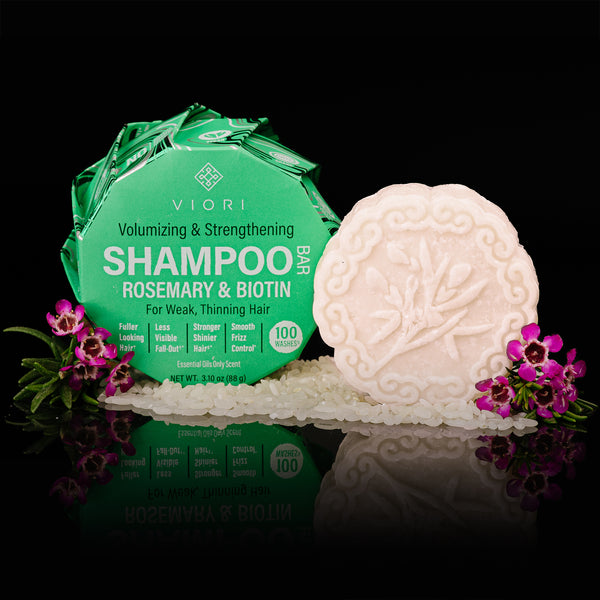
Viori’s conditioner bars use Behentrimonium Methosulfate (BTMS), a common and respected conditioning ingredient in professional formulation. Despite the name, it isn’t a harsh cleansing sulfate like the ones people worry about in shampoos. In a conditioner, BTMS is there for performance: slip, softness, and easier detangling without relying on silicone.
So what about biotin?
Let’s keep this grounded. In a rinse-off conditioner, biotin is unlikely to be the main driver of hair growth. Hair growth is largely influenced by what’s happening inside the follicle, along with health and genetics.
That said, biotin often gets credit for what’s really a “feel and physics” improvement. When your hair breaks less, tangles less, and behaves better, it’s easy to interpret that as new growth-even when what you’re actually seeing is better retention and a smoother fiber surface.
Protein sensitivity is real (and rice protein can be the reason)
If you’ve ever used a “strengthening” conditioner and ended up with hair that felt crunchy, stiff, or oddly dry, you’re not imagining it. Protein and film-formers can be amazing-or too much-depending on your hair’s porosity.
A quick porosity check you can do at home
Viori suggests a simple test: take a clean strand and place it in a glass of water. Use this as a general guide:
- If it floats, you likely have low porosity hair
- If it stays in the middle, you’re likely medium porosity
- If it sinks, you likely have high porosity hair
Low porosity hair often gets buildup more easily and may feel stiff if you overdo protein. High porosity hair often loves the extra support-but still needs plenty of conditioning slip so it doesn’t feel rough.
pH: the quiet hero behind shine, smoothness, and color longevity
Hair performs best when products stay in an appropriate pH range. Viori notes that hair products should generally fall between 3.5 and 6.5, and that very alkaline products can dry out hair over time.
From a practical standpoint, pH matters because it influences the cuticle. When the cuticle lies flatter, hair tends to look shinier, feel smoother, and tangle less. When it stays rough, you’ll notice more frizz and more snagging-especially at the ends.
A conditioner bar detail most people overlook: friction during application
This is one of the biggest “small changes” I see people miss with conditioner bars. If you rub a bar directly onto your hair, you can create too much friction and uneven application-meaning some spots get overloaded while others get almost nothing.
Viori specifically recommends a technique that’s especially smart for color-treated hair: build product in your hands and apply with your hands, rather than rubbing the bar directly on your head. It’s gentler, more even, and often gives a noticeably better finish.
WHAT CUSTOMERS ARE SAYING
Real reviews for Rosemary Biotin Shampoo Bar – Thinning Hair | VIORI
Choosing the right Viori bar: match your scalp first, then your ends
When clients ask me what to choose, I start with scalp behavior, not just hair texture. Viori’s general guidance is:
- Citrus Yao: often recommended for normal to oily scalps (it contains citric acid, which can help break down oil)
- Terrace Garden: typically a great option for normal to dry scalps and hair that wants more moisture
- Hidden Waterfall: a versatile choice that many people enjoy across hair types
- Native Essence: unscented and often the gentlest option for sensitive scalps or fragrance sensitivity
You can also mix your approach-cleanse the scalp based on oiliness and condition the ends based on dryness. That “split routine” is one of the easiest ways to get soft hair without sacrificing volume.
How to tell if your conditioner is working (or if you need to adjust)
If you want a clean, practical checkpoint, give a routine a few washes and watch for these signs.
Signs you’re on the right track
- Wet hair detangles more easily with less pulling
- You see less snapping during brushing or styling
- Ends feel smoother after air-drying
- Shine improves without greasy roots
Signs you may be overdoing it (especially with protein/film)
- Hair feels dry but coated
- Ends feel stiff or straw-like
- Tangles increase even though you’re conditioning
- Hair looks dull or loses bounce
If that’s you, the fix is usually simple: use less, keep conditioner off the roots, focus on mid-lengths to ends, and consider alternating with a more purely moisturizing routine.
The takeaway
Biotin + rice water conditioners can be excellent-but they work best when the formula is doing the heavy lifting: pH balance, smart deposition, the right protein level, and real friction control. That’s why a thoughtfully built system like Viori’s-using fermented Longsheng rice water alongside supportive ingredients such as hydrolyzed rice protein, vitamin B8, and vitamin B5, within a well-structured conditioner base-tends to give more consistent, hair-friendly results.
If you want, share your scalp type (oily/normal/dry), your porosity (low/medium/high), and whether your hair is color-treated or heat-styled, and I’ll help you dial in a Viori routine and application method that fits your hair exactly.


