
If you've been battling scalp eczema, you already know the frustration-that relentless cycle of inflammation, flaking, and discomfort that seems impossible to escape. After two decades working behind the chair with clients who struggle with this condition, I've noticed something fascinating: we might be approaching the problem from entirely the wrong angle.
The issue isn't just what you're putting on your scalp. It's what you're washing away every single day-and the cascade of disruption that follows.
Let me share some insights that rarely make it into mainstream beauty conversations but could revolutionize how you manage scalp eczema.
The Preservative Problem Nobody Talks About
Here's something that might surprise you: traditional liquid shampoos require powerful preservation systems to prevent bacterial growth in their water-rich formulations. These preservatives-compounds like methylisothiazolinone, phenoxyethanol, or parabens-don't just kill bacteria in the bottle. They create a scorched-earth scenario on your scalp's delicate microbiome with every wash.
Recent dermatological research is revealing that eczema isn't simply an "overactive immune response." It's actually a disruption of your skin's microbiome-specifically, an overgrowth of harmful bacteria like Staphylococcus aureus and a depletion of the protective bacteria that regulate your skin's barrier function.
Here's the paradox: we use antimicrobial-laden shampoos to "clean" eczema-prone scalps, but we're actually feeding the inflammatory cycle by decimating the beneficial bacteria our skin needs to heal.
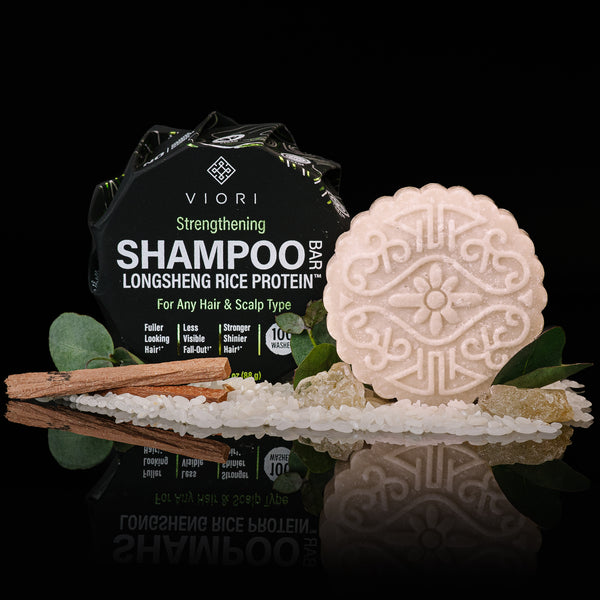
This is where shampoo bars offer a genuine advantage. Because they're formulated with low water activity, quality shampoo bars require minimal to no synthetic preservatives. Viori's bars, for example, are self-preserving and can be stored for 3-5 years without the chemical arsenal required by liquid formulas. They use sodium lactate as a natural preservative, allowing them to sidestep the microbiome destruction entirely.
Why Half a pH Point Could Change Everything
Most articles barely mention pH, but here's the truth: the pH of your shampoo doesn't just affect your hair-it fundamentally alters the activation state of enzymes in your skin.
NOT SURE WHICH PRODUCT IS RIGHT FOR YOU?
TAKE THE QUIZTakes 30 seconds · 134,000+ customers matched
Your healthy scalp maintains a pH of approximately 4.5-5.5, creating what dermatologists call the "acid mantle." In eczema-prone individuals, this pH tends to drift alkaline (toward 6.0-7.0), triggering a cascade of problems:
- Enzyme activation: At alkaline pH, certain enzymes become hyperactive, breaking down the intercellular "glue" that holds your skin cells together
- Ceramide depletion: Alkaline conditions accelerate the breakdown of ceramides-the lipid molecules that create your skin's waterproof barrier
- Moisture loss: As the barrier weakens, water escapes exponentially faster, creating that characteristic dry, cracked eczema presentation
Many commercial shampoos-even ones marketed as "gentle"-have pH levels between 6.0-8.0 to boost foaming and cleansing power. Viori's bars maintain a pH between 3.5-6.5, the ideal range for hair products. For eczema sufferers, this isn't just a cosmetic detail-maintaining that acidic pH during cleansing might be the difference between controlled symptoms and a flare-up.
The Friction Factor: Understanding the Double-Edged Sword
Here's where I'll offer a perspective you won't find in most "best shampoo for eczema" articles, and it requires nuance.
Bar shampoos require friction-you're applying a solid directly to your scalp rather than distributing a pre-dissolved liquid. For eczema sufferers, this physical mechanism creates both a risk and an opportunity.
The Risk: During active flare-ups with broken, inflamed skin, friction can absolutely worsen inflammation through mechanical irritation. This is real, and it matters.
The Opportunity: In healing or maintenance phases, controlled friction provides gentle mechanical exfoliation that liquid shampoos simply cannot deliver. Here's why this matters: eczema causes abnormal skin cell production-your cells divide rapidly but don't shed properly, creating those characteristic thick, scaly patches. Gentle physical exfoliation helps normalize this shedding cycle without the chemical exfoliants (like salicylic acid) that often sting compromised skin.
My professional recommendation: During active flare-ups, lather the bar in your palms first, then apply the foam to your scalp with your fingertips. During maintenance periods, direct scalp application using gentle circular motions can actually support barrier normalization.
Fermented Rice Water: Beyond the Beautiful Story
Let's move past the romantic marketing narrative and examine what's actually happening biochemically with fermented rice water, a signature ingredient in Viori's formulations.
The fermentation process creates several compounds with documented effects on barrier-compromised skin:
Inositol (Vitamin B8): This fermentation byproduct functions as an osmolyte-it helps cells maintain proper hydration under stress conditions. For eczema-prone scalps with impaired water retention, this is significant.
Panthenol (Vitamin B5): Another fermentation product that converts to pantothenic acid in your skin, where it plays a critical role in lipid synthesis-literally helping rebuild the barrier that eczema has compromised.
Hydrolyzed Rice Protein: When properly processed, rice protein can penetrate the skin's outer layer and provide amino acids for barrier repair. It also creates a breathable film that reduces water loss without creating the occlusive heaviness that eczema-prone skin often can't tolerate.
Here's the clinical detail that matters: rice protein is uniquely hypoallergenic compared to other protein sources. Wheat protein contains gluten components that can trigger contact dermatitis in susceptible individuals. Soy protein contains known allergens. Rice protein has the cleanest immunological profile of common botanical proteins-a genuine advantage for reactive skin.
Beyond "Sulfate-Free": What Actually Matters
Every natural shampoo brand proudly proclaims "sulfate-free!" but the conversation around eczema-prone scalps requires more sophistication.
Yes, sodium lauryl sulfate (SLS) and sodium laureth sulfate (SLES) are harsh surfactants that strip lipids aggressively-problematic for compromised barriers. But here's what matters just as much: the replacement surfactant system.
Viori uses Sodium Cocoyl Isethionate (SCI) as their primary cleanser. Let me break down why this particular choice benefits eczema-prone scalps:
- SCI is exceptionally mild: It has a larger molecular structure than SLS, making it less penetrating and less disruptive to your skin's lipid layers
- More efficient cleansing: It requires less surfactant to create effective cleaning action, allowing for gentler overall formulations
- Protein-friendly: Unlike SLS which can literally denature skin proteins, SCI's cleaning mechanism is gentler on the structural proteins that eczema-prone skin struggles to maintain
SCI is often called "baby foam" in the industry because it's gentle enough for infant skin-there's actual clinical rationale behind this designation.
Understanding Behentrimonium Methosulfate: Chemistry Matters
Here's where even well-meaning natural beauty advocates get confused, and it creates unnecessary anxiety for eczema sufferers.
When people see "Behentrimonium Methosulfate" (BTMS) in ingredient lists, they often assume it's a harsh sulfate like SLS. This is a case where chemistry literacy really matters.
The technical reality: BTMS is a quaternary ammonium compound, not a sulfate surfactant. The "methosulfate" refers to a neutralization salt, not the functional cleansing component. Functionally, BTMS is:
- Positively charged, which means it's attracted to the negatively charged hair shaft and damaged skin sites
- A conditioning agent, not a cleanser-it deposits beneficial fatty alcohols
- Substantive, meaning it forms a protective layer that persists through rinsing, providing ongoing barrier support
For eczema-prone scalps, BTMS's positive charge is actually advantageous: damaged skin has increased negative charge due to compromised cells, and BTMS-type conditioners selectively bind to these vulnerable zones, targeting exactly where you need the most support.
The Scent Selection Strategy: A Critical Clinical Decision
This is one area where I need to give you unvarnished professional advice: fragrance-whether natural or synthetic-is the most common cosmetic contact allergen.
Viori offers several scented options and one fragrance-free choice called Native Essence. For anyone managing scalp eczema, Native Essence should be your default choice. Here's why:
- Fragrance allergens are cumulative: You might not react initially, but sensitization can develop with repeated exposure
- Compromised barriers increase risk: Fragrance molecules penetrate more deeply through damaged skin, increasing sensitization potential
- Cross-reactivity is common: If you develop an allergy to one fragrance component, you may subsequently react to structurally similar molecules in other products
I know the scented options are appealing-they smell beautiful. But for eczema-prone skin, the fragrance-free route dramatically reduces your risk of making things worse.
Clinical recommendation: Use Native Essence exclusively during flare-ups and healing periods. If you want to incorporate scented varieties during maintenance phases, choose options with the gentlest fragrance profiles and monitor your scalp's response carefully.
Rethinking the Conditioner: A Counterintuitive Approach
Conventional hair care wisdom says: shampoo the scalp, condition the ends. For eczema-prone scalps, I'm going to suggest something different.
Quality conditioner bars contain ingredients that function as barrier support treatments:
- Cocoa butter and shea butter (emollients and protective agents)
- Rice bran oil (rich in anti-inflammatory compounds)
- Aloe vera (components that support barrier repair)
- Bamboo extract (silica and antioxidants)
This is essentially a leave-on treatment formulated as a rinse-out conditioner.
Here's my protocol for eczema-prone scalps:
- Cleanse with shampoo bar using the palm-lather method during flares, direct gentle application during maintenance
- Apply conditioner bar liberally to your scalp itself (not just hair ends)-this goes against convention but the formula supports it
- Leave on for 5-10 minutes for deep conditioning benefits
- Rinse with cool water (not hot-heat increases moisture loss)
- Optional: Apply a small amount of conditioner to problem scalp areas and leave in without rinsing
The conditioner's beneficial ingredients will preferentially bind to the most damaged scalp areas, creating a protective, moisture-retaining layer exactly where you need it most.
The Water Temperature Variable: The Most Overlooked Intervention
This isn't specific to any particular product, but it's so critical for eczema management that I must address it: the water temperature during your shampoo routine may matter more than the shampoo itself.
Hot water (above 100°F/38°C):
WHAT CUSTOMERS ARE SAYING
Real reviews for Rice Water Shampoo Bar – All Hair Types | VIORI
- Strips lipids more aggressively than any surfactant
- Increases skin blood flow, triggering histamine release and itching
- Elevates skin pH temporarily
- Dramatically increases moisture loss for hours after washing
Technical protocol:
- Initial rinse: Warm water (comfortable, not hot) to open cuticles slightly
- Shampoo application and working: Lukewarm to cool
- Shampoo rinse: Cool water
- Conditioner application: Cool water dampening
- Final conditioner rinse: Cold water (as cold as tolerable)
The cold final rinse serves multiple functions: seals the cuticle (reducing frizz), constricts blood vessels (reducing inflammation), and minimizes pH disruption.
I know cold water isn't pleasant. But if you're serious about managing scalp eczema, this single change could deliver more improvement than switching products.
The Frequency Paradox: Why "Wash Less" Isn't Always Right
Conventional eczema advice often says: wash less frequently to avoid stripping the scalp. But this oversimplifies a complex situation.
For seborrheic dermatitis (a specific type of scalp eczema driven by yeast), infrequent washing can actually worsen the condition because the yeast feeds on scalp oils. The buildup between washes creates the perfect environment for overgrowth.
My recommendations are more specific:
Atopic dermatitis (dry eczema): Wash 2-3 times weekly maximum, with conditioner-only "washes" (no shampoo) on intervening days.
Seborrheic dermatitis (oily, flaky eczema): Wash 4-5 times weekly, potentially daily during flares, but using a very gentle technique.
The low-intervention nature of quality shampoo bars-no harsh preservatives, pH-balanced, gentle surfactant systems-makes more frequent washing less damaging than it would be with many conventional liquid shampoos.
The Hard Water Factor: An Invisible Saboteur
Here's a variable that almost never appears in eczema discussions: your water chemistry might be undermining any product you use.
Hard water (high in calcium and magnesium) creates several problems:
- Forms residue with surfactants, leaving irritating deposits on your scalp
- Requires more product for adequate cleansing
- Elevates skin pH
- Interferes with conditioning ingredient deposition
Bar shampoos are particularly affected by hard water because they rely on direct contact and lathering. If you live in a hard water area (check your municipal water report), consider:
- Installing a shower filter that removes chlorine and reduces mineral content
- Doing a final rinse with filtered water stored in a pitcher
- Using an acidic rinse after conditioning (diluted apple cider vinegar or citric acid solution)-this removes mineral deposits and restores pH
In my professional experience, clients who report "the shampoo stopped working" or "it leaves residue" almost always have hard


