
Humidity has a special talent: it can turn a great hair day into a frizz halo before you’ve even finished your coffee. If you’ve ever stepped outside with smooth strands and come back looking like your hair “changed its mind,” you’re not imagining it. Hair is naturally hygroscopic, which means it absorbs and releases water from the air.
So can you truly “humidity-proof” hair? Not in the literal, airtight sense. But you can make your hair dramatically more stable in humid conditions by controlling how quickly it takes on moisture, how the cuticle behaves, and how well your conditioning “film” holds up throughout the day.
Here’s the angle most people miss: humidity control isn’t just about adding oils or piling on product. It’s about pH, surface charge, porosity, and friction-the behind-the-scenes mechanics that decide whether your style stays sleek or expands on contact.
What Humidity Actually Does to Your Hair
Hair has layers, and humidity interacts with each one differently. The outside layer (the cuticle) is like shingles on a roof. When those shingles lie flat, hair reflects light better, tangles less, and resists moisture swings more effectively. When they lift, hair gets rougher and moisture moves in faster.
NOT SURE WHICH PRODUCT IS RIGHT FOR YOU?
TAKE THE QUIZTakes 30 seconds · 134,000+ customers matched
Inside the strand sits the cortex, the part responsible for strength, elasticity, and shape. When humidity rises, water vapor can work its way in, disrupting temporary bonds and causing the strand to swell. That swelling isn’t always even-especially if your hair is porous-so you get the visual chaos we call frizz.
One detail that matters long-term: repeated “wet-to-dry” and “dry-to-wet” cycles create mechanical stress on the cuticle. Over time, that wear-and-tear can raise porosity, making the hair even more reactive to humidity. In other words, frizz can become a self-reinforcing pattern if your routine doesn’t protect the cuticle.
“Humidity-Proof” Isn’t One Problem-It’s Three
Frizz is the symptom. The cause usually falls into one (or more) categories, and each category needs a different strategy.
- Cuticle lift and surface roughness: flyaways, tangling, dullness, a rough feel.
- Internal swelling and shape change: curls expand, waves lose definition, straight hair bends and flips.
- Barrier breakdown: hair starts smooth, then turns puffy or fuzzy as the day goes on.
If your routine only targets one of these (like adding moisture) but ignores the others (like friction or pH), humidity will still win-just more slowly.
The Quiet Power Move: pH and Surface Charge
This is where routines either get smart or get stubborn. The hair and scalp tend to perform best in a mildly acidic range. When products skew too alkaline, the cuticle can lift more easily. And lifted cuticle means more pathways for water vapor to enter, more roughness, and more tangling (which leads to more damage).
Viori bars are pH balanced, which is a big deal for humidity control even if it doesn’t sound glamorous. A cuticle that stays calmer and flatter is simply less reactive when the air gets damp.
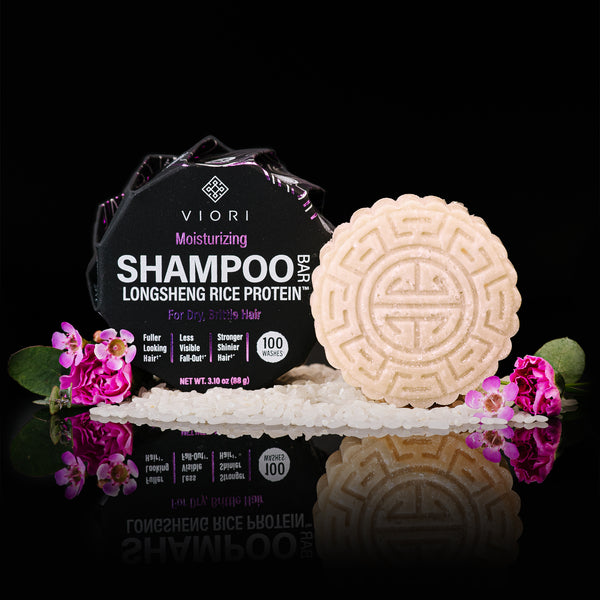
Conditioner chemistry matters, too. Conditioner is typically positively charged, and hair-especially damaged hair-often carries more negative charge in rough areas. That opposite-charge attraction helps conditioner “cling” where you need it most, smoothing the surface, improving slip, and reducing static.
Porosity: Your Hair’s Humidity Sensitivity Dial
If I had to pick one factor that predicts how hair behaves in humidity, it would be porosity-your hair’s ability to absorb and hold moisture. Higher porosity usually means hair drinks in humidity quickly and swells fast. Lower porosity resists moisture at first, but can become unpredictable if product buildup starts to sit on the surface.
Viori shares a simple at-home porosity check: place a clean strand of hair in a glass of water. If it floats, it’s likely low porosity; if it hangs in the middle, medium; if it sinks, higher porosity. It’s not a lab test, but it’s often accurate enough to guide a routine.
High Porosity Hair (Frizz Fast, Dries Fast)
High porosity hair usually needs a routine that supports the cuticle and improves the strand’s feel and resilience over time. Viori notes its bars use a low concentration of rice protein and include fermented Longsheng rice water components associated with hair-supporting nutrients such as vitamin B5 (panthenol) and vitamin B8 (inositol), designed to be gentle enough for frequent use.
Low Porosity Hair (Buildup-Prone, Easily “Coated”)
Low porosity hair often does better with lighter cleansing and very strategic conditioning placement. If you tend to get oily quickly or feel coated, Viori commonly recommends Citrus Yao as the option best suited for normal-to-oily scalps, in part because it contains citric acid which helps break down oil effectively.
“Sealing” Can Backfire: Why Soft Hair Isn’t Always Stable Hair
A lot of frizz advice stops at “add oil and seal it.” Sometimes that works. Sometimes it makes humidity frizz worse. Here’s why: in high humidity, overly heavy layers can turn tacky, increasing friction between strands. Increased friction encourages tangling and separation, which can read as frizz and puffiness.
Humidity-proofing is usually about building a barrier that’s flexible and lightweight, not heavy and sticky. Viori bars are silicone-free, and the approach leans on conditioning performance, pH balance, and overall hair health-rather than relying on a thick coating to force smoothness.
The Most Overlooked Trigger: Friction
Even the best products can’t outwork rough handling. Humidity makes hair slightly more “grabby.” If you add aggressive towel drying, harsh detangling, or constant touching, you’re basically multiplying the frizz response.
If you want your style to hold in humidity, think like a stylist: set the hair once, then disturb it as little as possible.
A Humidity‑Proof Routine with Viori (By Hair and Scalp Type)
You don’t need a complicated routine-you need the right match for your scalp and your ends. These are the most common “real life” combinations I see behind the chair.
WHAT CUSTOMERS ARE SAYING
Real reviews for Moisturizing Rice Water Shampoo Bar – Dry Scalp | VIORI
Oily Scalp + Frizzy Ends
This one is incredibly common and often misunderstood. Your scalp needs effective cleansing, while your lengths need conditioning and stability.
- Cleanse the scalp with Viori Citrus Yao Shampoo Bar.
- Condition mid-lengths to ends with a more moisturizing option like Terrace Garden, Hidden Waterfall, or Native Essence conditioner.
- Be gentle with friction: lather in your hands and apply with your palms rather than rubbing the bar directly on your hair (a technique Viori recommends, especially helpful for color-treated hair and for reducing mechanical stress).
Dry or High‑Porosity Hair (The “Puffs Instantly” Type)
- Choose a more moisturizing pairing such as Terrace Garden, Hidden Waterfall, or Native Essence.
- Don’t skip conditioner. Conditioning improves slip and helps the hair behave more predictably in damp air.
- For extra smoothing, let conditioner sit for at least 5 minutes before rinsing (Viori suggests this as a deep-conditioning method).
- Finish with cooler water if you can tolerate it-many people notice less frizz when the cuticle is encouraged to lie flatter.
Sensitive Scalp or Fragrance Sensitivity
If humidity makes your scalp feel reactive (itchy, tight, or easily irritated), simplifying is often the smartest move. Viori recommends Native Essence as its unscented, gentlest option for sensitive scalps.
What “Humidity‑Proof” Should Look Like in Real Life
Humidity-proof hair isn’t about looking airbrushed. It’s about predictability. A successful routine usually means:
- Frizz takes hours to show up instead of minutes
- The frizz halo is smaller and softer
- Curls and waves hold their shape longer
- Hair looks shinier because the cuticle sits smoother
And give your routine time to prove itself. Viori recommends using products consistently for 2-3 months before giving up, which aligns with what I see professionally: long-term humidity control improves as the cuticle is treated more gently and porosity patterns become less extreme.
Bottom Line: Humidity Control Starts in the Shower
If you only take one thing from this, make it this: the strongest humidity defense is built during cleansing and conditioning, not just with last-minute styling. The winning formula is simple and science-based.
- pH-balanced cleansing to keep the cuticle calmer
- Consistent conditioning for slip, smoothing, and charge-based adhesion
- Porosity-aware choices so you don’t overload or under-support your hair
- Low-friction handling to prevent future damage
- Flexible, lightweight barrier building for stability in damp air
If you want to personalize this, note three things: your texture (straight/wavy/curly/coily), your porosity (low/medium/high), and your scalp type (oily/normal/dry). Those details tell me almost everything I need to tailor a humidity-proof game plan with Viori.


