
If you’ve ever felt like your hair “grows” but never gets longer, or that your ponytail seems to get skinnier no matter what you try, you’re not imagining it. In the salon, I see this all the time-and the fix usually isn’t a trendy trick. It’s a systems problem.
Here’s the most helpful reframe I’ve learned in 20 years of doing hair: getting longer hair and getting thicker hair are connected goals, but they’re not the same challenge. Length is often lost to breakage. Thickness is often lost to shedding, inflammation, or scalp imbalance. When you treat both at the root (literally), progress becomes a lot more predictable.
The approach that rarely gets discussed online is what I call “hair habitat + length retention.” You build a healthier environment for the follicle to produce strong hair, and you protect the hair fiber you already have so it survives long enough to show the length and fullness you’re working for.
Length vs. thickness: what’s really holding you back?
Most generic advice lumps everything under “hair growth,” but in practice there are two separate bottlenecks.
NOT SURE WHICH PRODUCT IS RIGHT FOR YOU?
TAKE THE QUIZTakes 30 seconds · 134,000+ customers matched
What controls how long your hair gets
Length is mainly limited by two factors: how long hairs stay in the growth phase (anagen) and how much hair you lose to breakage while you wait. A lot of people have completely normal growth at the scalp, but their ends are quietly snapping off at nearly the same rate.
What controls how thick your hair looks and feels
Thickness is usually a combination of density (how many hairs are actively growing), strand diameter (your individual fiber thickness), and how your hair behaves (shine, frizz, clumping, and volume). For many people, “thicker hair” happens when they reduce shedding triggers and stop breaking so much hair that the overall mass never has a chance to build.
The overlooked key: your scalp is a living “hair factory”
A hair follicle isn’t just a hole-it's a tiny, active organ embedded in scalp tissue. That tissue has to stay stable and supported. When it’s irritated, the body shifts energy toward defense and repair, and that can show up as shedding, slower progress, or hair that comes in weaker.
What makes this tricky is that scalp issues don’t always look dramatic. Low-grade irritation can be subtle but persistent, and it’s one of the biggest “silent” reasons people struggle with thickness over time.
- Itchiness that comes and goes
- Flaking that isn’t consistent (and isn’t always true dandruff)
- Tightness after washing
- Oil rebound (getting greasy again very quickly)
- More shedding during washing or brushing
pH: not a buzzword-an engineering lever
One of the most underappreciated variables in haircare is pH. Hair and scalp tend to function best in a mildly acidic range. When products are too alkaline, the cuticle can lift, tangles increase, friction increases, and breakage becomes more likely-especially through the mid-lengths and ends.
This is one reason I pay attention to products that are intentionally pH balanced. Viori specifically emphasizes pH balance in its bars, which matters because the goal isn’t just clean hair-it’s clean hair that stays smooth, resilient, and less prone to damage over time.
Why hair “won’t grow past a certain point”: the length-retention problem
When someone tells me their hair won’t grow past their shoulders (or collarbone, or bra strap), I immediately think about length retention. Your ends are older than your roots, which means they’ve survived hundreds of wash days, brushing sessions, and friction events. Eventually, if the cuticle gets worn down, the cortex underneath starts to fray-and that’s where breakage lives.
The three breakage patterns I see most
- Wet stretching damage: hair is weakest when saturated, so aggressive brushing or tight twisting when wet can cause micro-tears.
- Cuticle abrasion: daily friction from detangling, sleeping, collars, and repeated styling slowly chips away at the cuticle.
- Protein/moisture imbalance: hair that’s too rigid can snap; hair that’s too soft can stretch and split. The goal is elasticity and strength together.
Fermented rice water: what it can do (and what it can’t)
Fermented rice water gets hyped like it’s magic. It isn’t. But in a well-formulated, consistent routine, it can be a meaningful support for hair quality-especially when the scalp is kept comfortable and the fiber is protected from friction.
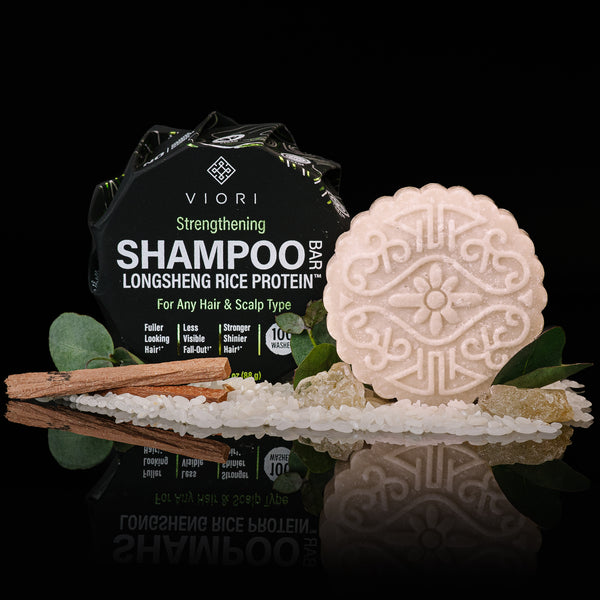
Viori uses fermented Longsheng Rice Water™ and highlights that fermentation increases vitamin B8 (inositol) and vitamin B5 (panthenol). In real-world hair terms, that tends to translate to better manageability, smoother feel, and less breakage-because hair that tangles less and combs more easily is hair that stays on your head.
Another detail I appreciate from a technical standpoint: Viori notes it uses a lower concentration of rice water because very high concentrations can disrupt hair and scalp pH if used too often. That’s the kind of nuance that matters when you’re trying to build results without triggering dryness, irritation, or a rough cuticle over time.
The bar-specific detail most people miss: friction
Shampoo bars can be fantastic, but the technique matters. When you rub any cleanser directly on the hair, you increase mechanical friction. Friction lifts the cuticle, which increases tangling, which increases breakage. It’s a domino effect.
If your hair is long, curly/coily, fine, high-porosity, or color-treated, this step alone can make a noticeable difference:
- Build lather in your hands first
- Cleanse your scalp with fingertips
- Let the suds rinse through the lengths instead of scrubbing the ends
Viori also recommends working the lather through the hair with your hands rather than rubbing the bar directly on your head, which is smart for preserving color and minimizing unnecessary cuticle disruption.
If you want length, conditioner isn’t optional
Conditioner isn’t just about softness. It’s about friction control. When hair is freshly cleansed, it has less of its natural protective coating. Conditioners are formulated to cling to the hair and help replace that slip temporarily so your strands can move past each other instead of snagging and snapping.
Viori explains this simply and accurately: conditioner has a positive charge and helps it adhere to hair, helping protect strands until natural sebum returns. In practice, this is how you get better detangling, less frizz, fewer split ends, and more length retained month after month.
Choose your routine by scalp type (not just by hair goals)
One of the biggest mistakes I see is choosing products based only on how the ends look, while ignoring what the scalp is actually doing. Your scalp type sets the rules.
- Oily scalp: Viori commonly recommends Citrus Yao, and it’s also a frequent pick for oily scalp flaking because citrus helps break down oil effectively.
- Dry scalp or dry scalp flakes: Viori commonly recommends Terrace Garden, Hidden Waterfall, or Native Essence depending on your comfort and sensitivity.
- Sensitive scalp or fragrance sensitivity: Native Essence is Viori’s unscented option and typically the gentlest place to start.
Matching to scalp type matters because the wrong direction (too stripping on dry scalps, too heavy on oily scalps) can trigger irritation-and irritation is one of the most common reasons thickness goals stall.
WHAT CUSTOMERS ARE SAYING
Real reviews for Rice Water Shampoo Bar – All Hair Types | VIORI
Porosity: why “thickening” can backfire
Hair porosity is your hair’s ability to absorb and retain moisture. It impacts whether your hair gets weighed down (and looks flatter) or stays too rough (and breaks).
Viori shares a simple porosity test (a clean strand in water: float = low, middle = medium, sink = high). It’s not perfect science, but it’s a helpful starting point for many people.
- Low porosity: often needs lighter application and careful rinse habits to avoid buildup that can make hair look limp.
- High porosity: often needs more support and gentler handling because it absorbs quickly but loses moisture quickly.
What to expect: timelines that won’t make you quit too early
Some improvements can happen quickly-shine, softness, easier detangling, better scalp comfort. But longer and thicker hair is a consistency game. Viori notes that some people see what they want after one wash, while others need 2-3 months. That range is realistic, especially if your main issue is breakage, scalp irritation, or an inconsistent routine.
If I had to give one professional guideline, it would be this: commit to a steady routine for 8-12 weeks before you judge whether your hair is truly responding.
A practical routine for longer, thicker hair using Viori
If you want a clear plan that supports both scalp health and length retention, use this framework.
-
Pick your bars based on scalp type.
- Oily/greasy scalp: Viori Citrus Yao
- Normal to dry scalp: Viori Terrace Garden or Viori Hidden Waterfall
- Sensitive scalp or fragrance concerns: Viori Native Essence
-
Cleanse with low-friction technique.
- Lather in hands
- Massage scalp with fingertips
- Let rinse water carry suds through the ends
-
Condition consistently (especially mid-lengths to ends).
- Apply thoroughly
- Let it sit a few minutes if frizz/breakage is an issue
- Detangle gently from ends upward
-
Protect the hair between washes.
- Handle wet hair gently
- Avoid rough towel rubbing
- Use a wide-tooth comb when needed
- Limit repeated tight styles that stress the same spots
-
Store bars so they dry fully between uses.
- Keep them out of direct water contact
- Allow airflow so they don’t soften and dissolve quickly
The takeaway: build the habitat, then keep the length
If you want longer and thicker hair, the goal isn’t to chase a miracle. It’s to run a smart system: keep the scalp calm, reduce friction, and protect the cuticle so the hair you’re growing actually stays with you. When those pieces are in place, your hair doesn’t just “grow”-it accumulates.
If you want to personalize this, start with two details: how fast your scalp gets oily after washing and whether your ends feel dry or fragile. From there, it’s much easier to choose the right Viori direction and adjust technique so you’re building length and fullness on purpose.


