
If you’ve ever picked up a “natural organic shampoo” and thought, “Great-this should be better for my hair,” you’re not alone. But in the salon, I’ve seen the full range of outcomes: some people get softer, shinier hair almost immediately, and others end up with a waxy feel, frizz, or an itchy scalp and swear off “natural” forever.
Here’s the part most articles skip: the results usually have less to do with the word organic and more to do with three quiet, technical factors-pH, the cleanser system, and what actually deposits onto the hair during washing and conditioning. When those are done well, hair behaves. When they aren’t, even the prettiest ingredient list can fall flat.
Why “Organic Shampoo” Isn’t a Simple Category
When people say “organic,” they can mean a few different things. And those meanings don’t always translate neatly to a rinse-off product like shampoo.
- Agricultural organic: how a plant ingredient was grown and processed.
- Naturally derived: ingredients that start in nature but are refined for safety, stability, or performance.
- Certification-based organic: rules that vary depending on region and certifying standards.
Shampoo isn’t just “ingredients in a bottle.” It’s a designed cleansing system. Some of the most important pieces that make shampoo work-cleansers, conditioning agents, pH balancing, and binding agents-often aren’t farm-grown ingredients. They’re functional materials chosen to behave predictably on hair and scalp.
NOT SURE WHICH PRODUCT IS RIGHT FOR YOU?
TAKE THE QUIZTakes 30 seconds · 134,000+ customers matched
The Under-Discussed Dealbreaker: pH
If there’s one technical detail I wish every shopper understood, it’s this: pH influences how your cuticle behaves. Hair tends to perform best when products sit in a mildly acidic range (commonly discussed as roughly 3.5-6.5).
When a shampoo runs too alkaline, the cuticle can lift more than it should, and that can show up as:
- Frizz that seems to appear out of nowhere
- Tangles and higher breakage from increased friction
- Dullness because light doesn’t reflect cleanly off the strand
- Faster color fading, especially if your color isn’t fully permanent
Viori specifically formulates its bars to be pH balanced, which is a big deal for long-term cuticle smoothness and overall scalp comfort.
The nuance most people miss: pH changes what “sticks” to your hair
Hair isn’t just a fiber-it’s a charged surface. Many conditioning ingredients are positively charged (cationic), while hair (especially damaged hair) tends to carry more negative charge. In a well-balanced formula, conditioning agents deposit more evenly, which helps with slip, softness, and control. When that balance is off, you get that frustrating split experience: roots that feel coated, ends that still feel thirsty, or hair that feels squeaky in the shower and puffy as it dries.
“Sulfate-Free” Isn’t the Whole Story
People often shop by what a shampoo doesn’t contain, but performance comes down to what it does-and how it does it. The goal is controlled oil removal, not aggressive stripping.
Viori’s shampoo bars use Sodium Cocoyl Isethionate (SCI) as a cleanser. In formulation circles, SCI has a reputation for being a milder, effective cleansing agent that can create a satisfying lather without relying on the harsher cleansing approach many people are trying to avoid.
In practical terms, shampoos typically fail in one of two ways:
- Too weak: buildup, flat roots, itchy scalp, dullness
- Too strong: squeaky feel, frizz, irritation, or a scalp that overcompensates with more oil
A balanced cleanser system matters more than buzzwords-especially if you’re washing frequently.
Conditioner Isn’t Optional for Most Hair (Here’s Why)
After shampoo lifts away some of the protective oils on the hair, strands are more vulnerable to friction from brushing, heat, sun, and everyday wear. Conditioner helps by providing slip, reducing static, and improving the way the cuticle lies down.
Viori’s conditioner bars use Behentrimonium Methosulfate (BTMS), a conditioning ingredient valued in haircare because it’s cationic and binds well to hair, helping with:
- Detangling and comb-through
- Smoothness and reduced friction
- Static control
- Improved manageability
Despite the name, BTMS is not used like the harsh cleansing sulfates people worry about; it functions as a conditioning agent in hair formulas.
Rice Water, Protein, and the Fine Line Between Strong and Stiff
Rice water has a long history in hair rituals, but the internet often treats it like “the more, the better.” Hair doesn’t always agree. Too much protein can leave certain hair types feeling rigid or brittle, especially if your hair is already low-porosity or protein-sensitive.
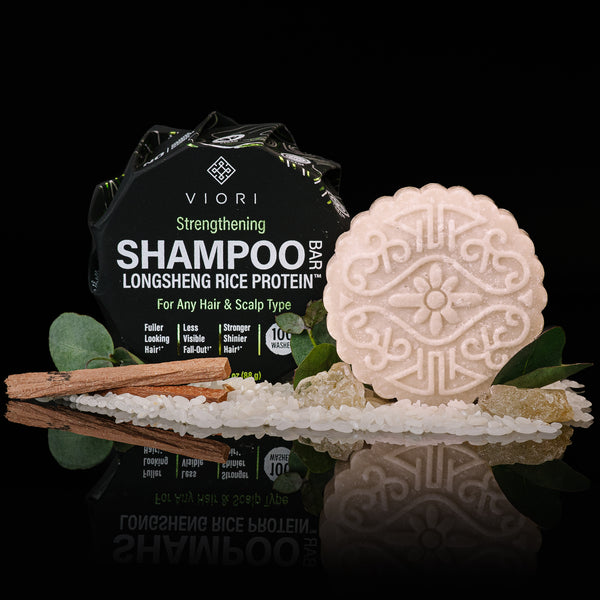
Viori uses fermented Longsheng rice water along with hydrolyzed rice protein and keeps the overall system pH balanced. The combination is designed to support strength and shine without pushing hair into that crunchy, over-proteined feel.
Fermentation is also meaningful because it can increase compounds like inositol (Vitamin B8) and panthenol (Vitamin B5), which are often associated with improved cosmetic feel, elasticity, and softness.
Fragrance: “Natural” Doesn’t Automatically Mean Gentle
One reason people seek natural or organic shampoo is scalp sensitivity. And this is where I’m very direct with clients: natural scents can still be irritating for some people.
If your scalp is reactive-prone to itch, bumps, dryness, or flare-ups-your simplest path is usually to reduce variables. Viori offers Native Essence, an unscented option with no added fragrance, which can be a smart starting point for sensitive scalps.
Bar Shampoo: The Real Advantage (and the Common Mistake)
Bars have a practical technical benefit: they contain very little free water, which can make them naturally more stable over time when stored correctly. But bars also introduce one of the biggest sources of hair damage that nobody talks about: friction.
If you rub a shampoo bar directly down the lengths like you’re scrubbing laundry, you can rough up the cuticle-especially on color-treated hair, high-porosity hair, curls, coils, or extensions.
WHAT CUSTOMERS ARE SAYING
Real reviews for Rice Water Shampoo Bar – All Hair Types | VIORI
The best technique (and Viori recommends this for color preservation) is simple:
- Create lather in your hands.
- Apply to the scalp with your fingertips and palms.
- Let the suds cleanse the lengths as you rinse, instead of aggressively scrubbing them.
If Your Hair Feels “Waxy,” Don’t Blame the Shampoo First
When someone tells me a natural shampoo made their hair feel coated, my first question is about hard water. Minerals in hard water can interfere with cleansing and rinsing, leaving behind a film that feels like residue.
If that’s you, you may need a routine adjustment-better saturation, more thorough rinsing, and being careful not to apply conditioner too close to the scalp. The goal is a clean scalp and conditioned ends, not a heavy layer everywhere.
How to Choose the Right Viori Bar for Your Hair
A quick, practical way to identify your scalp type is to notice how quickly oil returns after washing:
- Oily scalp: feels oily again in 1-2 days
- Normal scalp: feels oily again around day 3
- Dry scalp: can go 4+ days without feeling oily
From there, Viori’s recommendations are straightforward:
- Citrus Yao: best suited for normal-to-oily scalps (its scent system includes citric acid, which helps break down oil)
- Terrace Garden: a go-to for normal-to-dry scalps and moisture support
- Hidden Waterfall: a versatile option that works well for many hair types
- Native Essence: unscented and especially helpful for sensitive scalps; great for normal-to-dry needs
The Bottom Line: “Natural Organic Shampoo” Should Be Judged Like a System
If you want great hair, focus less on the romance of the label and more on the architecture of the formula and how you use it. The best outcomes usually come from products that prioritize:
- pH balance for cuticle health and color support
- effective, gentle cleansing that doesn’t strip the scalp barrier
- smart conditioning deposition (slip without heaviness)
- fragrance options that respect sensitive users, including unscented
- low-friction technique, especially with bar formats
When those pieces line up, “natural” stops being a gamble and starts being what it should be: clean, comfortable, shiny hair that’s easier to manage-and a scalp that stays calm between washes.


