
Rice powder has become one of those buzzy, back-to-basics hair hacks that pops up everywhere-mixed into masks, dusted on roots like a dry shampoo, or scrubbed into the scalp as a “detox.” And yes, it can make hair look shinier and feel fuller. But after two decades behind the chair, I’ll tell you what doesn’t get talked about enough: rice powder isn’t just an ingredient. It’s a mechanical experience your hair and scalp have to survive.
In other words, whether rice powder helps or hurts often comes down to particle size, friction, residue, and rinsing-more than it does to the idea of “rice nutrients.” If you’ve ever loved the results the first few times and then suddenly started feeling dryness, tangles, or itch, this is usually why.
What rice powder actually is (and why it behaves the way it does)
Most rice powders are mostly starch-specifically amylose and amylopectin-plus varying amounts of trace proteins, lipids, minerals, and sometimes a bit of bran (depending on how refined the powder is). That mix matters because starch doesn’t behave like an oil or a butter. It behaves like a film former.
NOT SURE WHICH PRODUCT IS RIGHT FOR YOU?
TAKE THE QUIZTakes 30 seconds · 134,000+ customers matched
When starch meets water, it swells and can dry down into a soft coating. That coating can create the “wow” effect people describe: smoother feel, more shine, and a little extra body. The catch is that if the film doesn’t rinse away cleanly, it can start acting like buildup-especially at the roots.
The detail most people miss: particle size and cuticle friction
This is the part that rarely makes it into viral tutorials. Rice powder can be finely milled and silky… or it can be coarse and irregular. And even when it’s labeled “natural,” coarse particles can still create abrasion.
Your hair cuticle is layered like shingles. Repeated rubbing with gritty particles can lift those layers over time, which shows up as:
- more frizz and puffiness
- less shine
- more tangling (especially at the nape and crown)
- ends that feel dry no matter how much conditioner you use
On the scalp, aggressive scrubbing can also backfire. That “super clean” feeling some people love can be a sign you’ve gone a little too far-irritating the scalp barrier and setting yourself up for rebound oiliness or sensitivity.
Rice powder vs. rice water: same family, totally different results
Online, rice powder and rice water often get treated like they’re interchangeable. They’re not. Rice powder is mostly about physics-how it sits on hair, how it grabs oil, and how well it rinses. Rice water (especially fermented) is more about chemistry, including how it plays with pH and how fermentation changes what’s available to the hair.
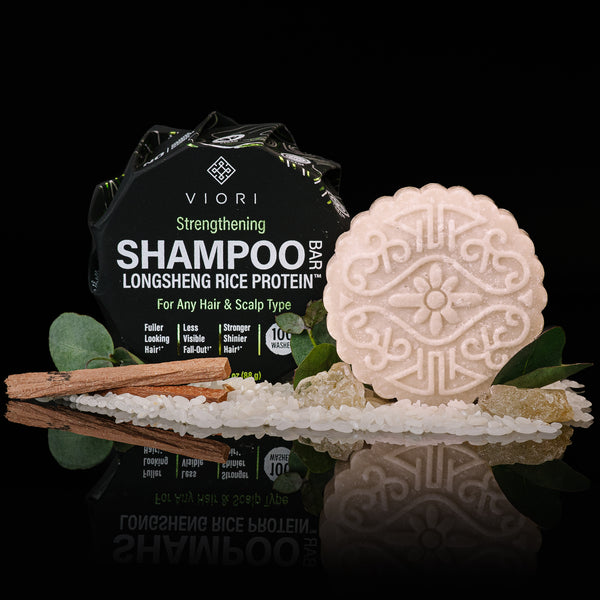
This is one reason I’m such a fan of a formulated, pH-conscious approach when people want the “rice hair” benefits. Viori uses Longsheng rice water in a lower, pH-balanced concentration, because using rice water too strong or too often can disrupt scalp and hair pH. Hair generally behaves best in a mildly acidic range-cuticles lie flatter, friction drops, and shine improves.
The “dry shampoo” effect: oil adsorption isn’t oil removal
Rice powder can make roots look less greasy because starch can adsorb oil-basically, oil clings to the powder and looks less shiny. That can be genuinely helpful in a pinch. But it’s not the same thing as removing oil from the scalp.
If you keep layering powder without doing a thorough cleanse, you can create a starch-and-sebum paste near the scalp. Over time, that can:
- trap sweat and debris around the follicle opening
- make itching more likely
- make flakes look worse (because shedding gets caught in the film)
- leave hair feeling “coated” at the roots
This is why powders often feel amazing… until one day your scalp suddenly feels off and your hair stops responding the way it used to.
Is rice powder a protein treatment? Not reliably
Rice gets associated with strengthening, so people assume rice powder equals protein care. The problem is consistency. Many rice powders are mostly starch, and whatever protein is present may not be in a form that deposits predictably on hair. That’s very different from hydrolyzed rice protein, which is processed specifically to behave more consistently in haircare.
So yes, rice powder can make hair feel thicker-but that doesn’t automatically mean it’s repairing the hair fiber the way a true, balanced strengthening routine would.
The common mistake: the pH + friction trap
Here’s the pattern I see most often: someone makes a rice paste, scrubs it in, rinses quickly, skips conditioner (or doesn’t use enough), and then wonders why their hair feels great at first but progressively rougher over a few weeks. In almost every case, it’s the combo of friction + residue-and sometimes pH habits like very hot water, rough towel drying, or inconsistent conditioning.
If you’re using any routine that increases friction (powders, scrubs, heavy massage), conditioning becomes non-negotiable. Conditioner helps reduce static, improve slip, and protect the cuticle while your natural oils redistribute. That’s also why Viori strongly recommends following shampoo with a conditioner bar-because washing removes some natural sebum, and conditioner helps temporarily replace that protective feel and reduce damage from daily life (water, heat, sun, brushing).
Who rice powder tends to work for (and who should be cautious)
Rice powder is usually at its best as a texture tool, not a daily treatment. In my experience, it tends to be most satisfying for people who want quick oil control or more styling grip.
WHAT CUSTOMERS ARE SAYING
Real reviews for Rice Water Shampoo Bar – All Hair Types | VIORI
It may feel great for:
- very oily scalps needing a short-term refresh
- hair that needs more grip for updos or styling
- denser hair that can tolerate a bit of texture
Use extra caution if you have:
- fine hair (buildup shows up fast and can feel heavy)
- low-porosity hair (product tends to sit on the surface)
- dry, damaged, or high-porosity hair (already friction-sensitive)
- a sensitive or easily irritated scalp
If you’re fragrance-sensitive or your scalp is reactive, an unscented, gentle routine is often the smarter move. Viori’s Native Essence bars are a solid option for sensitive scalps because they’re unscented and designed to be pH balanced.
How to use rice powder the “pro” way (so you get the benefit without the fallout)
If you want to experiment with rice powder, I recommend using it strategically and keeping the goal simple: oil control and styling texture. Here’s the approach that tends to cause the fewest problems long-term.
- Keep it mostly at the roots. Avoid dragging it through your lengths if your ends are dry, color-treated, or frizz-prone.
- Minimize friction. Think press-and-lift, not a hard scrub.
- Use it as a pre-wash step. Let it do its job, then wash it out-don’t make it a leave-on habit.
- Cleanse thoroughly afterward. You want the scalp clean, not coated.
- Condition every time. Restoring slip is key to keeping the cuticle calm and the hair smooth.
The bottom line
Rice powder can be useful-especially when you treat it like what it really is: a fast cosmetic tool for texture, grip, and oil control. But it’s not automatically a deep repair step, and it can cause dryness or irritation when friction and residue start stacking up.
If your goal is that classic “rice hair” look-softness, shine, strength, and scalp comfort-you’ll usually get more consistent results from a pH-balanced, formulated rice-water approach. Viori’s use of fermented Longsheng rice water in a safe concentration is designed to capture those traditional benefits without the common DIY pitfalls of harsh pH swings and stubborn buildup.
If you tell me your scalp type (oily/normal/dry), your porosity (low/medium/high), and what you want most (less oil, less frizz, more volume, scalp comfort, growth support), I can help you decide whether rice powder is worth using at all-and if it is, how to use it without sacrificing your cuticle health.


