
After twenty years behind the chair, I've seen countless hair care trends come and go. But every so often, I encounter something that fundamentally changes how I think about hair health-and rice starch as a dry shampoo ingredient is one of those game-changers.
Here's what surprises most people: we're not discovering something new. We're finally catching up to what the Red Yao women of China have known for nearly 2,000 years. And when you understand the science behind why rice starch works so exceptionally well, you'll never look at dry shampoo the same way again.
Why Most Dry Shampoo Articles Miss the Point
Walk into any beauty store and you'll find dozens of dry shampoos. Search online and you'll find hundreds of articles about application techniques and product reviews. But here's what almost nobody talks about: the molecular architecture that makes certain ingredients genuinely superior to others.
Most commercial dry shampoos use talc, cornstarch, or arrowroot powder. They work-sort of. They absorb some oil, give you a few extra hours, and help you stretch a blowout. But they're addressing a symptom, not working with your scalp's natural biology.
Rice starch is different. Profoundly different. And understanding why requires us to zoom in-way in-to the microscopic level.
The Geometry of Oil Absorption (This Is Where It Gets Fascinating)
Picture this: under a microscope, rice starch granules look like tiny, multi-faceted gems-angular and polygonal with multiple contact points. Cornstarch granules? They're round and smooth, like miniature pearls.
This geometric difference isn't just aesthetically interesting-it's functionally critical.
Those angular surfaces on rice starch granules create significantly more surface area for oil absorption compared to rounded granules. It's the difference between trying to soak up a spill with crumpled paper towels versus smooth, flat ones. The crumpled texture gives you more absorption in the same amount of space.
But there's another advantage: size matters.
Rice starch granules measure just 3-8 micrometers-notably smaller than cornstarch (15 micrometers) or tapioca starch (5-35 micrometers). This means rice starch can penetrate closer to your scalp surface and interact with oil right at the follicular level, rather than just sitting on top of your hair shaft like a powdery hat.
NOT SURE WHICH PRODUCT IS RIGHT FOR YOU?
TAKE THE QUIZTakes 30 seconds · 134,000+ customers matched
The Fermentation Factor: Where Ancient Wisdom Meets Modern Chemistry
Here's where the Red Yao tradition reveals something Western hair care is only beginning to understand.
Traditional rice water preparations involve fermentation-and this isn't just about following ancient rituals. During fermentation, rice starches undergo enzymatic breakdown that creates what chemists call resistant starch and produces inositol (Vitamin B8) plus other B-complex vitamins.
When fermented rice starch touches your scalp, three remarkable things happen:
1. pH Balancing for a Healthier Scalp
Fermented rice contains lactic acid and acetic acid, which help maintain your scalp's optimal pH range of 4.5-5.5. Most conventional dry shampoos are pH-neutral at best, completely missing this opportunity.
Why does this matter? Your scalp's acid mantle-that slightly acidic protective barrier-is your first defense against irritation, bacterial overgrowth, and excessive oil production. Maintaining it isn't just nice-to-have; it's fundamental to scalp health.
2. Feeding Your Scalp Microbiome
This is cutting-edge territory: the resistant starches and oligosaccharides produced during fermentation act as prebiotics for your scalp microbiome.
Emerging research suggests that scalp microbiome health directly influences sebum production regulation. In other words, a rice-starch based approach could theoretically train your scalp to produce less oil over time, not just mask the problem temporarily.
I've observed this pattern with clients who switch to rice-based hair care: after 6-8 weeks, they can often stretch the time between washes even further than when they started. That's not just better absorption-that's your scalp recalibrating.
3. Protein Deposition for Damaged Hair
Rice starch contains residual proteins (approximately 0.5-1% by weight) that can temporarily fill gaps in damaged hair cuticles. This is why clients with chemically-treated or heat-damaged hair consistently tell me their hair feels "fuller" when using rice-based products-it's not just the volumizing effect of powder application.
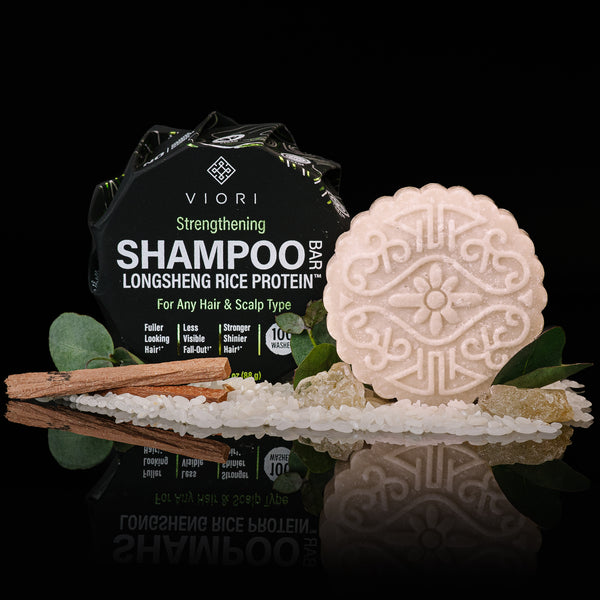
Viori's shampoo and conditioner bars harness this exact principle with fermented Longsheng rice water, combining the benefits of both starch and protein for comprehensive hair strengthening.
The Absorption Paradox Nobody Explains
Here's a technical question that stumped me early in my research: Rice starch is hydrophilic (water-loving), yet we're using it to absorb lipophilic (oil-loving) sebum. How does that even work?
The answer lies in rice starch's amylopectin content.
Rice starch contains approximately 70-80% amylopectin (versus 20-30% amylose). Amylopectin's branched molecular structure creates microscopic pockets that trap oil molecules through physical entanglement rather than chemical attraction.
Think of it like a molecular cage rather than a molecular magnet. The oil gets physically trapped in the branched structure-it doesn't need to be chemically attracted to it.
But here's the detail that separates traditional wisdom from random experimentation: waxy versus non-waxy rice varieties produce dramatically different starches.
Waxy rice (like glutinous rice used in some Asian beauty traditions) contains nearly 100% amylopectin, creating almost sponge-like absorption. Non-waxy rice with higher amylose content creates a smoother, more evenly-distributing powder that may absorb less total oil but feels more refined in texture.
The Longsheng rice cultivated by the Red Yao for nearly 1,000 years is a high-starch, short-grain variety. While the exact ratio isn't publicly documented, the centuries of selection specifically for hair care purposes suggests an optimal balance for scalp oil management.
Why Rice Starch Doesn't Create That Dreaded "Buildup"
One of the most common complaints I hear about conventional dry shampoos: buildup that makes hair feel coated, heavy, or unpleasantly crunchy after a few applications.
Rice starch addresses this problem through a simple but elegant property: it rinses away more easily than other starches.
The smaller granule size and lower protein content compared to alternatives like oat starch mean that rice starch doesn't create the same tenacious bond with your hair cuticle. Add in rice starch's minimal fiber content and very low lipid content (approximately 0.5% fat), and there's simply less "sticky" material to anchor it to your hair.
When you eventually shampoo, rice starch releases cleanly instead of requiring aggressive scrubbing or clarifying treatments.
The Scalp Inflammation Connection (This Changed My Client Recommendations)
This is where my professional observations align with emerging research in ways that deserve serious attention.
Over the years, I noticed a pattern: clients who used conventional aerosol dry shampoos 3-4+ times per week often developed subtle signs of scalp sensitivity-increased redness, occasional flaking, or paradoxically, increased oil production (likely a rebound effect from disrupted barrier function).
Rice starch contains gamma-oryzanol, a mixture of ferulic acid esters with documented anti-inflammatory properties. Even in small concentrations, these compounds may actually soothe irritation rather than exacerbate it.
Additionally, rice starch is naturally hypoallergenic-true allergic reactions to rice protein are extraordinarily rare compared to corn, wheat, or soy-derived ingredients.
This makes rice starch an excellent option for clients with sensitive scalps, psoriasis, eczema, or seborrheic dermatitis-conditions where I'd typically be very cautious about dry shampoo use.
The Environmental Angle That Actually Matters
"Biodegradable" has become a buzzword that gets thrown around carelessly. But the rate and completeness of biodegradation matters enormously.
In aquatic environments (where your shower water goes), rice starch breaks down through enzymatic hydrolysis by naturally occurring bacteria. Complete mineralization to CO₂ and water typically occurs within 28-60 days under aerobic conditions.
Compare this to:
- Talc: Does not biodegrade (it's a mineral)
- Synthetic polymers (often in aerosol formulations): Can persist for years
- Cornstarch: Biodegradable, but often GMO-sourced with associated agricultural concerns
The Longsheng rice terraces where Viori sources its rice represent nearly 2,000 years of sustainable agriculture. These terraces create a self-regulating ecosystem where rice cultivation actually enhances biodiversity rather than depleting it-a stark contrast to industrial farming.
When you choose rice-based hair care, you're not just making a choice for your hair-you're making a choice about what agricultural systems you want to support.
Why You Don't See More Rice Starch Dry Shampoos (The Industry Secret)
If rice starch is so superior, why isn't it in every dry shampoo on the market?
The answer reveals exactly why approaches like Viori's matter:
1. Cost: Rice starch is 2-3x more expensive than cornstarch or tapioca starch for industrial quantities.
2. Processing complexity: To maximize rice starch's benefits, you need proper fermentation and processing techniques. Simply grinding rice into powder doesn't give you the same molecular profile as properly extracted and fermented rice starch.
3. Texture engineering: Raw rice starch can feel slightly grittier than cornstarch. Achieving a silky, imperceptible texture requires particle size optimization and often blending with complementary ingredients.
4. Moisture management: Rice starch is more hygroscopic (moisture-attracting) than some alternatives, meaning it can clump in humid conditions without sophisticated packaging.
Most companies take the path of least resistance: use cheaper starches, add synthetic fragrance for differentiation, and focus marketing on convenience rather than efficacy.
But when you understand what you're missing-the pH balancing, the microbiome support, the anti-inflammatory properties, the superior absorption geometry-the cost difference becomes an investment in genuinely better results.
A Special Advantage for Gray and Aging Hair
Here's a niche application I've explored extensively with my mature clients, and it's transformed how I approach their hair care.
Gray and aging hair has fundamentally different structure-the cuticle tends to be more raised and porous, and hair shaft diameter often decreases. This creates unique challenges for dry shampoo.
Rice starch's residual protein content (including albumin and globulin proteins) creates a temporary biomimetic coating that can:
- Smooth raised cuticles
- Fill microscopic gaps
- Reflect light more uniformly, reducing the dull or yellowish cast that gray hair can develop
When clients with gray or white hair use rice-based products, I've noticed they maintain brightness longer between washing. This is likely because rice starch doesn't oxidize or yellow the way some synthetic ingredients can.
WHAT CUSTOMERS ARE SAYING
Real reviews for Rice Water Shampoo Bar – All Hair Types | VIORI
Viori's bars, with their fermented Longsheng rice water, contain hydrolyzed rice protein alongside starch-creating this synergistic effect. While not a dry shampoo per se, the principle demonstrates how rice-based formulations can address aging hair's unique needs.
Professional Application Techniques That Maximize Results
Based on two decades of experience, here's how to get the most from rice starch dry shampoo:
The "Humidity Method"
Lightly dampen your fingertips and press (don't rub) rice starch into the scalp at the roots. The slight moisture helps starch granules swell, increasing their absorption capacity by approximately 30%. Let sit for 2-3 minutes, then brush through.
This technique is especially effective for extremely oily scalps or when you need maximum oil control.
The "Strategic Sectioning Approach"
Apply rice starch only to true oil-production zones-typically the frontal hairline, part line, and crown. The back of your head rarely needs dry shampoo, and overapplication creates unnecessary buildup.
Part hair in 1-inch sections and apply directly to the scalp, not the hair shaft. This targets the oil at its source.
The "Overnight Reset"
For extremely oily scalps, apply rice starch before bed. The extended contact time (8 hours versus 5 minutes) allows for maximum oil absorption. In the morning, brush thoroughly and style as normal.
I've had clients with hyperactive sebaceous glands achieve a full extra day between washes using this technique.
The "Volumizing Base Layer"
On fine or thinning hair, apply a minimal amount of rice starch to completely dry hair at the roots before using any styling products. This creates microscopic texture that helps other products grip better, reducing the amount of potentially heavy styling products needed.
The Future: Rice Starch as a Delivery System
Here's where this gets truly innovative, and why I'm excited about where rice-based hair care is heading.
Rice starch granules can be hollowed out or chemically modified to carry active ingredients. Research in pharmaceutical delivery systems has demonstrated that rice starch microspheres can encapsulate and slowly release compounds.
Imagine a next-generation product where rice starch granules carry:
- Scalp-nourishing peptides
- Anti-DHT compounds for hair loss prevention
- Scalp microbiome modulators
- Natural antimicrobials for dandruff control
The starch absorbs excess oil while simultaneously delivering therapeutic compounds directly to the follicular environment. This transforms the concept from cosmetic convenience into genuine scalp treatment.
Perfect Compatibility with Natural Ingredients
For clients seeking completely natural routines, rice starch has exceptional compatibility with botanical ingredients:
- Essential oils: Rice starch can be pre-scented with essential oils that bond with the starch's hydroxyl groups (lavender, rosemary, peppermint)
- Clay minerals: Blending rice starch with kaolin or bentonite creates a multi-mechanism oil absorption system
- Herbal powders: Amla, hibiscus, or neem powders combine with rice starch for additional scalp benefits
Viori's approach-using bamboo extract, aloe vera, and rice-derived vitamins-demonstrates this principle beautifully. Each ingredient serves multiple functions rather than requiring synthetic stabilizers or preservatives to hold the formula together.
The Textural Difference You Can Feel
This is deeply subjective but professionally critical: rice starch imparts a distinctive silky slip to hair that other starches don't quite replicate.
When I run rice-starch treated hair between my fingers during a client consultation, it feels smoother and


