
When aluminum-bottled shampoo started appearing in salons five years ago, I'll admit-I was intrigued. After two decades of watching mountains of plastic bottles pile up in our industry, this felt like progress. Finally, beauty brands were listening to environmental concerns!
But here's what two decades of working with hair at the molecular level has taught me: when something seems too good to be true in the beauty industry, it usually is. So I did what any curious professional would do-I started asking uncomfortable questions about what was actually inside those sleek metal bottles.
What I discovered changed how I recommend products to my clients. And it's a conversation the beauty industry really doesn't want us having.
The Secret Inside Your Aluminum Bottle (Hint: It's Not Just Shampoo)
Here's the detail most marketing conveniently glosses over: your shampoo never actually touches the aluminum.
Nearly every aluminum container used for personal care requires an interior coating-typically epoxy resins, polymer films, or phenolic lacquers. Why? Because aluminum is remarkably reactive, and without that barrier, you'd have a chemistry experiment happening inside your shower caddy.
Why Aluminum and Shampoo Don't Mix
Let me get technical for a moment, because this matters for your hair health:
Most effective shampoos operate at a pH between 4.5-6.5-the slightly acidic range that keeps your hair cuticle sealed and healthy. Aluminum starts corroding at pH levels below 4 and above 8.5. Sounds safe enough, right?
Not quite. Many clarifying shampoos, anti-dandruff treatments, and color-correcting formulas push these boundaries. Even more concerning-as products age, their pH can shift. Conditioners with humectants and conditioning agents gradually alter pH over their shelf life.
But here's where it gets really interesting from a hair care perspective: Many advanced formulations contain chelating agents like EDTA or citric acid. These ingredients are specifically designed to bind to metal ions and remove mineral buildup from your hair. (You know that brassy tone that happens after swimming in a pool? Chelating agents help fix that.)
NOT SURE WHICH PRODUCT IS RIGHT FOR YOU?
TAKE THE QUIZTakes 30 seconds · 134,000+ customers matched
These same ingredients will aggressively pull aluminum ions from container walls if given any opportunity. The interior coating is supposed to prevent this, but any microscopic breach or degradation creates a pathway for aluminum to migrate into your product-and eventually onto your hair and scalp.
This is exactly why at Viori, we chose bar formulations with simple, recyclable paper packaging. Our Longsheng Rice Water™ and nutrient-rich ingredients remain stable without requiring protective barriers that can eventually fail.
The Coating Problem: Meet the New Concern, Same as the Old Concern
Let's talk about those protective interior coatings, because this is where "eco-friendly" packaging takes an ironic turn.
Many of these coatings contain bisphenol compounds-yes, including BPA, BPS, or BPF. The same chemicals we've been trying to avoid in plastic water bottles.
Why This Matters for Your Hair (Not Just Your Health)
A 2019 study in the Journal of Hazardous Materials found measurable migration of bisphenol compounds from epoxy-coated aluminum containers into personal care products, particularly those with:
- Higher oil content (like most conditioners)
- Extended shelf life (18+ months)
- Temperature fluctuations during shipping and storage
From a hair health perspective, this is more significant than you might think. Your scalp is one of the most absorptive areas of your body. These endocrine-disrupting compounds don't just potentially affect your overall health-they can interfere with your hair growth cycle itself.
Here's what I've learned working with clients: Your hair follicles go through distinct phases-growth (anagen), resting (telogen), and shedding (catagen). Compounds absorbed through your scalp can directly affect these phases. When I work with clients experiencing unexplained hair thinning or growth stagnation, I've learned to ask about everything that contacts their scalp-including what their products are packaged in.
The Ingredient Limitations Nobody Mentions
Here's an insider secret from product development: aluminum packaging severely restricts what can actually go into your hair care products.
This means you're often not getting the most effective formulation possible-not because of the brand's choices, but because of their packaging limitations.
What Can't Live in Aluminum Bottles
Based on years of formulating and testing products, aluminum containers restrict or complicate:
1. High-concentration botanical extracts
Many plant-based ingredients contain naturally occurring acids and tannins that react with aluminum over time, even through protective coatings:
- Fermented ingredients (like Viori's Longsheng Rice Water™)
- Citrus extracts for oily hair
- Apple cider vinegar or vinegar-based scalp treatments
- Essential oils with high phenol content
2. Vitamin C formulations
One of the most powerful antioxidants for scalp health and hair strength, vitamin C is notoriously difficult to stabilize in aluminum containers. Its acidic nature and potential to oxidize when near metals makes aluminum packaging particularly problematic.
3. Active protein treatments
Hydrolyzed proteins-like the hydrolyzed rice protein in Viori bars-can be compromised by trace metal contamination. Proteins bind to metal ions, which can denature them and dramatically reduce their effectiveness in strengthening and repairing your hair.
4. Bamboo extract and silica-rich ingredients
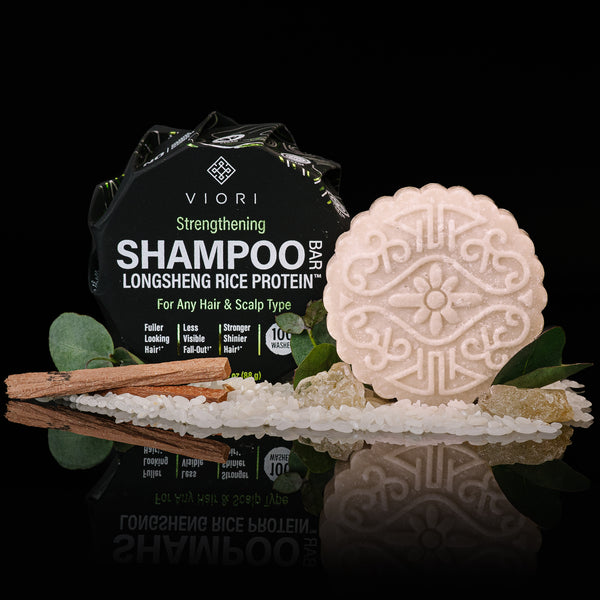
These popular hair-strengthening ingredients (we use bamboo extract in our formulations) have natural mineral content that can create reactions with aluminum.
The Preservation Paradox
Aluminum packaging advocates claim the material provides superior protection from light and air, reducing the need for preservatives. While partially true, this narrative omits something crucial: the coatings themselves often require additional stabilizers and preservation systems to prevent coating degradation.
You're essentially trading one set of preservatives for another, less transparent set.
In contrast, properly formulated bar products are self-preserving. Viori's bars dry between uses, naturally inhibiting microbial growth-no synthetic preservatives required, and no protective coatings with questionable long-term stability.
The Recycling Reality: It's Complicated
I'm going to share something that challenged my own environmental assumptions: the actual recyclability of aluminum personal care bottles is dramatically overstated.
Why Your Aluminum Bottle Probably Isn't Being Recycled
Most aluminum shampoo bottles aren't pure aluminum. They're composite packaging including:
- The aluminum body
- Plastic pump mechanisms (often non-recyclable mixed plastics)
- Interior polymer coatings (permanently bonded to aluminum)
- Adhesive labels (contamination source)
- Plastic bases or caps (different recycling stream)
According to waste management professionals, personal care aluminum bottles have a contamination rate exceeding 60% when they arrive at recycling facilities.
The problems:
Product residue: Unlike beverage cans that rinse clean, shampoo and conditioner bottles retain sticky, oily residue. This contamination can ruin entire batches of recycled aluminum.
Coating separation: Those interior coatings don't separate easily during recycling. When aluminum is melted (at approximately 1,220°F), these polymer coatings burn off, releasing potentially toxic fumes and reducing the quality of recycled aluminum.
Economic viability: Personal care aluminum bottles require additional processing compared to beverage cans, making them economically unviable for many facilities. The result? They're often diverted to landfills despite being "theoretically" recyclable.
The Real Energy Equation
Yes, recycled aluminum requires only 5% of the energy needed for virgin aluminum-an impressive statistic regularly cited. But this calculation doesn't account for:
- Transportation energy (aluminum is heavy; shipping filled bottles requires significantly more fuel)
- Cleaning and processing energy for contaminated containers
- Embedded energy in protective coatings that end up incinerated
- Energy to manufacture replacement pump mechanisms
The Viori difference: Our lightweight bars eliminate 92% of transportation weight compared to liquid products. One bar equals approximately three 10oz bottles but weighs only 3.2oz (shampoo) or 2.5oz (conditioner). Our recycled paper packaging biodegrades naturally-no protective coatings required.
The Formulation Compromises You Don't See
After twenty years in this industry, I can tell you: packaging dictates formulation more than consumers realize.
When a company commits to aluminum bottles, they're making implicit decisions about what they can't include in their products.
The Surfactant Limitation
The cleansing agents (surfactants) in shampoo are particularly problematic for aluminum packaging:
- Anionic surfactants are the most aluminum-reactive, requiring the most robust (and potentially problematic) interior coatings
- Amphoteric surfactants are moderately reactive
- Non-ionic surfactants are most aluminum-compatible but often less effective for thorough cleansing
This is why aluminum-packaged shampoos frequently use more aggressive coating systems or compromise on cleaning efficacy.
At Viori, we use Sodium Cocoyl Isethionate-a gentle, coconut-derived cleanser that works beautifully in bar form without requiring any protective barriers.
The Conditioning Challenge
Conditioners present even greater challenges:
Cationic conditioning agents (like the behentrimonium methosulfate we use at Viori) are positively charged to bind to your negatively charged hair strands. These same positive charges can interact with aluminum oxide on container surfaces, even through protective coatings, potentially:
- Reducing conditioning efficacy over time
- Creating stability issues as products age
- Requiring additional stabilizers that wouldn't otherwise be necessary
Rich conditioning ingredients: Formulations with shea butter, cocoa butter, or specialized oils face the "coating migration" problem. These fat-loving ingredients can slowly dissolve certain protective coatings. This is why many aluminum-bottled conditioners feel thinner than their plastic-bottled counterparts-they're formulated to be coating-compatible rather than hair-optimal.
In Viori's bar format, we can pack our conditioners with cocoa butter, shea butter, rice bran oil, and other deeply nourishing ingredients at concentrations that would be problematic in aluminum bottles.
WHAT CUSTOMERS ARE SAYING
Real reviews for Rice Water Shampoo Bar – All Hair Types | VIORI
The Temperature Problem Nobody Talks About
Here's a technical consideration most articles miss: aluminum's superior thermal conductivity is actually a liability for hair care products.
What Happens During Shipping
During shipping and storage, aluminum bottles transfer temperature changes to the product much more rapidly than plastic or glass. In a delivery truck or warehouse, products can experience 60-90°F temperature swings.
These thermal cycles:
- Stress emulsions and accelerate oxidation of beneficial ingredients
- Can cause phase separation in complex formulations
- Create expansion-contraction cycles that stress interior coatings
Ingredients I particularly worry about with temperature fluctuations include:
- Vitamin E (which we include in Viori bars for antioxidant protection)
- Natural extracts like aloe vera and bamboo
- Proteins like hydrolyzed rice protein
- B-vitamins including inositol and panthenol that support hair growth
The bar advantage: Solid products are remarkably stable across temperature ranges. The absence of water means no liquid expansion-contraction, and the solid format naturally resists temperature-driven degradation. Viori bars have a shelf life of 3+ years when stored properly-something liquid products in any container struggle to match.
The Water Waste We're Ignoring
One of the most overlooked aspects of liquid shampoos and conditioners-regardless of their container-is that you're shipping and storing approximately 70-80% water.
From a sustainability perspective, this is absurd:
- You're paying to ship water from manufacturing to distribution to stores to your home
- You're paying for packaging to contain... water you already have in your shower
- The energy required to heat water during manufacturing adds environmental burden
Think about it: Why dilute concentrated, beneficial ingredients just to require problematic packaging?
At Viori, our bars contain the same Longsheng Rice Water™ and beneficial ingredients-but in concentrated form, without unnecessary water content. You're getting pure effectiveness without waste. When you use our bars, you're adding the water at the moment of use, in exactly the amount you need.
The Sensitive Scalp Concern
This is where my experience working with clients with sensitive scalps becomes particularly relevant: aluminum packaging introduces additional variables that can complicate ingredient sensitivity.
The Mystery Reaction
I've worked with numerous clients who experienced unexplained scalp irritation or allergic responses that they attributed to "natural" or "clean" products. Investigation revealed potential issues with:
Coating leachates: Even approved coating materials can contain trace compounds that trigger sensitivities:
- Residual monomers from polymer coatings
- Catalysts and crosslinking agents from coating production
- Plasticizers that improve coating flexibility
- Adhesion promoters that help coatings bond to aluminum
Aluminum itself: While systemic exposure from topical products is debated, aluminum salts can cause contact dermatitis in sensitive individuals. Any coating breach potentially exposes users to this risk.
Impossible troubleshooting: When a client reacts to a product, we need to identify the trigger ingredient. But with aluminum bottles, you're not just dealing with the ingredient list on the label-you're dealing with potential migration from packaging components that aren't disclosed.
The Viori approach: Our ingredient lists are complete and transparent. What you see is what you get-no hidden coating compounds, no protective barriers. For clients with sensitive skin or scalps, we particularly recommend our Native Essence unscented bars, which eliminate even fragrance as a variable.
What I Tell My Clients: The Three-Lens Evaluation
After two decades of professional hair care, I evaluate products through three lenses:


