
After two decades of working with every hair texture imaginable, I've learned that 4A hair is perhaps the most misunderstood type in the entire industry. And honestly? We've been having the wrong conversation about it for years.
Walk into any beauty store, and you'll find shelves overflowing with products promising "maximum moisture" and "intense hydration" for coily hair. But here's what twenty years behind the chair has taught me: the best products for 4A hair aren't necessarily the heaviest, richest, or most moisturizing ones on the shelf.
In fact, that approach might be exactly what's holding your hair back.
Let me share some professional insights that will completely change how you think about product selection for 4A hair.
What Makes 4A Hair Structurally Different (And Why It Matters)
Before we talk about products, we need to understand what we're actually working with.
4A hair isn't just "very curly hair." It has a unique structural characteristic that fundamentally changes everything about how it interacts with products: variable porosity along the same strand.
Think about it this way: Every tight coil in 4A hair creates a point of mechanical stress. Over time, these stress points develop different levels of cuticle integrity. Some sections have smooth, intact cuticles that repel moisture. Others have lifted cuticles that absorb everything instantly. And many sections fall somewhere in between.
This means when you apply a product to 4A hair, you're not getting uniform coverage or absorption. Some areas drink up the product and become oversaturated. Other areas repel it completely and remain dry. The result? Parts of your hair can be simultaneously over-moisturized and undernourished.
I call this phenomenon "differential hydration stress," and it's the root cause of many issues 4A hair faces-from persistent dryness to unexplained breakage to products that seem to stop working after a few uses.
The "Moisture-Heavy" Product Trap
The beauty industry has convinced us that 4A hair is inherently dry and needs maximum moisture at all times. This advice is both true and dangerously incomplete.
Yes, 4A hair struggles with dryness. But not in the way most people think.
NOT SURE WHICH PRODUCT IS RIGHT FOR YOU?
TAKE THE QUIZTakes 30 seconds · 134,000+ customers matched
The issue isn't that 4A hair can't hold moisture-it's that the tight coil pattern prevents your scalp's natural sebum from traveling down the hair shaft. Your roots might actually be producing plenty of oil, but it gets trapped at the scalp while your ends are parched.
When you layer on thick butters, heavy creams, and multiple oils, you're often creating more problems than you're solving:
- Intact cuticle sections get coated but not penetrated, leading to buildup that blocks real moisture
- Compromised sections absorb too much, becoming limp and protein-deficient
- Your scalp may become even oilier as you add more products to "solve" the dryness at your ends
This is why so many people with 4A hair go through a cycle of using heavy products, experiencing buildup, clarifying everything away, dealing with dryness, and starting the whole cycle over again.
There's a better way.
The Protein Timing Secret Most Stylists Don't Know
Let's talk about protein, because there's a massive misconception I need to clear up.
When clients tell me they have "protein-sensitive hair," I've learned that's rarely accurate. What they actually have is improper protein timing.
Here's what I've observed across hundreds of 4A-textured clients: protein treatments don't fail because of the protein itself-they fail because of when and how the hair receives it.
Most people apply protein treatments to soaking wet hair fresh out of the shower. Makes sense, right? That's when hair is most "open" and receptive.
Actually, that's exactly when protein application works worst for 4A hair.
When 4A hair is completely saturated, it's maximally swollen. Each coil bend creates lifted cuticle points. At this moisture level, protein molecules can't properly align with your hair's keratin structure. Instead, they create a brittle surface coating that leads to that stiff, straw-like feeling people associate with "protein overload."
The professional approach: Apply protein treatments when 4A hair is approximately 60-70% dry-still damp, but not dripping wet. At this moisture level, the cuticle is partially closed but still receptive. Protein can penetrate strategically rather than haphazardly, strengthening the structure without creating brittleness.
This single timing adjustment has transformed results for countless clients who thought they "couldn't use protein."
Why I'm Increasingly Recommending Bar Products for 4A Hair
This might seem unconventional, but stay with me: solid bar products may actually be structurally superior for 4A hair compared to liquids and creams.
I know bars seem old-fashioned or basic. But there's sophisticated chemistry at work here.
Traditional liquid shampoos and conditioners contain emulsifiers-ingredients that help mix water and oils into a spreadable consistency. These emulsifiers make products user-friendly, but they can actually interfere with 4A hair's natural sebum distribution pattern.
Remember, 4A hair already struggles with sebum traveling down those tight coils. Adding synthetic emulsifiers can further disrupt this process, creating more dependency on external products.
Solid bars-particularly those formulated with naturally-derived ingredients-deliver their benefits in a more controlled, targeted way. When you work a quality shampoo bar into 4A hair, you're creating beneficial friction that temporarily smooths the cuticle while depositing cleansing agents exactly where you apply them.
You have control over how much product you use and where it goes. No oversaturation. No random distribution. Just strategic application.
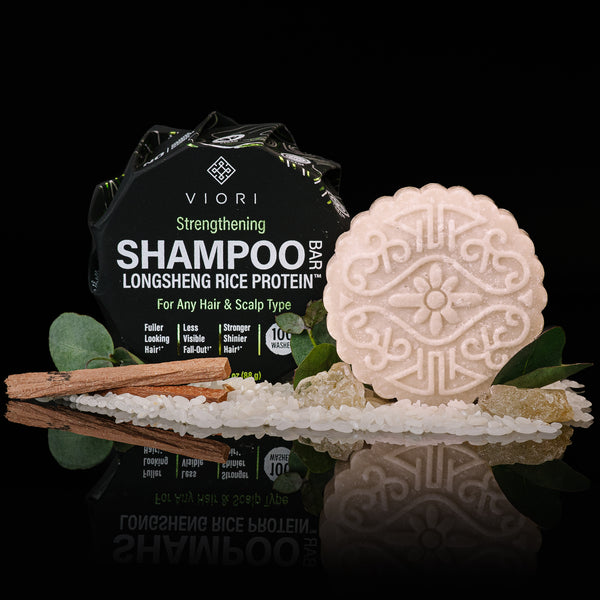
This is one reason I've become such a proponent of Viori's rice-based bar formulations for my 4A-textured clients. The fermented rice water contains a molecule called inositol that's small enough to penetrate even those intact cuticle sections I mentioned earlier, while the bar format allows for that precise, section-by-section application.
The pH Factor Nobody Talks About
Here's a technical insight that changes everything: 4A hair experiences more dramatic pH fluctuation than looser curl patterns.
Each lifted cuticle point in those tight coils acts as a gateway for pH-altering substances. When you use a product with the wrong pH, the effect cascades along each coil, causing progressive damage from root to tip.
This is why pH-balanced products aren't just "nice to have" for 4A hair-they're structurally essential.
A shampoo with a pH of 7 or higher (alkaline) can create a domino effect of cuticle lifting and damage. Even your local water supply, depending on its pH, can cause this cascading effect.
The sweet spot for hair products is a pH between 3.5 and 6.5-slightly acidic, which helps the cuticle lie flat and prevents excessive swelling.
But here's the key most people miss: consistency matters more than hitting an exact number. Using products that all operate within a similar pH range prevents the expansion-contraction cycle that leads to something called hygral fatigue-basically, damage from your hair swelling and deflating repeatedly.
This is another area where Viori's approach aligns with what 4A hair actually needs. Their formulations maintain that optimal pH range, and because you're using coordinated products from the same system, you avoid the pH whiplash that happens when you mix products from different lines with wildly different formulations.
The Strategic Minimalism Approach
Based on everything I've learned about 4A hair's structural reality, here's what I now recommend to clients-and it contradicts most conventional wisdom:
Use fewer products, applied more strategically.
4A hair doesn't need a seven-step routine with multiple leave-ins, creams, oils, and gels layered on top of each other. That's often what's causing the problem.
What 4A hair actually needs:
- A cleansing agent that removes buildup without stripping-this is where quality bar shampoos excel
- A conditioning agent that deposits moisture selectively-again, bars allow for targeted application
- A protein treatment applied at optimal moisture levels (remember: 60-70% dry)
- A sealing method that respects your hair's variable porosity-lightweight oils on specific sections, not everywhere
The beauty of Viori's rice water-based bars is that they align perfectly with this minimalist philosophy. Rice protein is unique because it contains molecules of varying sizes. Larger molecules sit on the surface providing immediate strength, while smaller ones (particularly that inositol from fermentation) penetrate deeper for structural repair.
You're getting graduated penetration from a single ingredient-no need to layer multiple products trying to address different depth levels of your hair strand.
The Citrus Reset Strategy
Here's something that surprises most of my clients: some 4A hair actually suffers from localized excess oil, not universal dryness.
Stay with me here.
Your scalp produces sebum just like everyone else's. But that sebum can't travel down your tight coils effectively. Result? Oily roots and parched ends existing on the same head.
When you use universally moisturizing products, you're often making this imbalance worse-adding more moisture and oils to roots that don't need them while not addressing the true barrier preventing natural oils from reaching your ends.
This is where Viori's Citrus Yao bar becomes a game-changer for 4A hair, even though it's marketed primarily for oily scalps.
The citric acid content helps:
- Break down excess sebum and product buildup at the roots without harsh stripping
- Maintain proper pH throughout the cleansing process
- Allow your natural oils to travel more efficiently down the hair shaft after cleansing
My professional recommendation: Use Citrus Yao strategically every third or fourth wash as a "reset" to remove the buildup that's blocking moisture absorption. Between those reset washes, use a more moisturizing formula like Viori's Terrace Garden or Native Essence for regular maintenance.
This alternating approach addresses both the oily root/dry end problem and prevents the buildup cycle that plagues so many product routines.
The Water Temperature Protocol
Here's one more technical factor that makes a huge difference: water temperature creates mechanical stress that disproportionately affects 4A hair.
Hot water causes maximum cuticle swelling. For 4A hair with its numerous coil points, each bend expands and contracts more dramatically than it would in straight hair. Over time, this creates microscopic tears that lead to that differential hydration stress we discussed earlier.
The professional protocol:
- Cleanse with warm (not hot) water to open the cuticle gently
- Apply conditioner and work through with cool water to begin closing the cuticle
- Final rinse with cold water to fully seal everything
When using bar products like Viori's, this temperature protocol becomes even more important. You're relying on physical manipulation (creating lather, working it through) rather than just pouring liquid over your hair. The friction combined with water temperature creates either restorative or destructive force-your technique determines which.
WHAT CUSTOMERS ARE SAYING
Real reviews for Rice Water Shampoo Bar – All Hair Types | VIORI
The Proper Bar Technique for 4A Hair
If you're using solid bars on 4A hair, technique is absolutely everything. Do it wrong, and you'll experience tangles and frustration. Do it right, and you'll wonder why you ever used liquid products.
The professional method:
1. Never rub the bar directly on your hair. Those coil points are vulnerable to friction damage. Direct rubbing creates unnecessary mechanical stress.
2. Create a rich lather in your palms first. Work the bar between your hands with warm water until you have a good, creamy lather. Then apply it to your hair in sections.
3. Work in a downward, smoothing motion. Follow the curl pattern rather than roughing it up. Think smooth and gentle, not scrubbing and vigorous.
4. For conditioner bars, focus on mid-lengths to ends. Don't apply conditioning products at the scalp where sebum naturally accumulates. Focus on the areas that actually need external moisture.
5. Let the conditioner sit for at least 3-5 minutes. 4A hair's coil pattern means products need time to travel along the strand and penetrate those variable porosity zones. Rushing this step wastes the product's potential.
This technique applies whether you're using Viori's shampoo or conditioner bars. The method is just as important as the product itself.
My Professional Assessment: The Best Products for 4A Hair
After this deep technical dive, let me give you my bottom-line professional opinion.
The "best" product for 4A hair isn't determined by how rich it feels, how many natural oils it contains, or how expensive it is.
The best product is one that:
- ✓ Respects the pH cascade effect (pH 3.5-6.5)
- ✓ Delivers ingredients in a controlled, targeted manner (why I prefer bars)
- ✓ Contains proteins of varied molecular weights (rice protein excels here)
- ✓ Doesn't rely heavily on synthetic emulsifiers that disrupt natural sebum patterns
- ✓ Allows you to customize application based on your hair's variable porosity
Viori's bar system checks all these boxes. The fermented rice water base, pH balancing, and format flexibility address the unique structural needs of 4A hair in ways that most liquid products simply can't.
But the key is understanding that 4A hair isn't a monolith. It's a structurally complex texture that needs products sophisticated enough to match that complexity.
Your Specific Viori Approach for 4A Hair
Based on everything I've outlined, here's how I'd recommend building your routine:
For sensitive scalps or maximum moisture needs:
Start with Native Essence or Terrace Garden bars. These provide gentle cleansing and conditioning without harsh stripping.
For balanced moisture-protein maintenance:
Hidden Waterfall offers that middle-ground approach that works for regular washing without going too far in either direction.
For strategic resets (every 3rd-4th wash):
Citrus Yao breaks down buildup, optimizes sebum distribution, and gives you a clean slate for your moisturizing products to work effectively.
The real


