
I'll be honest with you. After twenty years behind the salon chair, I've heard every hair care claim imaginable. "Miracle ingredients," "ancient secrets," "revolutionary formulas"-the beauty industry loves its mystique. But when it comes to traditional Indian hair cleansing methods, something genuinely different is happening at the molecular level that most people-and even most beauty professionals-don't understand.
This isn't about romantic notions of exotic rituals. This is about biochemistry. Specifically, it's about how plant-based saponins interact with your hair's keratin protein structure in ways that conventional surfactants simply cannot replicate.
Let me take you into the fascinating science that makes natural Indian shampoo legitimately revolutionary-and why, despite all our modern cosmetic technology, we're still trying to recreate what these traditional methods achieved centuries ago.
The Saponin Secret: Not Just "Gentle Cleaning"
When you hear about traditional Indian hair care, three plants typically come up: shikakai, reetha (soapnut), and amla. But here's what most articles won't tell you: these aren't just milder versions of regular shampoo. Their molecular structure creates an entirely different cleaning mechanism.
How Modern Shampoos Work
Standard shampoos-even quality natural options-use surfactants: molecules with one water-loving end and one oil-loving end. They surround oil and dirt particles, allowing water to wash them away. Effective? Absolutely. But here's the problem: they're indiscriminate. They strip away excess sebum along with the beneficial oils your hair needs for protection and moisture.
How Indian Plant Saponins Work Differently
The saponins in traditional Indian cleansing plants have a steroidal glycoside structure that behaves remarkably differently:
They selectively target oxidized sebum while leaving fresher, protective oils relatively intact. Think of it like smart cleaning-removing what needs to go while preserving what your hair needs.
They temporarily open the hair cuticle at a lower pH (around 5.5)-closer to hair's natural slightly acidic state. Most cleansers operate at higher pH levels, which can disrupt your hair's natural structure.
They form smaller micelles (cleaning clusters) that can work on the hair shaft without causing excessive swelling. This is crucial because when hair absorbs too much water repeatedly, it experiences hygral fatigue-the cuticle scales lift, the inner cortex expands and contracts, and damage accumulates over time.
NOT SURE WHICH PRODUCT IS RIGHT FOR YOU?
TAKE THE QUIZTakes 30 seconds · 134,000+ customers matched
From a professional standpoint, this last point is huge. I've seen countless clients with "mysteriously" damaged hair that turned out to be hygral fatigue from over-washing with aggressive cleansers.
The Tannin-Saponin Partnership: The Missing Link
Here's where we venture into territory that's almost never discussed, even in professional circles.
Traditional Indian hair care didn't use these ingredients in isolation. The standard practice combined:
- Cleansing saponins (shikakai and reetha)
- Hydrolyzable tannins (primarily from amla)
- Proteins (often from gram flour or other legume sources)
The tannins aren't just there for antioxidant benefits. Their polyphenolic structure creates something chemists call coacervation with the saponins-essentially forming a beneficial complex that deposits onto your hair shaft during the washing process.
This deposited layer provides:
- Immediate mechanical strengthening as tannins cross-link with your hair's proteins
- A semi-permeable barrier that moderates moisture exchange (preventing both excessive dryness and waterlogging)
- UV protection through chromophore absorption
- Oxidative protection that helps prevent color degradation
No modern conditioner replicates this exactly because it's happening during cleansing, not after. The timing matters biochemically-your hair cuticle is in a receptive state during washing that allows these compounds to penetrate and bond more effectively.
As a colorist, I find this fascinating. The UV and oxidative protection built into the cleansing process itself? That's elegant chemistry.
Why Modern Natural Products Face Unique Challenges
Even when contemporary products incorporate natural ingredients and avoid harsh sulfates, they encounter fundamental obstacles that prevent authentic replication of traditional systems.
The Protein Problem
Traditional Indian cleansing often incorporated fresh-ground legume flours (besan, mung dal) that provided both mechanical cleansing through gentle abrasion and protein conditioning. Modern products can include hydrolyzed proteins, but they can't replicate the particle-size distribution and physical action of fresh-ground flour pastes.
It's similar to the difference between eating whole fruit versus taking a vitamin supplement-the synergistic effects of the whole food matrix matter.
The Freshness Factor
Saponins remain relatively stable, but the beneficial polyphenolic compounds in amla begin oxidizing immediately after grinding. Traditional use involved fresh or recently-dried materials prepared in small batches.
Commercial products must remain stable for months or years on shelves, requiring:
- Concentration methods that alter the chemical profile
- Preservation systems that may interact with active compounds
- Standardization processes that eliminate "impurities" (which may actually contribute to effectiveness)
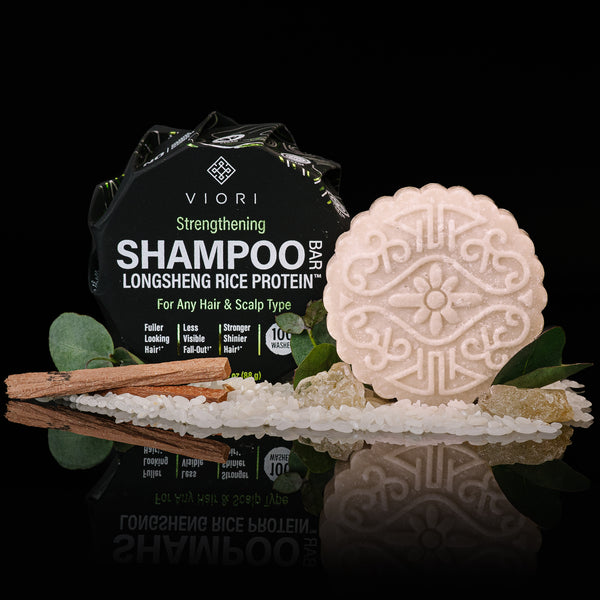
This is an honest limitation of commercial natural hair care. At Viori, for instance, the use of fermented rice water addresses this challenge through fermentation-a process that naturally preserves beneficial compounds while creating new ones. The fermentation creates modified starches with mild cleansing properties, increases levels of inositol and other beneficial compounds, and maintains a naturally acidic pH similar to traditional Indian formulations.
The pH Balancing Challenge
Traditional Indian cleansing mixtures naturally operated at a pH of 5.0-5.5-acidic enough to smooth the cuticle but not so harsh as to damage protein structures. Many modern shampoos target a slightly higher pH (5.5-6.5) to improve foam generation and sensory experience, missing that optimal sweet spot.
This matters more than most people realize. That slightly acidic pH doesn't just "close the cuticle"-it actually affects how proteins and moisture interact with your hair shaft.
The Hard Water Factor Nobody Talks About
Here's something I've never seen adequately addressed in beauty blogs or even professional literature: traditional Indian hair care formulations evolved in specific water conditions that fundamentally affected their performance.
Much of India has moderately hard to very hard water (200-400+ mg/L calcium carbonate equivalent). This created an accidental advantage:
Saponins behave differently in hard water than sulfates do. Sulfate surfactants form insoluble precipitates with calcium and magnesium-that's the filmy, dull feeling you get washing your hair in hard water areas. Saponins actually form complexes that help sequester hard water minerals, and the tannin component provides additional chelating activity.
Traditional formulations were naturally optimized for hard water conditions, which explains why:
- People in hard water areas who try traditional Indian methods are often amazed by the results
- People in soft water areas sometimes find them less impressive
- These methods were hyper-localized solutions to specific environmental conditions
If you're using modern formulations designed for variable water chemistry (like Viori's bars, which work beautifully across different water conditions), you're benefiting from deliberate formulation adjustments that traditional methods achieved through local adaptation.
The Sebum Composition Consideration
This ventures into sensitive territory, but it's scientifically valid: sebum composition varies among populations due to genetic factors, diet, and environmental adaptation.
Research has documented that populations from different regions often have:
- Varying ratios of squalene to wax esters in sebum
- Different saturation levels of sebum lipids
- Distinct scalp microbiome compositions
Traditional Indian cleansing methods evolved to work optimally with the specific sebum profiles common in the populations that developed these practices. The particular saponin types in shikakai and reetha happen to be especially effective at emulsifying those specific lipid profiles.
This doesn't mean they don't work for other hair types-they absolutely can. But it explains why results can be more dramatic for some individuals than others. It's a factor almost never mentioned in discussions of "universal" natural hair care.
In my salon experience, I've found that hair care methods work best when they account for individual variation. There's no truly one-size-fits-all approach, whether you're using traditional methods or modern formulations.
Practical Applications: What Actually Works Today
Given this biochemical background, what can modern users take away for practical application?
For Traditional Method Enthusiasts
If you want to experiment with authentic Indian cleansing methods:
1. Source quality whole dried materials rather than pre-powdered versions. Whole shikakai pods, whole soapnuts, and whole dried amla experience less oxidation and retain more beneficial compounds.
2. Pay attention to traditional ratios (they weren't arbitrary):
- 2 parts shikakai : 1 part reetha : 1 part amla provides balanced cleansing
- Adjust based on your scalp type-more reetha for oily scalps, more shikakai for normal to dry
3. Consider your water hardness. In soft water areas, you may need less product; in hard water, these methods really shine.
4. Fresh mixing matters. If you powder these ingredients yourself, store them separately in airtight containers away from light and mix small batches weekly.
For Modern Natural Product Users
Look for formulations that understand these underlying principles:
- pH-balanced products in the 4.5-5.5 range that respect hair's natural acidity
- Gentle surfactant systems that clean without over-stripping
- Protein inclusion from plant sources like rice or bamboo
- Polyphenolic compounds from plant extracts that can provide some of that traditional tannin benefit
Viori's approach using fermented rice water is particularly interesting from a comparative chemistry perspective. While it's a different botanical tradition (Chinese rather than Indian), the underlying chemistry shares fascinating parallels with traditional Indian methods-particularly the reliance on plant-based compounds that clean through mechanisms beyond aggressive surfactant action.
The fermentation process creates:
- Modified starches with mild cleansing properties
- Increased beneficial compounds like inositol
- Naturally acidic pH that mimics traditional formulations
- Protein fractions that interact with hair similarly to traditional legume-based cleansers
Both traditions arrived at similar biochemical solutions to hair care challenges using their respective regional plant resources.
The Microbiome Connection: Cutting-Edge Research
Here's the frontier that almost no one is discussing yet: how different cleansing methods affect scalp microbiome composition.
WHAT CUSTOMERS ARE SAYING
Real reviews for Rice Water Shampoo Bar – All Hair Types | VIORI
Emerging research suggests:
Saponin-based cleansing may better preserve beneficial scalp bacteria compared to sulfate-based systems that can disrupt the entire microbial ecosystem.
Tannins have selective antimicrobial properties that may suppress problematic organisms (like Malassezia species associated with dandruff) while sparing beneficial flora.
The pH of traditional cleansers aligns with optimal ranges for beneficial scalp microbiome diversity-slightly acidic conditions that support healthy bacterial populations.
This is still speculative territory as the research is preliminary, but it suggests the benefits people experienced from traditional Indian hair care may have included microbiome effects we're only beginning to understand.
Modern products that maintain appropriate pH levels may provide some of these benefits even when using different botanical sources. Viori's pH-balanced formulation, for instance, creates scalp conditions conducive to healthy microbiome balance.
Personalizing Your Approach
One aspect of traditional Indian hair care that gets lost in modern commercial adaptation is extreme personalization.
For Oily Scalps
Traditional approach:
- Higher reetha content for stronger cleansing
- Inclusion of neem powder for additional astringency
- More frequent washing cycles
- Citrus additions for scent and oil control
Modern equivalent: Choose formulations with citric acid properties or clarifying ingredients. Viori's Citrus Yao bars, for example, include natural citrus elements that help break down excess oil-a different botanical tradition arriving at a similar solution.
For Dry Scalps
Traditional approach:
- Higher shikakai content for gentler cleansing
- Inclusion of fenugreek for moisturizing mucilages
- Less frequent washing
- Addition of conditioning elements like hibiscus
Modern equivalent: Select more moisturizing formulations and use conditioner generously. Products with rice water or bamboo extracts can provide similar moisturizing benefits through different plant chemistry.
For Normal Scalps
Traditional approach:
- Balanced formulas
- Flexibility in washing frequency
- Seasonal adjustments
Modern equivalent: You have the most flexibility. Experiment with different products and washing frequencies to find your optimal routine.
Setting Realistic Expectations: What Science Actually Supports
As a professional, I feel obligated to separate verified benefits from hopeful claims.
Scientifically Supported Benefits
- Mild cleansing action - Documented through surfactant studies showing gentler lipid removal
- Antioxidant effects - Polyphenols show measurable free radical scavenging activity
- Protein strengthening - Tannin-protein interactions are well-characterized in biochemistry
- pH benefits - Acidic pH smooths the hair cuticle (observable via electron microscopy)
- Reduced hygral fatigue - Lower swelling factors measured in comparative studies
Less Certain or Individual-Dependent
- Hair growth promotion - Minimal clinical evidence; mostly anecdotal testimonials
- Gray hair prevention - No robust clinical evidence (though various traditional practices have interesting claims here)
- Scalp condition cure - May help manage symptoms but unlikely to cure underlying medical conditions
- Universal superiority - Individual responses vary significantly; not everyone finds these methods optimal for their specific hair


