
After two decades behind the chair, I've witnessed countless hair transformations-and just as many hair disasters. One of the most misunderstood culprits? Hard water. But here's what most people don't realize: the solution might actually be creating new problems.
Today, I want to pull back the curtain on something that rarely gets discussed outside professional circles: the molecular tradeoff between removing minerals and preserving your hair's natural protein structure.
What's Really Happening to Your Hair in Hard Water
Let's start with the science. Hard water isn't just about that chalky feeling or the white residue on your faucets. At a molecular level, something far more complex is happening to your hair every time you wash it.
Hard water contains dissolved minerals-primarily calcium and magnesium. When water measures 120+ mg/L of these minerals (the technical threshold for "hard"), each wash deposits microscopic layers of positively charged ions onto your hair shaft. These ions form coordinate bonds with the negatively charged sites on your hair's keratin structure.
Think of it like tiny magnets attaching to your hair, except these magnets:
- Lift your cuticle layer by 15-30 degrees from its optimal flat position
- Reduce moisture retention by interfering with your hair's natural ability to hold water
- Accelerate color fading by 40-60% (yes, really!)
- Increase breakage particularly at the mid-shaft where hair is most vulnerable
Over time, this creates a cascade effect that leaves hair feeling rough, looking dull, and breaking more easily than it should.
The Chelation Solution: A Double-Edged Sword
Enter chelating shampoos-products specifically designed to tackle hard water buildup. The active ingredients in these formulas (most commonly EDTA or similar compounds) work by binding to metal ions and making them water-soluble so they can be rinsed away.
Sounds perfect, right?
Here's the catch that changed how I approach hard water treatment: chelating agents can't tell the difference between the minerals you want to remove and the ones your hair actually needs.
NOT SURE WHICH PRODUCT IS RIGHT FOR YOU?
TAKE THE QUIZTakes 30 seconds · 134,000+ customers matched
Your hair relies on trace minerals for structural integrity:
- Zinc is essential for the disulfide bonds that give hair its strength
- Copper is involved in melanin production and helps maintain your natural color
- Manganese supports the cross-linking that keeps keratin stable
Aggressive chelation doesn't discriminate. It removes everything.
The Phenomenon I Call "Chelation Rebound Syndrome"
In my practice, I started noticing a pattern among clients who used chelating shampoos more than once weekly. They'd come in with a constellation of issues:
- Increased porosity-hair that felt like a sponge, absorbing everything but holding nothing
- Protein sensitivity-sudden reactions to protein treatments that previously worked beautifully
- Uneven color absorption-patchy results when we'd color or highlight
- Elastic fatigue-hair that lost its natural bounce and resilience
Initially, I attributed these issues to other factors. But after connecting the dots across dozens of clients, the pattern became clear: over-chelation was stripping away more than just surface buildup. It was extracting trace elements embedded in the hair's cortex, weakening the internal protein matrix that gives hair its strength.
The pH Paradox Nobody Talks About
Here's where hair chemistry gets particularly tricky, and where many hard water shampoos create an impossible compromise.
Effective chelation typically requires a pH range of 8-10 (alkaline territory). Your hair, however, thrives at a pH of 4.5-5.5 (slightly acidic). At this lower pH, your cuticle lies flat, moisture is locked in, and your hair is protected.
Most chelating shampoos try to split the difference, but this middle ground often means:
- The cuticle opens enough to remove minerals (good)
- But stays open longer than ideal (bad)
- Then requires a highly acidic conditioner to rebalance (creating what I call "pH whiplash")
Your hair is essentially being put through a chemical roller coaster with every wash.
A Different Approach: Prevention Over Intervention
This is where my philosophy has evolved significantly over my career. What if, instead of aggressively removing minerals after they've bonded to hair, we prevented them from adhering in the first place?
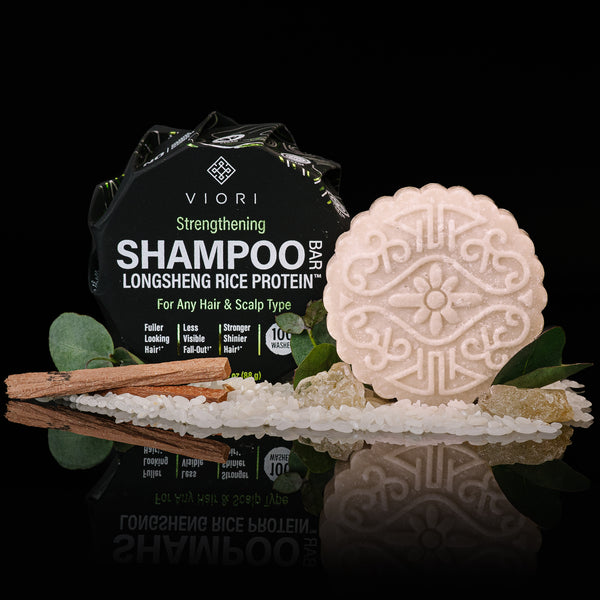
This is why I was drawn to Viori's rice water approach. After spending time studying the formulation and seeing real-world results with clients, I've come to appreciate the biomimetic elegance of this method.
Fermented rice water works through a completely different mechanism:
During fermentation, inositol (a form of Vitamin B8) is produced. This compound creates a protective coating that:
- Fills in the microscopic gaps along the cuticle where minerals typically deposit
- Provides slip that prevents mineral adhesion before it starts
- Strengthens the cortex from within, making hair more resilient to environmental stressors
Panthenol (Vitamin B5) acts as a humectant that:
- Maintains moisture balance even when washing in high-mineral water
- Creates a breathable barrier on the hair shaft
- Doesn't strip away the beneficial trace minerals your hair needs
The pH of Viori bars sits right in that sweet spot of 5.0-5.5. This means your cuticle stays relatively flat during washing, preventing minerals from penetrating in the first place. It's a preventative strategy rather than a remedial one-and your hair's protein structure stays intact.
The Oxidative Stress Factor: Advanced Concepts
Let me share something that doesn't get nearly enough attention in consumer hair care: hard water minerals don't just sit passively on your hair. They're chemically active, particularly iron and copper.
These minerals act as catalysts for oxidative damage. They accelerate the breakdown of hydrogen peroxide (used in coloring and lightening) and amplify damage from environmental oxidizers like UV rays and pollution.
This makes chelation potentially most beneficial for:
- Color-treated hair (preventing accelerated fading)
- Chemically straightened hair (reducing oxidative bond damage)
- Gray hair (which has less melanin protection)
But here's the irony: these are precisely the hair types most vulnerable to the damage caused by over-chelation. It's a delicate balancing act.
My Professional Protocol for Hard Water
Based on two decades of trial, error, and client outcomes, here's the strategic approach I now recommend:
For Weekly Maintenance (All Water Types)
Focus on prevention rather than aggressive removal:
- Use a pH-balanced formula that creates a barrier against mineral buildup
- Prioritize cuticle sealing over harsh cleansing
- Adjust your protein-moisture balance based on your hair's porosity level
This is where I recommend Viori's rice water bars for most clients. The daily prevention they provide eliminates the need for frequent chelation treatments.
For Monthly Clarification (If You Live in Hard Water Areas)
If you're seeing visible buildup despite preventative care:
- Perform a chelation treatment once monthly maximum
- Follow immediately with a protein-free deep conditioner
- Use cool water for your final rinse to maximize cuticle closure
- Give your hair a week to rebalance before any chemical services
For Quarterly Reset (Severely Mineralized Hair)
For extreme cases-think well water with very high mineral content, or years of buildup:
- Consider a professional chelation treatment in a salon setting where we can monitor the process
- Follow with an immediate bond-building treatment (not traditional protein)
- Restructure your home care routine to prevent re-mineralization
What to Look For in Hard Water Products
Whether you're evaluating chelating treatments or preventative products, here are the professional markers I use:
Signs of Gentle, Thoughtful Chelation:
- Citric acid, gluconic acid, or phytic acid (much milder than EDTA)
- pH between 5.5-6.5 (minimizes cuticle disruption)
- Presence of amino acids or hydrolyzed proteins (replacing what's removed)
- Recommended usage of once weekly or less
Red Flags for Over-Chelation Risk:
- EDTA listed in the first five ingredients
- pH above 7.0
- Sulfate surfactants combined with chelators (double-stripping effect)
- No conditioning agents in the formula
- Recommendations for daily use
Markers of a Preventative Approach (My Preference):
- Rice protein, wheat protein, or silk amino acids (fill gaps before minerals can)
- Natural oils that coat the shaft (jojoba, broccoli seed oil)
- Humectants that maintain hydration despite mineral exposure
- pH of 4.5-5.5 (keeps cuticle flat, blocking mineral penetration)
- Can be used daily without cumulative damage
Why Traditional Wisdom Sometimes Outperforms Modern Chemistry
What fascinates me about Viori's approach is that it's rooted in centuries of empirical evidence. The Red Yao women of Longsheng village have been using fermented rice water for generations-and they live in a region with varying water quality.
Their hair, famously healthy and maintaining color well into their eighties, suggests that this traditional method:
- Strengthens hair structure against environmental stressors (including minerals)
- Maintains optimal moisture regardless of water hardness
- Supports rather than strips the hair's natural protective mechanisms
The Native Essence formulation (for sensitive scalps) and Terrace Garden (for dry, mineral-damaged hair) both embody this philosophy. They work by reinforcing your hair's existing structure rather than stripping everything away and hoping to rebuild from scratch.
The Truth: Context Matters More Than Marketing
After twenty years in this industry, I can tell you definitively: there is no universal "best" solution for hard water. The most effective approach depends on:
Your water's specific mineral profile-Calcium-heavy water behaves differently than iron-rich water. You can usually get a water quality report from your municipality, or invest in a home testing kit.
Your hair's current condition-Virgin hair can tolerate more intervention than chemically treated hair. If you're color-treated, relaxed, or regularly heat-style, you need a gentler approach.
Your porosity level-Low porosity hair actually resists mineral penetration better than you'd think. High porosity hair has gaps that minerals slip right into, making prevention critical.
Your washing frequency-Daily washers absolutely need gentler formulas. If you're washing every day with an aggressive chelator, you're steadily dismantling your hair's structure.
Aggressive chelating shampoos have their place-specifically, as monthly or quarterly reset treatments for severely mineralized hair. But for regular use, a preventative, fortifying approach that works with your hair's natural structure will give you healthier long-term results.
My Professional Recommendations by Hair Type
Let me get specific about what I recommend to clients in different situations:
Fine, Low-Porosity Hair in Hard Water
My recommendation: Viori Citrus Yao
Why it works: The lightweight formula won't weigh down fine hair, and the natural citric elements provide mild chelation without aggression. The preventative approach means minerals don't build up in the first place.
WHAT CUSTOMERS ARE SAYING
Real reviews for Rice Water Shampoo Bar – All Hair Types | VIORI
What to avoid: Traditional chelating shampoos unless you're doing color correction work. Your low porosity already protects you better than you realize.
Thick, High-Porosity, Color-Treated Hair
My recommendation: Viori Terrace Garden or Hidden Waterfall
Why it works: Maximum moisture retention is critical for high porosity hair. These formulations fill in the gaps where minerals would typically deposit, while protecting your color investment.
Professional tip: If you're seeing visible mineral buildup despite preventative care, do a monthly clarification with a gentle chelator. Focus on filling those porosity gaps between treatments.
Sensitive, Reactive Scalps
My recommendation: Viori Native Essence
Why it works: Fragrance-free and formulated for sensitivity, this option provides hard water protection without the scalp irritation that chelators can trigger.
What to avoid: EDTA-based formulas entirely. If possible, invest in a filtered shower head to reduce your mineral exposure at the source.
Chemically Straightened or Relaxed Hair
My recommendation: Alternate between Viori bars for prevention and quarterly professional chelation only if needed
Critical timing rule: Never use a chelating shampoo within two weeks of a chemical service. Your bonds are already restructured and vulnerable.
Watch for: Increased elasticity or "spongy" texture-these are signs of over-chelation and protein matrix damage.
The Bottom Line: Smarter Care, Not Harsher Care
The hard water conversation in beauty has been oversimplified into "use a chelating shampoo." But as professionals, we know hair chemistry is infinitely more nuanced than that.
The future of hair care isn't in developing more aggressive removal systems. It's in smarter prevention-working with your hair's natural protective mechanisms rather than constantly overriding them.
This is where I find traditional approaches like rice water treatment to be remarkably sophisticated. They've been refined over centuries of real-world use, optimized for exactly this balance: protecting hair from environmental challenges while maintaining its structural integrity.
Your hair is a complex biological structure, not a surface to be scrubbed clean. When you understand what's happening at a molecular level, you can make choices that support your hair's health rather than inadvertently undermining it.


