
After twenty years in professional hair care, I've learned that the most interesting innovations happen where ancient wisdom meets modern science. Today, I want to pull back the curtain on something fascinating that's rarely discussed outside formulation labs: the complex molecular challenge of creating truly effective Ayurvedic shampoo bars-and why most of them don't work as promised.
The Problem Nobody Talks About
Here's something that might surprise you: traditional Ayurvedic hair care and modern shampoo bars are fundamentally incompatible. Let me explain why.
Ayurvedic hair treatments have always centered on rich, nourishing oils-coconut oil infusions, herbal tailas (medicated oils), and intensive leave-in preparations. The very word "amrit" (meaning nectar or elixir in Sanskrit) implies deeply moisturizing, oil-based formulations.
Shampoo bars, by contrast, are solid surfactant structures designed to create lather when they meet water. They're essentially the opposite of oily.
So when you see a shampoo bar claiming to deliver authentic Ayurvedic benefits, you should ask: How is that even possible?
The Molecular Puzzle
Creating an effective Ayurvedic shampoo bar requires solving problems that most consumers never consider. As someone who's consulted with formulators for decades, I can tell you these challenges are significant:
The Separation Problem
Oil and water don't mix-we all know this. But in a solid shampoo bar, you're trying to create what's essentially a frozen combination of oils and cleansing surfactants that must remain stable through temperature changes, shipping, and storage. It's like trying to keep a vinaigrette from separating, except it needs to stay mixed for months while sitting on a shelf.
The Lather Interference Issue
Here's an irony: the very oils that provide Ayurvedic benefits actively suppress lather. Too much beneficial oil, and your bar won't foam properly (and consumers will think it doesn't work). Too little oil, and the Ayurvedic benefits become meaningless.
NOT SURE WHICH PRODUCT IS RIGHT FOR YOU?
TAKE THE QUIZTakes 30 seconds · 134,000+ customers matched
Finding that sweet spot requires precision formulation that goes far beyond mixing ingredients in a pot.
The Freshness Challenge
Many Ayurvedic oils contain delicate fatty acids that can go rancid. In liquid shampoos, water dilutes oxygen exposure. In bars, you don't have that protection. Without synthetic preservatives (which would contradict natural positioning), keeping these oils fresh becomes incredibly difficult.
The "Navel Amrit" Concept: Ancient Practice Meets Modern Reality
You might wonder about the reference to "navel" in some Ayurvedic hair products. This draws from a traditional practice called nabhi chikitsa-navel therapy.
In Ayurvedic philosophy, the navel is considered the body's energy center, connected to over 72,000 nadis (energy channels). Practitioners believe that applying specific oils to the navel region delivers benefits throughout the body, including to hair and scalp.
Traditional navel oils typically contain powerful ingredients like:
- Castor oil: Over 85% ricinoleic acid
- Sesame oil: Rich in antioxidant lignans
- Brahmi (Bacopa monnieri): Contains beneficial triterpenoid saponins
- Bhringraj (Eclipta alba): Loaded with unique coumestan compounds
But here's the critical question: These compounds work in traditional applications through sustained skin contact-often overnight oil treatments. When you're shampooing for just 2-3 minutes before rinsing, how much can actually penetrate and deliver benefits?
This is where most Ayurvedic shampoo bars fall short. They contain the ingredients on the label, but lack the delivery technology to make them effective.
The Advanced Solution Most Brands Aren't Using
The cutting edge of Ayurvedic bar formulation involves technology borrowed from pharmaceutical delivery systems: solid lipid nanoparticles (SLNs) and nanostructured lipid carriers (NLCs).
I realize that sounds intimidating, but the concept is elegant:
How Nanoencapsulation Works
- Encapsulation: Beneficial Ayurvedic compounds are wrapped inside protective shells made from natural waxes (like carnauba or candelilla)
- Miniaturization: These capsules are processed down to 50-1000 nanometers-small enough to slip between the scales of your hair cuticle
- Controlled Release: When the bar contacts warm water and your scalp's natural oils, these tiny capsules gradually release their contents, extending the effective contact time well beyond your actual shower
- Lather Protection: Because the oils are sealed inside until the moment of use, they don't interfere with the bar's ability to create satisfying lather
The Manufacturing Complexity
Creating these advanced bars requires precision that goes far beyond traditional soap-making:
- Ingredients are heated to exact temperatures (70-85°C)
- The mixture undergoes high-pressure homogenization (500-1500 bar pressure)
- Rapid cooling prevents particles from clumping together
- Nanoparticles must be evenly distributed throughout the surfactant base
This sophisticated processing explains why genuinely effective Ayurvedic bars command premium prices-and why discount alternatives rarely deliver on their promises.
The pH Dilemma: Tradition vs. Modern Hair Science
Here's a fascinating conflict that reveals a lot about formulation philosophy:
The Traditional Approach
Many authentic Ayurvedic cleansers (like shikakai or reetha powders) are naturally alkaline, with pH levels of 7.5-9.5. This alkalinity:
- Opens the hair cuticle for deep cleansing
- Allows herbal extracts to penetrate more effectively
- Aligns with Ayurvedic concepts of balancing the kapha dosha (associated with oil and moisture)
The Modern Standard
Contemporary hair science emphasizes pH-balanced products (4.5-5.5) that:
- Match hair's naturally slightly acidic state
- Keep cuticles sealed for smoothness and shine
- Minimize color fading and protein loss
So which is right?
The Intelligent Compromise
The most sophisticated formulators are exploring bi-phasic pH systems:
The outer layer of the bar has a slightly elevated pH (6.5-7.0) for initial cleansing and cuticle opening, while deeper layers or complementary products provide acidic compounds (like citric acid or amla extract) to re-seal cuticles.
This mimics the traditional two-step Ayurvedic approach (alkaline cleansing followed by acidic rinse) while maintaining bar format convenience.
The Sustainability Story Brands Don't Share
Every shampoo bar is marketed as the sustainable alternative to bottled products. But when Ayurvedic ingredients enter the equation, the environmental calculation becomes far more complex.
The Hidden Carbon Costs
- Global Ingredient Sourcing: Authentic brahmi, bhringraj, and other Ayurvedic botanicals often travel from India to manufacturing facilities worldwide. Sometimes this carbon footprint exceeds that of locally-sourced ingredients in plastic bottles.
- Energy-Intensive Processing: Creating stable nanoencapsulated bioactives requires significantly more energy than simple mixing. Does eliminating water transport offset this?
- Usage Efficiency: Bars often lead to over-application (too much lather) or under-application (insufficient contact). This affects the true environmental cost per wash.
- Special Storage Requirements: Ayurvedic oils need careful climate control. The energy cost of maintaining optimal warehouse conditions can be substantial.
True Sustainability Requires Honesty
For an Ayurvedic shampoo bar to be genuinely more sustainable than conventional products, total lifecycle impact must be lower-including manufacturing energy, ingredient transport, packaging, AND use-phase water.
The most environmentally responsible approach would involve:
- Bioregional ingredient sourcing (adapting Ayurvedic principles to local botanicals)
- Ambient temperature processing where possible
- Optimized concentration to minimize waste
- Consumer education on proper usage
The Uncomfortable Truth About "Ayurvedic" Claims
As a beauty professional, I need to address something most brands avoid: many Ayurvedic ingredients lack clinical validation for topical hair application, especially in rinse-off formats.
This doesn't mean they're ineffective-it means:
The Evidence Gap
Traditional use doesn't equal mechanistic understanding. We know from centuries of practice that certain preparations support hair health, but we often don't know which specific molecules are responsible or their optimal concentrations.
Leave-on vs. rinse-off matters enormously. Traditional Ayurvedic hair care emphasized overnight oil treatments. Shampoo bars contact your hair for maybe three minutes. The bioavailability is completely different.
Synergy may be disrupted. Ayurvedic philosophy emphasizes whole-plant benefits. Modern extraction and incorporation into surfactant matrices might break these synergistic relationships.
How to Evaluate Ayurvedic Bars Like a Professional
When I'm assessing an Ayurvedic shampoo bar for salon use or personal recommendation, I look beyond marketing to ask:
Critical Questions
- What's the actual concentration of bioactive compounds? Many bars contain homeopathic amounts that are analytically insignificant. Ask brands for specific percentages, not just "contains brahmi."
- What extraction method was used? CO2 extraction preserves more beneficial volatiles than heat extraction. Water decoctions and oil macerations have entirely different compound profiles.
- Is the contact time realistic for claimed benefits? A bar claiming hair growth benefits from bhringraj would need sustained follicle penetration-impossible in a quick wash.
- Are there third-party bioavailability studies? Not just safety testing, but actual measurement of compound delivery to target tissues.
- How are unstable compounds protected? Look for natural vitamin E, rosemary extract, or encapsulation technology-not just strong fragrances masking rancidity.
A Better Approach: The Viori Model
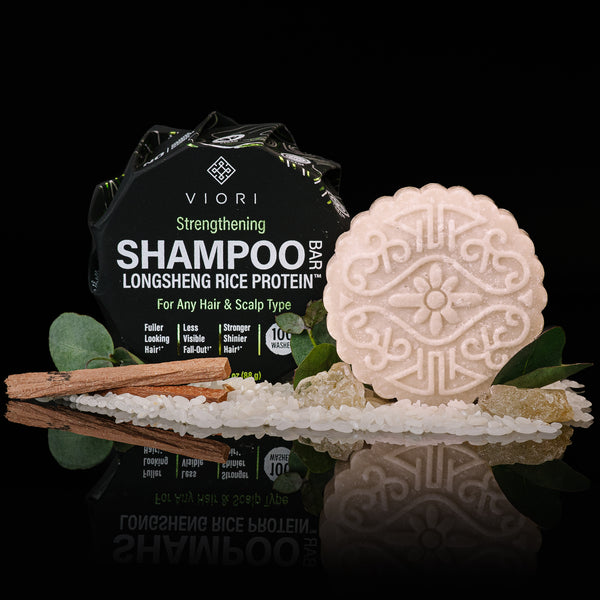
Viori's fermented rice water technology addresses many of the challenges we've discussed-representing a parallel evolution in translating traditional wisdom into effective modern formats.
Why Fermentation Changes Everything
The fermentation process offers elegant solutions:
Enhanced Bioavailability: Fermentation breaks down large molecules into smaller, more penetrable forms-achieving similar goals to nanoencapsulation through biological rather than mechanical means.
Natural Preservation: Fermented products generate their own antimicrobial compounds, extending shelf life without synthetic preservatives.
pH Modulation: Fermentation naturally produces organic acids that help achieve the pH-balanced finish modern hair science recommends.
Improved Compatibility: Fermentation converts some oil-soluble nutrients into water-soluble forms that work better with surfactant-based cleansers.
The Longsheng Rice Water Tradition
Viori's approach draws from the centuries-old hair care practices of the Red Yao tribe in Longsheng, China-women renowned for maintaining lustrous, dark hair well into old age. Their secret involves fermenting rice water to create a hair treatment rich in:
WHAT CUSTOMERS ARE SAYING
Real reviews for Rice Water Shampoo Bar – All Hair Types | VIORI
- Inositol (a carbohydrate that strengthens hair)
- Amino acids (the building blocks of keratin)
- Vitamins B and E
- Minerals
- Antioxidants
The fermentation process enhances these compounds' bioavailability while creating new beneficial metabolites that don't exist in fresh rice water.
This represents the kind of intelligent synthesis between traditional practice and modern delivery science that actually works.
The Future of Traditional Hair Care
The most sophisticated next-generation formulations will combine:
- Traditional Wisdom: Time-tested ingredients and application philosophies
- Modern Delivery Science: Nanoencapsulation, controlled release, bioavailability enhancement
- Sustainable Processing: Fermentation, ambient temperature methods, bioregional sourcing
- Clinical Validation: Actual measurement of claimed benefits, not just historical use
Practical Recommendations from Two Decades in the Industry
If You're Considering Ayurvedic Shampoo Bars
Match to your hair type carefully. Ayurvedic formulations work best when aligned with your specific needs. A moisture-rich formulation won't help oily scalps.
Adjust your expectations. Even the best-formulated Ayurvedic bar cannot replicate sustained overnight oil treatments. Think of bars as maintenance, not intensive intervention.
Demand transparency. Ask brands for specific bioactive concentrations, extraction methods, and delivery technology. "Contains brahmi" tells you nothing useful.
Use as part of a broader routine. Combine bars with occasional oil treatments, scalp massage, and dietary considerations for comprehensive Ayurvedic hair care.
If You're a Formulator
Invest in delivery technology. Simply mixing Ayurvedic oils into standard bar bases yields disappointing results. Consider encapsulation, nano-structuring, or fermentation.
Source with purpose. Work with suppliers who can provide extracts optimized for your specific delivery system.
Test the pH journey. Measure pH at multiple points during use, not just the finished bar. The pH your customer's hair experiences may differ dramatically.
Validate your claims. Commission basic penetration studies if making specific benefit claims. This elevates the entire category and builds consumer trust.
The Bottom Line
The concept of Ayurvedic shampoo bars-whether drawing from navel oil traditions, herbal preparations, or other ancient practices-represents a genuinely challenging formulation problem.
Success requires more than listing traditional ingredients on a label. It demands:
- Advanced delivery systems that extend bioavailability beyond typical rinse-off contact time
- Intelligent pH engineering that balances traditional cle


