
When I first encountered natural shampoo and conditioner bars twenty years ago, I dismissed them as a passing trend-another well-intentioned eco-product that would sacrifice performance for sustainability. I was wrong. Profoundly wrong.
What I've discovered through years of professional experience and diving deep into formulation chemistry is that the shift to bar format isn't just about eliminating plastic bottles. It's fundamentally changing how active ingredients interact with your hair's biological structure in ways that most people-and frankly, most stylists-don't fully understand.
Let me take you behind the scenes into the fascinating science that rarely gets discussed outside of formulation labs.
The Preservation Revolution You Never Knew Was Happening
Here's something that might surprise you: the solid bar format creates an entirely different preservation ecosystem than liquid formulations, and this changes everything about how products work with your hair.
In liquid shampoos, water typically comprises 70-80% of the formula. This high water content creates an environment where bacteria and mold can thrive, necessitating synthetic preservatives like parabens, formaldehyde-releasers, and other compounds you'd rather not put on your scalp.
But bars exist in what chemists call an "anhydrous" or low-water-activity state. Even though you activate them with water during use, their resting state contains minimal free water molecules. This dramatically reduces microbial growth without harsh preservatives.
The self-preserving cycle works like this: You wet the bar, use it, then it dries between applications. This constant drying creates an environment where microorganisms simply can't establish themselves. It's elegant, natural preservation that liquid products cannot achieve.
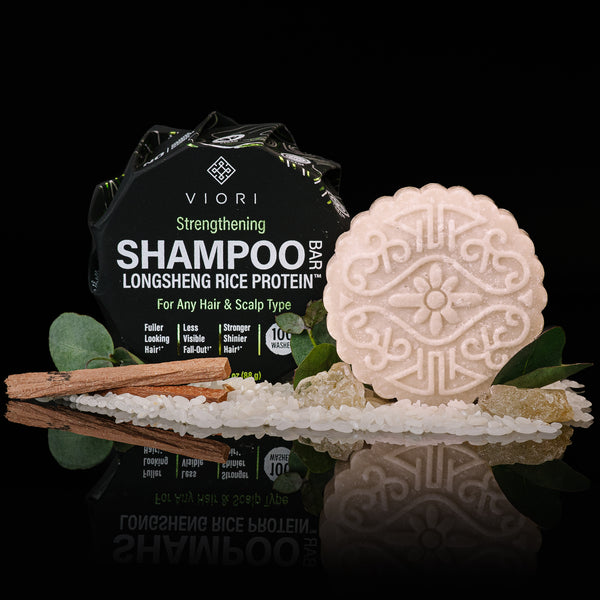
Working with Viori's bars, I've observed they contain ingredients like sodium lactate-derived from fermented corn and beet sugars-which acts as a natural humectant and mild preservative. But the real preservation power comes from the format itself.
NOT SURE WHICH PRODUCT IS RIGHT FOR YOU?
TAKE THE QUIZTakes 30 seconds · 134,000+ customers matched
This explains why properly stored bars can maintain their efficacy for 3-5 years-far longer than their liquid counterparts, which typically begin degrading after 12-18 months.
The Ancient Wisdom That Modern Science Confirms
Let's talk about something that bridges traditional beauty rituals and cutting-edge biochemistry: fermentation and its impact on nutrient bioavailability in hair care.
The ancient Red Yao tradition of using fermented Longsheng rice water isn't just folklore-it's sophisticated chemistry that we're only now beginning to fully understand.
When rice undergoes fermentation, several critical transformations occur:
Inositol Amplification: Fermentation dramatically increases vitamin B8 (inositol) content. This molecule has a unique structure that allows it to penetrate the hair cuticle and strengthen the cortex from within. In my experience treating damaged hair over the years, inositol is one of the few ingredients that genuinely repairs at the molecular level rather than just coating the surface.
Panthenol Enhancement: Vitamin B5 (panthenol) levels rise during fermentation. This isn't synthetic panthenol-it's a naturally-derived form that exhibits superior moisture retention properties. I've seen it work wonders on dry, brittle hair that seemed beyond help.
Protein Hydrolysis: The fermentation process breaks down rice proteins into smaller peptide chains. These hydrolyzed proteins are small enough to actually penetrate the hair shaft rather than merely sitting on top of it. Think of it like the difference between trying to push a basketball through a chain-link fence versus pushing marbles through-size matters tremendously.
When these fermented nutrients are incorporated into a solid bar format, they remain in a more concentrated, stable form than in water-diluted liquids. It's like the difference between fresh herbs and dried spices-the concentrated format preserves and even amplifies potency.
The pH Balancing Act: Why Some Bars Damage While Others Transform
One of the most technically challenging aspects of bar formulation is pH management, and this is where natural bars either excel or fail catastrophically.
The Alkalinity Problem
Remember your grandmother's hair after washing with bar soap? That dull, straw-like texture wasn't accidental. Traditional soap bars (made with lye) have a pH of 9-10-far too alkaline for hair, which thrives at 4.5-5.5 pH. This high alkalinity causes the hair cuticle to swell and lift, leading to tangling, frizz, and cumulative damage.
Modern natural shampoo bars use different chemistry entirely. They employ syndet (synthetic detergent) bases like Sodium Cocoyl Isethionate-a coconut-derived cleanser that maintains hair-friendly pH levels. Despite the technical-sounding name, this ingredient performs dramatically differently than harsh sulfates.
Here's the crucial distinction: Sodium Lauryl Sulfate (SLS), found in many commercial shampoos, strips away too much sebum-your scalp's natural protective oil. This disrupts your scalp's acid mantle, triggering a compensation response where your scalp produces even more oil, creating a vicious cycle. Many people think they have "oily hair" when they actually have reactive scalps trying to recover from harsh cleansing.
Sodium Cocoyl Isethionate cleanses effectively while respecting your scalp's natural pH balance. It's the difference between pressure-washing your deck and gently cleaning it with appropriate tools-both remove dirt, but only one preserves the underlying structure.
The Conditioner Conundrum: Creating Slip Without Water
Conditioner bars present an even more interesting formulation challenge. How do you create that silky slip and effortless detangling without water as a carrier?
The answer lies in cationic surfactants-specifically, ingredients like Behentrimonium Methosulfate (BTMS). I know, I know-it sounds chemical and scary. But despite the "sulfate" in its name, BTMS is completely different from cleansing sulfates, and understanding why matters for your hair health.
Here's the science:
- Hair carries a negative electrical charge, especially when damaged
- BTMS carries a positive charge
- This electrostatic attraction allows conditioning agents to bond directly to hair shafts
- The solid format delivers these ingredients in much higher concentrations than liquid conditioners
In my professional experience, a properly formulated conditioner bar actually provides superior slip and detangling compared to most liquid conditioners, precisely because the active ingredients aren't diluted in water. That paste-like lather you get (rather than airy foam) consists of emollients actually coating each hair strand.
The first time I used a well-made conditioner bar, I was genuinely shocked at how easily my comb glided through my hair. I'd been skeptical, but the concentrated delivery system proved more effective than the liquid products I'd used for years.
The Friction Factor: Why Application Technique Makes or Breaks Results
Here's something I rarely see discussed but consider absolutely critical: the physical act of applying a bar to your hair creates friction that can either damage or benefit your hair, depending entirely on your technique.
Understanding Cuticle Direction
Hair cuticles are like scales on a fish-they overlap in one direction, from root to tip. When you rub a bar directly onto hair, particularly in upward motions or circular patterns, you're essentially working against this natural grain. This can lift the cuticles, causing:
- Increased porosity (leading to moisture loss)
- Accelerated color fading in treated hair
- Mechanical damage at cuticle edges
- Frizz and tangling
I've seen people blame the bar product when the issue was entirely application technique.
The Professional Application Method
After years of working with bar formulations and training clients, I've developed a technique that maximizes benefits while minimizing damage:
1. Emulsify First: Rub the bar between wet palms to create a concentrated lather. Think of it like creating a luxurious paste.
2. Apply With Intention: Use this lather rather than applying the bar directly to your hair. This gives you control and eliminates damaging friction.
3. Follow the Cuticle: Always work from scalp to ends, never in reverse. Move with the grain of your hair's natural structure.
4. Section Your Hair: Part hair into 4-6 sections, applying methodically to each. This ensures even distribution and prevents overworking any single area.
For color-treated hair especially, this indirect application method is absolutely crucial. Semi-permanent and demi-permanent dyes sit primarily in the cuticle layer rather than penetrating deep into the cortex. The friction from direct bar application can physically remove these color molecules, leading to premature fading-not due to harsh ingredients, but purely from mechanical action.
I learned this the hard way with a client's freshly colored auburn hair. After she rubbed the bar directly on her head in circular motions for a week, she came back complaining the color was fading. It wasn't the product-it was the technique.
The Concentration Principle: Why Less Product Delivers More Results
Let's discuss something formulators obsess over but consumers rarely consider: the concentration of active ingredients in relation to water content.
The Dilution Reality
A standard liquid shampoo might contain:
- 70-80% water
- 10-15% surfactants (cleansers)
- 5-10% conditioning agents
- 5-10% active ingredients and preservatives
A well-formulated shampoo bar contains:
- 0-5% water (primarily from botanical extracts)
- 50-60% surfactants
- 20-30% oils, butters, and conditioning agents
- 10-20% active ingredients
The mathematics are striking. When you use a bar, you're getting 3-4 times the concentration of beneficial ingredients compared to liquid formulations. This is why bars last for 60+ washes-you're using far less product per application to achieve superior results.
It's like comparing orange juice concentrate to regular orange juice. Both are orange juice, but one is far more potent per ounce.
The Protein Balance Question
Here's where formulation becomes both art and science. Highly concentrated rice water and rice protein can actually cause "protein overload" in hair-yes, this is a real phenomenon I've seen countless times.
Hair is composed of approximately 90% protein (keratin). When you apply excessive external protein, especially to already healthy hair, it can create:
- Brittleness and breakage
- Stiffness and loss of elasticity
- A straw-like texture
- Increased tangling
This is why properly formulated bars use a calibrated concentration of rice water-enough to provide strengthening benefits without overwhelming the hair's natural protein balance. The inclusion of oils (like rice bran oil and broccoli seed oil) and butters (cocoa and shea) provides the necessary moisture to balance the protein contribution.
It's this balance that separates exceptional formulations from mediocre ones. At Viori, this careful calibration is evident in how the bars strengthen without creating that stiff, over-proteined feeling.
Your Scalp Is an Ecosystem: The Microbiome Revolution
Here's a cutting-edge angle that's only recently gaining attention in professional circles: how bar versus liquid formulations impact your scalp's microbial ecosystem.
WHAT CUSTOMERS ARE SAYING
Real reviews for Rice Water Shampoo Bar – All Hair Types | VIORI
The Invisible World on Your Scalp
Your scalp hosts millions of microorganisms-bacteria, fungi, and microscopic mites-that form a complex, generally beneficial ecosystem. This microbiome:
- Helps regulate sebum production
- Protects against pathogenic organisms
- Influences inflammation and conditions like dandruff
- May even affect hair growth cycles
Emerging research suggests that synthetic preservatives in liquid shampoos (parabens, formaldehyde-releasers, MIT/CMIT) may disrupt this delicate balance. While these ingredients prevent bacterial growth in the bottle, they don't distinguish between beneficial and harmful microbes on your scalp.
Natural bars, particularly those using the anhydrous preservation strategy, don't deposit these broad-spectrum antimicrobial agents onto your scalp with each wash. This potentially allows your scalp microbiome to maintain its natural, healthy balance.
The Adjustment Period Is Real
I've observed a fascinating pattern with clients who switch to natural bars: an initial adjustment period (typically 2-4 weeks) where their scalp seems oilier or occasionally drier than usual, followed by normalization where they can actually extend time between washes.
This isn't marketing speak-it's your scalp recalibrating its sebum production. Years of using harsh cleansers that strip natural oils train your scalp to overproduce sebum defensively. When you switch to a pH-balanced, gentler cleanser, your scalp gradually reduces this overproduction. The microbiome stabilizes, inflammation decreases, and the scalp becomes genuinely healthier over time.
The adjustment period is real though, and this is where many people give up on natural bars prematurely. I always counsel clients to commit to at least 8-12 washes before evaluating results. Your scalp needs time to recalibrate after years of disruption.
One client messaged me after ten days saying the bar wasn't working. I convinced her to continue. After week four, she reported her scalp felt better than it had in a decade, and she was washing her hair half as frequently. Patience pays off.
The Hard Water Challenge: A Variable Most Companies Ignore
Here's a practical consideration that dramatically affects bar performance but rarely gets adequate attention: water hardness.
Mineral Interactions
Hard water contains high concentrations of calcium and magnesium. In certain formulations, these minerals can form insoluble compounds that deposit on hair-creating that filmy, waxy feeling some people experience with bars.
Traditional soap bars are particularly susceptible because they react with hard water minerals to form soap scum (calcium or magnesium salts of fatty acids). However, modern syndet bars using coconut-derived cleansers are far less reactive with hard water minerals.
The Solution
Some natural bar formulations incorporate ingredients like citric acid (naturally derived from citrus) which acts as a chelating agent-it binds to hard water minerals, preventing them from depositing on hair. This is one reason why bars with citrus components often perform particularly well in hard water areas.
If you live in a hard water area and experience buildup with bars, try this professional technique I've used for years: do a final rinse with diluted apple cider vinegar (1 tablespoon per cup of water). This acidic rinse removes mineral deposits and closes the hair cuticle, adding significant shine. I keep a spray bottle of this mixture in my shower.
The Temperature Advantage: Stability Across Conditions
Here's a travel and storage consideration with fascinating chemistry behind it: bars are remarkably temperature-stable in ways liquid products simply cannot be.
Freeze-Thaw and Heat Cycles
Liquid shampoos contain emulsions-mixtures of water and oil held together by emulsifiers. Temperature extremes can break these emulsions:
- Freezing can cause permanent separation


