
After two decades working with hair, I've witnessed countless trends come and go. But what's happening right now with plant-based shampoo bars? That's not a trend-it's a genuine revolution in how we understand hair care chemistry. And the science behind it is far more fascinating than most people realize.
Here's what bothers me about most conversations around these bars: everyone focuses on what they don't have. No sulfates. No parabens. No synthetic ingredients. But as a professional who's spent years studying formulation chemistry, what captivates me is the elegant complexity of what these bars do contain-and how plant compounds create systems that often outperform traditional synthetic chemistry.
Let me take you behind the scenes of something you probably use every day without realizing its sophistication.
You're Not Holding Compressed Powder-You're Holding Molecular Architecture
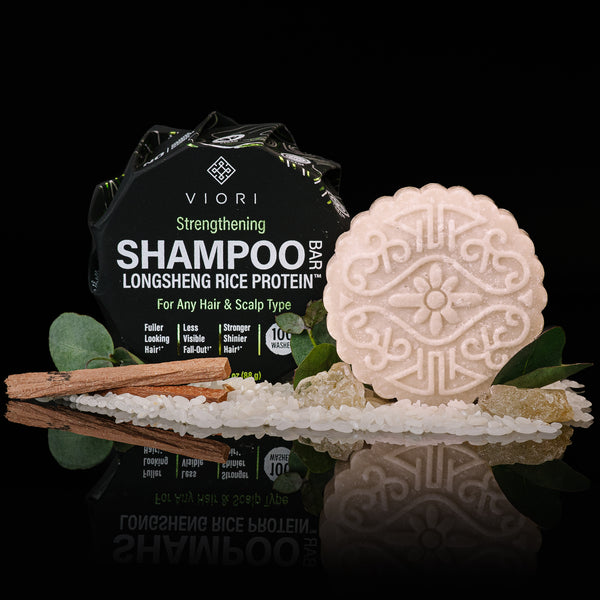
Pick up a well-crafted plant-based shampoo bar, like those from Viori. That solid form you're feeling? It's not just ingredients mashed together. You're holding what chemists call a "crystalline solid-state system"-organized plant molecules working together like microscopic architecture.
The structural components-cocoa butter, shea butter, plant-derived cetyl alcohol-form what we call a "lamellar crystalline phase." Think of it like microscopic playing cards stacking at precise angles. These plant-derived ingredients contain long-chain fatty acids (typically 16-22 carbon atoms) that naturally align in parallel formations. Each molecule has a water-loving "head" and an oil-loving "tail," causing them to self-assemble into organized structures without any forcing or synthetic bonding.
Here's where it gets interesting: cocoa butter exists in six different crystalline forms, each with different melting points. Form V-the most desirable for cosmetics-stays stable at room temperature but melts just below body temperature. That's why your bar softens slightly in warm hands but remains perfectly solid on your shower ledge.
It's not magic. It's precision molecular engineering using compounds that plants evolved over millions of years.
Rice Protein: The Chemistry Nobody Talks About
Let me share something that almost never appears in consumer content: the role of hydrolyzed rice protein as a natural alternative to synthetic conditioning polymers.
NOT SURE WHICH PRODUCT IS RIGHT FOR YOU?
TAKE THE QUIZTakes 30 seconds · 134,000+ customers matched
In conventional liquid shampoos, synthetic quaternary ammonium compounds provide what we call "substantivity"-the ability to stick to hair and condition it. But in plant-based bars containing fermented rice water and hydrolyzed rice protein, like Viori's formulations, something far more elegant happens.
What Fermentation Actually Does
During fermentation-a process the Red Yao women have perfected over centuries-rice undergoes enzymatic breakdown. This isn't just tradition; it's sophisticated biochemistry. The process creates:
- Short-chain peptides (2-20 amino acids long) with exposed amine groups that give them a slight positive charge
- Oligosaccharides from starch breakdown that bind moisture
- Inositol (vitamin B8)-a ring-shaped molecule with six hydroxyl groups perfect for bonding with hair
These components create what I call a "biofilm" on hair that mimics synthetic conditioning polymers with a crucial difference. The peptides, being slightly positively charged at hair's natural pH (around 4.5-5.5), are attracted to negatively charged damaged sites on hair fibers. The multiple hydroxyl groups form hydrogen bonds with your hair's keratin structure, creating a protective layer that's breathable and flexible.
This is fundamentally different from silicone coating. Silicones create an impermeable seal-like wrapping your hair in plastic. The rice-derived complex allows moisture to move in and out while still providing slip, shine, and protection.
The molecular size matters enormously. Too large, and proteins can't penetrate the cuticle. Too small, and they wash away immediately. Fermentation creates the perfect size distribution-large enough to adhere, small enough to penetrate where your hair needs it most.
Why Your Shampoo Bar Behaves Differently in Winter
Here's something that keeps cosmetic chemists awake at night but rarely reaches consumer discussion: how shampoo bars transition between states depending on temperature.
The In-Between Phases
Between fully liquid and fully solid, these bars pass through fascinating intermediate phases called "mesomorphic" or "liquid crystalline" states. Think of them as the molecular equivalent of that stage between ice and water-not quite one, not quite the other.
The vegetable-derived conditioning agent in Viori's formula forms what's called a "lamellar gel network" when combined with fatty alcohols and water. In this structure, water molecules are trapped between double layers of surfactant molecules, and the system exhibits both solid-like and liquid-like properties simultaneously.
This explains something you've probably noticed: shampoo bars feel different depending on your shower temperature.
In cold water, the crystalline structure remains more rigid, making the bar harder to lather. You're asking those organized molecular layers to break apart while they're in their most stable state.
In warm water, you're accessing those mesomorphic phases where the bar becomes more fluid at its surface, releasing ingredients more readily. The molecular layers loosen up, becoming more willing to transfer ingredients from bar to hair.
This isn't a flaw-it's physics. Understanding it helps you optimize your technique for different conditions.
Ancient Fermentation Meets Modern Biochemistry
The fermentation of Longsheng rice-a cornerstone of Viori's formulation-involves a complex cascade of enzymatic reactions that fundamentally transforms the rice's chemical profile. As someone who's studied both traditional practices and modern cosmetic chemistry, I find this intersection absolutely fascinating.
What Happens During Those 7-10 Days
During fermentation, naturally occurring microorganisms (primarily lactobacilli and yeasts) perform several critical transformations:
Enhanced Protein Breakdown: Microbial enzymes break down rice proteins more completely than water extraction ever could. This creates a peptide profile with specific molecular weights optimized for hair penetration-not too big, not too small, just right.
Vitamin Amplification: Here's something remarkable-fermentation doesn't just preserve existing B vitamins, it actually increases their concentration. Yeast cells synthesize additional pantothenic acid (B5) and biotin (B7), while enzymes break down phytic acid to release inositol. You end up with more beneficial compounds than you started with.
Antioxidant Liberation: Bound phenolic compounds trapped in the rice are released by microbial enzymes, increasing antioxidant capacity. These polyphenols help protect hair keratin from oxidative damage caused by environmental stressors, UV radiation, and even oxidative stress from coloring treatments.
Natural pH Optimization: The production of lactic acid during fermentation naturally brings the pH down to 3.5-4.5-almost exactly the optimal range for hair care. This acidic environment helps seal the hair cuticle and maintain the integrity of the disulfide bonds that give hair its structure and strength.
The Red Yao women perfected this process long before we had the scientific vocabulary to explain why it works. Modern analysis simply confirms the biochemical sophistication of what they already knew.
The Surfactant Story: Why Solid Form Changes Everything
Sodium cocoyl isethionate (SCI)-the primary cleanser in plant-based shampoo bars-behaves dramatically differently in solid bar format compared to liquid shampoos.
Controlled Release Through Matrix Dissolution
In bar form, SCI exists as crystalline particles dispersed throughout the fatty alcohol matrix. When water contacts the bar surface, a fascinating sequence unfolds:
- Surface hydration: Water molecules penetrate the outer crystalline layers
- Localized dissolution: SCI begins dissolving, but only in the immediate surface layer where water is present
- Micelle formation: As SCI molecules separate, they spontaneously form spherical micelles-nano-scale structures that trap oil and dirt in their cores while remaining water-soluble on their exteriors
- Controlled delivery: The surrounding fatty alcohols modulate the rate of SCI release, preventing the "burst release" common in liquid formulations
This controlled release mechanism means you're never overwhelming your hair with surfactant. The traditional problem with liquid shampoos-over-application leading to excessive stripping of natural oils-is physically constrained by the solid format. You literally cannot release as much surfactant at once, no matter how enthusiastically you lather.
The Built-In pH Buffer System
Something remarkable happens when you combine cetyl alcohol, stearic acid, SCI, and sodium lactate in Viori's formula: you create a multi-tiered pH buffering system that automatically adjusts to varying conditions.
- The fatty acids buffer in the pH 4-6 range through their carboxyl groups
- Sodium lactate buffers in the pH 3.5-5 range through the lactic acid/lactate equilibrium
- The amine groups in hydrolyzed proteins contribute additional buffering capacity
This means the shampoo bar naturally resists pH shifts when mixed with different water conditions or hair types. Hard water with high mineral content? The buffer system compensates. Chemically treated hair with elevated pH? The buffer system helps restore the optimal acidic environment that keeps cuticles sealed and hair healthy.
Bamboo Extract: Nature's Structural Reinforcer
Let me share one of my favorite underappreciated components in advanced plant-based formulations: bamboo extract, specifically its bioavailable silica content.
Silica Your Hair Can Actually Use
Bamboo contains remarkably high concentrations of silica (up to 70% of dry weight in some species), but more importantly, it contains this silica in a bioavailable form called orthosilicic acid. This matters because most silica compounds are poorly absorbed by biological tissues-they just wash away.
Research in hair science has shown that orthosilicic acid can:
- Penetrate the hair shaft through the cuticle layer during washing
- Form stable complexes with keratin proteins through hydrogen bonding
- Cross-link adjacent keratin chains, effectively reinforcing the internal structure of damaged hair
- Increase hair elasticity by creating a more flexible protein network
This is fundamentally different from external coating. You're achieving structural reinforcement from within the hair fiber itself-what materials scientists call "biomimetic mineralization."
The time-dependent nature of this effect explains why users of plant-based bars containing bamboo extract often report that results improve over 2-3 months of consistent use. You're gradually building up the silica content within the hair structure itself, creating stronger, more elastic hair from the inside out.
The "Preservative-Free" Question: Let's Get Technical
Let's address something that's often oversimplified in marketing: the claim that shampoo bars don't need preservatives.
The Truth About Microbiological Stability
The reality is more nuanced and more interesting. Shampoo bars achieve microbiological stability through multiple mechanisms working together:
Low Water Activity: In their finished form, properly formulated bars have water activity below 0.6. Most bacteria require water activity above 0.91 to grow, and most molds need above 0.80. The bar simply doesn't have enough available water to support microbial life.
Hurdle Technology: Rather than relying on a single preservative, the formulation creates multiple "hurdles" that microorganisms must overcome:
- Low pH from organic acids
- Low water activity
- Natural antimicrobials in some plant extracts
- High concentration of fatty alcohols that disrupt microbial cell membranes
Sodium Lactate's Dual Role: Listed primarily as a humectant and hardening agent, sodium lactate also provides antimicrobial effects through pH reduction and the ability of undissociated lactic acid to cross microbial cell membranes and disrupt their internal pH.
WHAT CUSTOMERS ARE SAYING
Real reviews for Rice Water Shampoo Bar – All Hair Types | VIORI
However-and this is critical for users-once the bar becomes wet and stays wet, water activity increases, and the preservation system can be compromised.
This is why storage between uses is crucial. The bar must be allowed to dry completely. As water evaporates, the crystalline structure reforms, re-establishing the low water activity that prevents microbial colonization. A well-draining soap dish isn't just a nice-to-have; it's essential for maintaining the bar's stability and longevity.
The Interface Chemistry: What Happens When Bar Meets Hair
When you rub a shampoo bar on wet hair, you're creating a three-phase system: solid bar, aqueous layer, and hair fiber. The chemistry occurring at these interfaces determines whether the product works well or poorly.
The Hydration Shell
As water contacts the bar surface, it doesn't simply dissolve ingredients randomly. It forms a structured hydration shell where water molecules organize themselves around the surfactant heads in specific orientations. This is sometimes called "structured water" or "bound water"-water that doesn't behave like the bulk water from your shower. It has different viscosity, different properties, different behavior.
This hydration shell serves as the transfer medium, carrying dissolved ingredients from the bar to your hair surface. The thickness of this layer (typically 50-200 nanometers) and its composition depend on:
- Water temperature (warmer = thicker, more active)
- Pressure applied during application
- Duration of contact
- Water hardness (mineral content)
The Three-Stage Adsorption Process
Once ingredients reach your hair surface, they must attach before they can provide benefits. This happens in three distinct phases:
Initial rapid adsorption (0-30 seconds): Positively charged components quickly attach to negatively charged damage sites on hair. This is the immediate "grab" phase.
Slower penetration phase (30 seconds - 5 minutes): Smaller molecules like inositol, panthenol, and short-chain peptides begin penetrating through the cuticle, especially if it's slightly raised (which warm water encourages).
Rearrangement phase (occurs after rinsing): After water is removed, adsorbed molecules rearrange to optimize their interaction with the hair surface, similar to how proteins fold into their final functional shape after synthesis.
This is why leaving conditioning products on for a few minutes provides demonstrably better results-you're allowing time for the penetration and rearrangement phases to complete.
The Water Chemistry Variable: Why Location Matters
One of the most overlooked factors in shampoo bar performance is something completely out of the product's control: your water chemistry, particularly hardness (calcium and magnesium ion concentration).
The Hard Water Challenge
In hard water (above 120 mg/L calcium carbonate equivalent), calcium ions can interact with negatively charged components in the formulation, forming insoluble precipitates. This is the chemistry behind "soap scum"-that filmy residue that's so frustrating.
However, SCI-the primary surfactant in quality plant-based bars-is significantly less susceptible to this than traditional soaps because its chemical structure doesn't bind as strongly


