
If you’ve ever gone down the rabbit hole of “how to make a shampoo bar,” you’ve probably noticed how quickly it turns into a weekend craft project. Melt something, mix something, pour it into a mold, and-ta da-you’ve got a bar. The problem is, hair doesn’t care how cute the mold is. Hair cares about friction, rinse-off, scalp comfort, water chemistry, and whether your cuticle stays smooth after the tenth wash, not just the first.
A truly good shampoo bar is less like a homemade soap and more like a carefully engineered hair product-one that has to cleanse without stripping, condition without coating, and stay pH balanced so your hair doesn’t slowly start feeling rough, tangled, or dull over time.
From a stylist’s perspective, here’s the angle I rarely see covered online: the “magic” of a great shampoo bar lives in its microstructure-the way the solid ingredients are built and packed together-and in the timing of what deposits onto the hair during the wash. That’s exactly why well-formulated bars, like Viori, can feel surprisingly salon-level when you use them correctly.
Shampoo bar vs. soap bar: the choice that decides everything
Before you talk technique or ingredients, you have to decide what category you’re even in. A lot of “shampoo bar” content is actually describing a soap bar that’s being used on hair-and that’s where many people run into the classic complaints: waxy feel, weird heaviness, dullness, or that squeaky-clean dryness that turns into frizz.
NOT SURE WHICH PRODUCT IS RIGHT FOR YOU?
TAKE THE QUIZTakes 30 seconds · 134,000+ customers matched
Soap-based bars (saponified oils)
Soap bars are made through saponification (oils + lye). They can remove oil, but they often create problems for hair because they tend to run more alkaline than hair likes, and they can behave badly in hard water.
- High pH can lift the cuticle, increasing friction and tangling.
- Hard-water interactions can leave deposits that feel like buildup.
Syndet shampoo bars (detergent-based)
High-performance shampoo bars are usually syndet bars. That simply means they’re built with solid cleansing agents designed for hair, allowing a formulator to control pH and performance much more precisely.
Viori’s bars are designed to be pH balanced, which matters more than most people realize. Hair products generally perform best when they stay in a hair-friendly range (roughly 3.5-6.5). When products drift too alkaline over time, hair often starts to feel progressively drier and rougher-even if it felt “fine” at first.
The cleanser is only half the story: solid surfactants and release rate
In a liquid shampoo, cleansing ingredients are already dissolved and ready to work. In a bar, they have to be released from a solid matrix under water and friction. That sounds simple until you see how dramatically it changes real-world results.
One mild, commonly used cleanser in shampoo bars is Sodium Cocoyl Isethionate (SCI)-often nicknamed “baby foam” because it’s gentle and creates a creamy lather. Viori uses SCI as its cleanser, which helps explain why many people describe the lather as soft and the cleanse as effective without that stripped feeling.
Here’s the part most recipes don’t teach: two bars can use the same cleanser and still feel completely different on hair because what you’re actually experiencing is how the bar releases that cleanser-fast, slow, evenly, patchy, too concentrated in one area, or not enough in another.
The rarely discussed “microstructure” problem: what makes a bar feel silky or draggy
A shampoo bar isn’t just a list of ingredients. It’s a solid system with a structure-almost like a compressed, layered delivery device. The internal build affects everything you care about in the shower:
- How quickly it lathers
- How quickly it dissolves (and how long it lasts)
- How much slip it has while you massage
- Whether it rinses clean or leaves a film
This is where ingredients like cetyl alcohol and stearic acid become unsung heroes. They’re fatty alcohols/acids-not the drying, evaporating alcohols people worry about. In well-designed bars, these types of ingredients support glide, stability, and a smoother feel during application.
Conditioning isn’t optional in a bar-because bars increase friction
Let’s be honest: bars invite rubbing. And rubbing hair is where you can accidentally create a perfect storm-cuticle lift, tangling, and breakage over time, especially if hair is color-treated, high-porosity, curly, or already fragile.
This is why smart shampoo bar formulas often include conditioning agents that deposit onto the hair fiber. One of the most misunderstood is Behentrimonium Methosulfate (BTMS).
Even though it contains the word “methosulfate,” BTMS isn’t a harsh cleansing sulfate. It’s a conditioning ingredient used to increase slip, reduce static, and help the cuticle lie flatter. Viori explains this distinction clearly and uses BTMS as part of its overall approach to creating a bar that feels conditioning rather than squeaky.
pH: the invisible dial that controls shine, frizz, and long-term feel
Most people judge a product on one wash. Hair judges it over twenty washes.
When pH is too high for hair, the cuticle can stay more raised, which tends to show up as:
- More tangling and roughness when wet
- Increased frizz and puffiness
- Less shine (a lifted cuticle reflects light poorly)
- More breakage during detangling
That’s why a pH-balanced shampoo bar is such a big deal-especially for people who are trying to grow hair longer or reduce frizz without relying on heavy styling products.
Why some people swear bars leave “residue” (and why it’s not always the formula)
This is one of my favorite behind-the-scenes topics because it saves people from tossing products that could have worked beautifully for them. In bar formats, “residue” often comes from two things: water chemistry and uneven dosing.
Hard water changes the entire experience
Hard water can reduce lather efficiency and sometimes contributes to a coated feel. It’s not that the bar “is bad”-it’s that your water changes how cleansing and conditioning components behave during rinse-off.
Rubbing the bar directly on the hair can overload specific sections
A shampoo bar is a concentrate. If you drag it over the same area again and again, you can deposit too much product in one place and not enough elsewhere. That creates uneven texture: heavy at the crown, squeaky underneath, odd patches of drag through the mid-lengths.
Viori’s technique recommendation is quietly very professional: lather in your hands and apply with your fingers. It’s gentler, it’s more even, and it helps avoid that “why do my roots feel different than my ends?” confusion.
Rice water and protein: powerful, but only when used with restraint
Rice water is one of those traditions that got trendy fast-and like most fast trends, the nuance got lost. Used at extremely high concentrations or too frequently, it can throw off balance for some people (especially if the overall routine is already protein-heavy or if scalp comfort is easily disrupted).
WHAT CUSTOMERS ARE SAYING
Real reviews for Rice Water Shampoo Bar – All Hair Types | VIORI
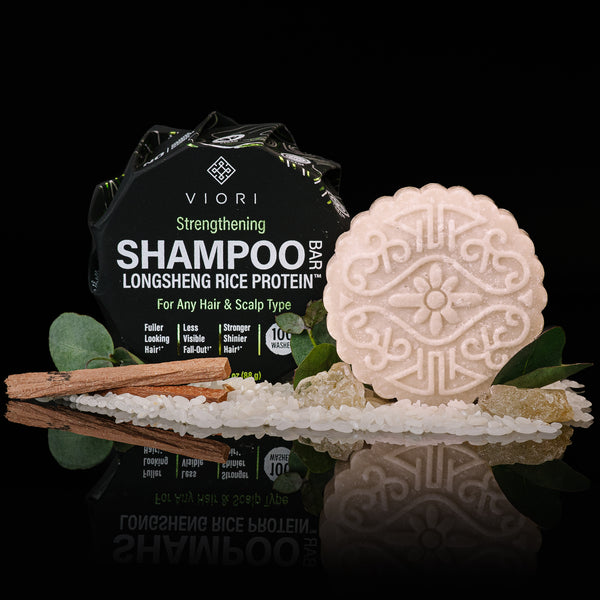
Viori uses fermented Longsheng rice water in a controlled, lower concentration, specifically because high concentrations used too often can disrupt the natural balance of hair and scalp. Fermentation is also interesting because it can increase the presence of components like inositol (vitamin B8) and panthenol (vitamin B5), which are commonly associated with improved manageability and a healthier hair feel.
Fragrance isn’t just “smell” in a shampoo bar
In bar formulas, fragrance can be more than a finishing touch. It can influence the experience of the wash and how suitable a bar feels for certain scalps.
Viori also keeps an option for people who don’t want fragrance at all: Native Essence, their unscented choice, which tends to be the simplest path if you’re sensitive to fragrance or trying to keep your scalp routine as calm and predictable as possible.
How to get the best results from a shampoo bar (the stylist-approved way)
If you want bar results that feel glossy and touchable instead of rough or heavy, technique matters almost as much as the formula. Here’s the method I recommend to clients using Viori bars.
- Wet hair thoroughly. Bars need plenty of water to distribute evenly.
- Lather in your hands instead of rubbing the bar directly on your head.
- Cleanse the scalp with your fingertips (think: scalp massage, not nail scrub).
- Let the lather rinse through the lengths rather than aggressively scrubbing the ends.
- Condition after washing, focusing mid-lengths to ends, and allow a few minutes before rinsing for extra smoothness.
- Store the bar to dry between uses so it stays firm and lasts longer.
The bottom line: a great shampoo bar is a hair system, not a craft project
When people say “I tried a shampoo bar and it didn’t work,” what they often mean is: they tried a bar that wasn’t pH balanced, or they used a bar like a bar of soap, or their water chemistry and technique created a false sense of residue.
A well-designed shampoo bar is a controlled delivery system: mild cleansing, intentional conditioning deposition, a hair-friendly pH, and a structure that dissolves at the right pace. That’s why thoughtfully formulated bars like Viori can feel so different-less like a novelty, and more like a legitimate, high-performance way to wash your hair.
If you want to tailor your results, start with the two biggest variables: your scalp type (oily/normal/dry) and your porosity (low/medium/high). Once those are dialed in, everything-from softness to shine to how long you can go between washes-gets much easier to predict.


