
After twenty years behind the salon chair, I've heard the same question thousands of times: "What's the best smelling shampoo?" But here's the truth-that's actually the wrong question to ask.
What you should be asking is: "Which shampoo fragrance will work with my unique hair type, scalp chemistry, and lifestyle?" This shift in thinking transforms shampoo selection from a guessing game into a personalized science. And once you understand the chemistry behind fragrance and hair, you'll never choose a shampoo the same way again.
Why the Same Shampoo Smells Different on Everyone
Have you ever borrowed a friend's shampoo, loved how it smelled on her, but found it disappointing on your own hair? You're not imagining things. Your scalp's pH level, oil production, and natural microbiome literally change how fragrance molecules express themselves on your hair.
The Oil-Fragrance Connection
Women with oily scalps experience fragrance completely differently than those with dry scalps. This comes down to basic chemistry: sebum (your scalp's natural oil) is lipophilic, meaning it attracts and binds with oil-based fragrance molecules.
Citrus-based scents, for instance, interact beautifully with excess sebum. The natural acids in citrus compounds work synergistically with oily hair chemistry, which is why fresh, bright scents often smell cleaner and more vibrant on women with oilier scalps. The fragrance molecules are literally working with your scalp's natural chemistry rather than against it.
On the flip side, if you have a dry scalp, you lack this natural medium for fragrance suspension. This is where deeper base notes-like vanilla, musk, or amber-shine. These heavier molecules don't require as much natural oil to "bloom." Instead, they can adhere directly to the hair shaft itself through hydrogen bonding with your hair's natural proteins.
Understanding this simple principle can save you from buying shampoos that smell amazing in the store but disappoint when you actually use them.
The Hot Shower Effect Nobody Talks About
Here's something that will completely change how you think about shampoo fragrance: your shower temperature is actively working against certain scent components.
Most of us shower in water between 105-110°F. At these temperatures, fragrance compounds don't just sit there-they volatilize, meaning they turn into vapor at different rates depending on their molecular weight.
Top notes (citrus, green, light florals) evaporate within seconds of contact with hot water. They give you that initial burst of scent, then they're gone.
NOT SURE WHICH PRODUCT IS RIGHT FOR YOU?
TAKE THE QUIZTakes 30 seconds · 134,000+ customers matched
Middle notes (jasmine, rose, ylang-ylang) emerge as the water temperature cools slightly on your hair shaft.
Base notes (vanilla, amber, sandalwood, musk) persist because they have higher molecular weights and lower vapor pressure-they're not easily bullied by heat.
This is the real reason a shampoo might smell incredible in the bottle but underwhelming in your shower. You're experiencing rapid top-note loss before the deeper, more complex notes have time to develop. The truly "best smelling" shampoo isn't the one with the strongest initial scent-it's the one with balanced fragrance architecture that accounts for this thermal cascade effect.
Natural Fragrance: The Sustainability Secret the Industry Won't Tell You
Let's address the elephant in the room: the beauty industry has convinced us that "all-natural essential oils" are automatically superior to anything labeled "fragrance." But from both a sustainability and performance standpoint, this oversimplification misses the mark.
Certain pure essential oils-particularly sandalwood, rosewood, and jasmine absolute-require enormous amounts of plant material. We're talking thousands of pounds of flowers to create a single pound of essential oil. This level of extraction can contribute to deforestation and ecosystem disruption.
The more sophisticated approach involves what chemists call "nature-identical" fragrance molecules. These are compounds that are molecularly identical to their natural counterparts but synthesized in a lab without environmental destruction.
Here's the fascinating part: your olfactory receptors literally cannot distinguish nature-identical molecules from naturally extracted ones because the molecular structure is the same. A nature-identical vanillin molecule smells exactly like one extracted from vanilla beans because, chemically speaking, they are the same thing.
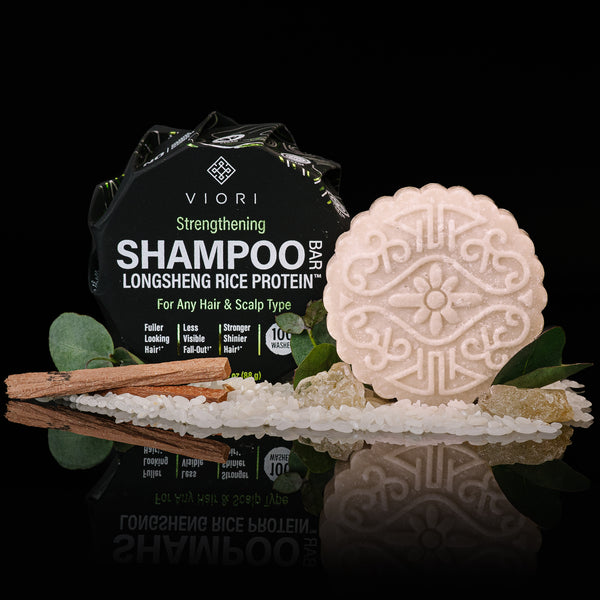
Viori has embraced this approach, using clean fragrance compositions that replicate natural scents molecularly while avoiding the ecological damage of mass essential oil extraction. You get the scent experience you love without the environmental cost.
The Rice Protein-Fragrance Connection
Here's where we get into advanced territory that almost nobody discusses: the proteins in your shampoo are actively affecting how long fragrance lasts on your hair.
Hydrolyzed rice protein-a key component in rice water-based formulations-has amino acid chains with both water-loving (hydrophilic) and oil-loving (hydrophobic) regions. These amphipathic properties allow rice protein to bind fragrance molecules and slow their release from the hair shaft.
Think of it like a time-release capsule for scent. When you use a rice protein-enriched shampoo, the protein forms a microscopically thin film on your hair cuticle. Fragrance molecules become temporarily trapped in this protein matrix, releasing gradually throughout the day as the film is disrupted by movement, humidity, and your hair's natural oils.
This is why rice water shampoos, like those in Viori's collection, often have superior scent longevity compared to formulations without protein complexes. It's not marketing hype-it's biochemistry working in your favor.
pH Balance: The Fragrance Preservation Factor
Most people have no idea that their shampoo's pH level is actively destroying the fragrance before it even has a chance to work.
Shampoos with unbalanced pH-typically too alkaline, above 7.0-cause fragrance degradation through chemical reactions. Specifically, alkaline conditions accelerate oxidative degradation of fragrance aldehydes and terpenes (the compounds that give citrus and floral scents their characteristic aroma).
A properly pH-balanced shampoo (in the 3.5-6.5 range) preserves fragrance integrity in two crucial ways:
- Prevents fragrance oxidation: Neutral-to-slightly-acidic conditions protect delicate fragrance molecules from breaking down
- Maintains cuticle closure: A balanced pH keeps the hair cuticle sealed, trapping fragrance molecules within the hair cortex rather than allowing immediate evaporation
This is why bargain shampoos often smell wonderful in the shower but leave zero residual scent. The pH is wrong, the cuticle opens, and fragrance molecules escape before they can properly bond to your hair structure.
When evaluating a shampoo, pH balance isn't just about hair health-it's fundamental to fragrance performance.
The Three-Phase Fragrance Experience
Professional perfumers think about fragrance in terms of architecture-building a structure that evolves over time. The same principle applies to choosing the right shampoo scent.
Phase 1: Wet Hair (0-5 minutes)
This is your "top note burst"-bright, volatile compounds like citrus oils, green notes, or light fruits. These are designed for immediate impact but aren't meant to last. This is the initial impression.
Phase 2: Drying Hair (5-30 minutes)
Middle notes emerge: florals, spices, more complex aromatics. This is actually the most critical phase for satisfaction because it's what you're experiencing while styling. If the middle notes are discordant or weak, you'll feel like the shampoo "lost its scent."
Phase 3: Dry Hair (30 minutes - 24 hours)
Base notes dominate: woods, musks, vanilla, amber. These provide the subtle, lasting impression that makes people say "your hair smells amazing" hours after washing.
A truly exceptional shampoo successfully manages all three phases without discord between them. The scent should evolve naturally, not disappear abruptly or shift jarringly from one phase to another.
Matching Fragrance to Your Hair Type: A Professional Framework
Here's something you won't find in typical beauty articles-a technical framework for matching fragrance profiles to your specific hair structure:
Fine Hair
Optimal Fragrance Profile: Light florals, green notes, citrus
Why It Works: Fine hair has less surface area and cuticle mass to hold fragrance molecules. Lighter, more volatile compounds create adequate scent presence without overwhelming the limited binding sites available. Heavy musks or deep vanillas can actually smell too strong on fine hair because there's not enough hair mass to balance them out.
Thick/Coarse Hair
Optimal Fragrance Profile: Rich musks, deep florals, woody bases, vanilla
Why It Works: Thick hair has expanded cuticle structures with more protein binding sites. Heavier fragrance molecules can anchor effectively to these abundant sites, creating lasting, complex scent development. Light citrus notes may seem to disappear almost immediately on thick hair.
Curly/Textured Hair
Optimal Fragrance Profile: Creamy, rich bases-vanilla, shea, amber notes
Why It Works: Curly hair typically has higher porosity, meaning fragrance molecules can penetrate deeply into the cortex but also escape quickly. Heavier base notes have lower volatility and remain trapped in the complex curl structure longer. Plus, the natural volume of curly hair creates more air circulation, which can strip lighter fragrances too quickly.
Understanding this matching principle is transformative. It explains why your straight-haired friend raves about a shampoo that does nothing for your curls, or why the citrus scent you love smells completely different on your sister's fine hair versus your thick mane.
Your Water Quality Is Sabotaging Your Fragrance
This is perhaps the most overlooked technical factor in shampoo scent satisfaction: your water's mineral content fundamentally alters how fragrance expresses itself.
Hard water (high in calcium and magnesium) creates insoluble complexes with certain fragrance molecules, particularly aldehydes and ketones. These minerals can completely neutralize top notes before you even smell them. Hard water also creates soap scum and mineral buildup on the hair shaft that physically blocks fragrance molecules from binding to the cuticle.
Soft water allows fragrance molecules to express more freely, but can lead to over-lathering and residue that traps fragrance in a soapy film rather than allowing it to bond with hair proteins.
If you've moved to a new city and suddenly your favorite shampoo doesn't smell the same, this is likely why. The "best smelling" shampoo for you depends partly on your local water chemistry-something fragrance marketing never mentions but makes an enormous practical difference.
Why Your Favorite Scent Stops Working: The Habituation Problem
Have you noticed that the shampoo that smelled incredible the first week becomes somehow "meh" by week four? You're not imagining it, and the shampoo hasn't changed.
Your brain has.
From a neurological perspective, your olfactory receptors undergo something called "sensory adaptation" or habituation. When exposed repeatedly to the same fragrance compounds, your brain literally down-regulates the receptors responsible for detecting them. It's an evolutionary mechanism designed to help you notice new scents (potential threats or food sources) rather than wasting neural resources on familiar ones.
Professional Strategy: Rotate between two complementary fragrance profiles. For example, alternate between a fresh citrus formulation and a warm vanilla one. This prevents complete olfactory habituation while allowing your sensory system to "reset" between uses. You'll enjoy both fragrances more than if you used either one exclusively.
Scalp Conditions and Fragrance Selection
Different scalp conditions require different fragrance considerations-not just for comfort, but for actual therapeutic compatibility:
Dry Scalp/Dandruff
Avoid: High concentrations of citrus oils (which can be further drying)
Choose: Soothing bases-vanilla, light musks, subtle florals
WHAT CUSTOMERS ARE SAYING
Real reviews for Rice Water Shampoo Bar – All Hair Types | VIORI
Why: These fragrances don't contain high percentages of alcohol-based top notes that can exacerbate dryness
Oily Scalp/Seborrheic Issues
Optimal: Citrus, green, fresh aquatic notes
Why: These fragrance families often contain compounds with mild astringent properties that complement oil-control without being harsh
Sensitive/Eczema-Prone Scalp
Safest: Minimal fragrance with hypoallergenic testing
Why: Even "natural" essential oils can trigger immune responses in sensitive individuals. Tea tree, eucalyptus, and peppermint-often touted as "healing"-are actually common allergens.
The Seasonal Fragrance Shift
Professional perfumers know that fragrance perception changes dramatically with ambient temperature and humidity. The same principle applies to choosing shampoo scents:
Summer/Humid Climates
Best choices: Lighter, citrus-forward, green, aquatic notes
High temperatures increase fragrance volatility-molecules evaporate faster. You need fresh, bright top notes that can "punch through" heat. Additionally, humidity can make heavy vanilla or amber bases smell cloying or oppressive because the moisture in the air traps heavier molecules close to your scalp.
Winter/Dry Climates
Best choices: Richer, warmer bases-vanilla, amber, deeper florals
Cold air slows fragrance volatility, so you need deeper notes with more tenacity to create noticeable scent. Dry air also doesn't carry scent molecules as effectively-richer compositions compensate for this physical limitation.
If you live in a climate with dramatic seasonal shifts, consider having a "summer" and "winter" shampoo rotation based on fragrance profile, not just moisture level.
Color-Treated Hair: The Fragrance Factor Nobody Mentions
Here's insider knowledge that connects scent choice directly to hair health outcomes: certain fragrance components can affect color longevity in dyed hair.
Fragrance aldehydes-particularly citral and citronellal (common in citrus scents)-can have mild oxidative effects. On color-treated hair, especially with semi-permanent dyes, this can accelerate color fade.
This doesn't mean you should avoid citrus scents if you color your hair. It means understanding the chemistry allows for informed choices. If you're trying to preserve vibrant fashion colors or expensive balayage, you might choose formulations with antioxidant fragrance components-vanilla, certain florals with phenolic compounds-which may actually provide mild protective effects against color oxidation.
Viori's natural approach to fragrance works particularly well for color-treated hair because their formulations avoid harsh synthetic aldehydes that can strip color while providing the protein support color-treated hair desperately needs.
Clean Fragrance Chemistry: Beyond the "Natural vs. Synthetic" Debate
Modern fragrance chemistry has evolved beyond the crude "synthetic versus natural" argument into something far more sophisticated:


