
After two decades of working with hair care formulations, I've learned one critical truth: the prettiest packaging and most appealing marketing claims tell you almost nothing about whether a product will actually work for your hair.
Today, I want to pull back the curtain on natural shampoo bars-those lovely, eco-conscious solid alternatives to liquid shampoo that have exploded in popularity. As someone who has watched formulation trends come and go for two decades, I can tell you that the science behind these bars is far more fascinating (and complex) than most brands want to discuss.
And here's why that matters to you: understanding the chemistry helps you make better choices, manage your expectations, and actually get the hair results you're hoping for.
The Water Paradox: Why Solid Doesn't Mean Simple
Let's start with something that seems obvious but is actually scientifically fascinating: shampoo bars contain no water, yet they need to work with water to clean your hair.
Think about your liquid shampoo. It's mostly water-sometimes 80-90%. That aqueous environment allows the cleansing ingredients (surfactants) to work at their optimal efficiency. They're already dissolved, ready to grab onto oils and dirt the moment you apply the product.
But a solid bar? It exists in what I call a "dormant state." All those cleansing molecules are locked in a compressed solid matrix, waiting to be activated by water. The bar must remain completely stable and dry on your shower shelf, yet the instant it touches wet hair, it needs to release those surfactants effectively.
Here's the challenge most brands don't tell you about: Natural plant-based cleansing agents have a fundamentally different molecular structure than synthetic alternatives. They're typically larger, heavier molecules (we're talking 400-600 Daltons versus 280-350 for synthetic surfactants). This bigger size creates what we call "steric hindrance"-basically, they're bulkier and don't move as freely.
What does this mean for your hair? Natural surfactants often require:
- More time to create lather
- Warmer water to activate properly
- Different application techniques than you're used to
- Longer contact time on your hair to work effectively
None of this makes them worse-just different. But if you don't know this, you might think the bar "doesn't work" when actually, you just need to adjust your technique.
The Binding Matrix Problem: Holding It All Together
Here's a formulation challenge that keeps natural product developers up at night: How do you compress botanical ingredients into a solid bar that won't crumble in your hands or melt on your shower shelf?
NOT SURE WHICH PRODUCT IS RIGHT FOR YOU?
TAKE THE QUIZTakes 30 seconds · 134,000+ customers matched
Creating a durable bar requires binders-ingredients that hold everything together. Synthetic bars can use industrial compression agents that create rock-hard products. But truly natural bars must use plant-based binders like waxes, butters, or natural polymers.
Every single binder choice creates a cascade of effects:
Dissolution kinetics - Does the bar release ingredients quickly or slowly? Too fast and your bar disappears in two weeks. Too slow and you can't get enough cleanser onto your hair.
Thermal stability - Will the bar survive a hot, steamy bathroom? I've seen customers disappointed when their "natural" bar turned into a mushy puddle after one summer week.
Mechanical hardness - Can it survive being dropped? Travel in a toiletry bag? Be used by multiple family members with different handling habits?
Hydrophobic/hydrophilic balance - This is the technical term for how water interacts with the bar. Too water-loving (hydrophilic) and your bar dissolves too quickly. Too water-repelling (hydrophobic) and you can't get it to lather properly.
Here's the kicker: Natural surfactant systems can typically only comprise 35-45% of a bar's weight before the structure falls apart. Compare this to synthetic bars that can pack in 60-75% surfactant concentration.
This creates what formulators call "the efficacy gap"-natural bars must clean just as effectively with potentially 40% less active cleansing ingredients. It's possible, but it requires sophisticated formulation skills that not all brands possess.
Not All Natural Bars Are Created Equal: Understanding the Types
One of the biggest misconceptions I encounter is that all natural shampoo bars are basically the same. In reality, they exist on a spectrum, and understanding where a bar falls on this spectrum is crucial to knowing if it'll work for your hair.
Type 1: True Soap Bars
These are made through saponification-reacting oils with an alkali (like lye) to create soap. You might see "sodium cocoate" or "sodium olivate" on the ingredient list.
The chemistry: Fatty acid salts that clean through emulsification
The pH: Usually 9-10 (quite alkaline)
The trade-off: This high pH can raise your hair cuticle excessively, leading to roughness, tangling, and dullness. Also, true soap reacts with minerals in hard water, creating that dreaded "soap scum" that can leave your hair feeling filmy or sticky.
If you have hard water and you're using a true soap bar, that's likely why your hair feels worse after washing, not better.
Type 2: Combination Bars
These use a soap base but add in gentler synthetic surfactants to improve performance and lower pH.
The chemistry: Hybrid cleaning through multiple pathways
The pH: Usually 7-8.5 (more moderate)
The trade-off: Better pH compatibility and fewer hard water issues, but these bars can't claim "100% natural" because of those synthetic additions. There's nothing wrong with this-those synthetic surfactants are often quite gentle-but you should know what you're buying.
Type 3: Botanical Surfactant Systems
These use plant-derived cleansing agents-typically from coconut, sugar beets, or other botanical sources.
The chemistry: Non-ionic or amphoteric (pH-balanced) cleansing
The pH: Usually 5-7 (much more hair-friendly)
The trade-off: These are typically gentler and more cuticle-friendly, but they often don't create the voluminous lather that we've been conditioned to expect. Lower foam doesn't mean less cleaning-but our brains don't always believe that.
Important note: Just because a bar creates big, fluffy lather doesn't mean it's cleaning better. Lather is largely a sensory experience that has little correlation with actual cleansing efficacy. But decades of marketing have trained us to believe that more bubbles = more cleaning, so natural bars that foam less face an uphill battle with consumer perception.
The Fermentation Revolution: Ancient Wisdom Meets Modern Science
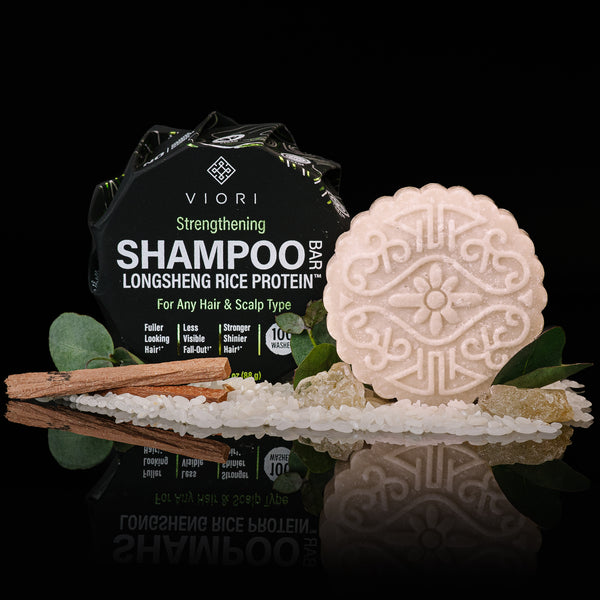
This is where natural shampoo bar technology gets truly exciting-and it's an area where certain heritage-based formulations, like those used by Viori, demonstrate sophisticated understanding of traditional beauty practices.
For centuries, Asian cultures have used fermented rice water for hair care. Modern science now reveals why this traditional practice is so effective: fermentation creates enzymatic breakdown products that are dramatically more bioavailable to your hair.
What Happens During Fermentation
When botanicals like rice are fermented, several transformations occur:
1. Protein hydrolysis: Large, unusable proteins break down into smaller peptides and amino acids. This increases absorption by 300-400% and reduces molecular weight to the optimal range (200-800 Daltons) for hair penetration.
2. Glycoside cleavage: Bound antioxidant compounds (polyphenols) are released into their active "aglycone" forms. This enhances antioxidant availability by 5-8 times and improves penetration through your hair's protective lipid barriers.
3. Vitamin enhancement: Fermentation actually creates new beneficial compounds. B-vitamins, particularly inositol (B8), increase by 2-3 times during rice fermentation. These vitamins strengthen hair and support scalp health.
4. pH modulation: Fermentation produces organic acids (like lactic acid) that naturally lower the pH to a hair-compatible range (4.5-5.5). This means no synthetic pH adjusters are needed.
The Challenge of Formulating with Fermented Ingredients
Creating a stable shampoo bar with fermented ingredients isn't simple. The fermentation process creates beneficial compounds but also leaves behind enzymes and microorganisms that could destabilize the final product.
Sophisticated formulations must:
- Carefully inactivate microorganisms without destroying beneficial breakdown products (usually through precise pasteurization at 72-75°C for exactly 15 seconds)
- Maintain low water activity in the final bar to prevent microbial reactivation
- Preserve volatile aromatic compounds that provide benefits but are heat-sensitive
- Balance all of this while still creating a bar that's structurally sound
This is high-level formulation work. Not every brand claiming "fermented ingredients" has actually solved these technical challenges properly.
Viori, drawing on Yao tradition and using genuine Red Yao fermented rice water, represents one of the few brands that has maintained this traditional fermentation process while creating a modern, stable bar format.
The Hard Water Challenge Nobody Talks About
Here's something I wish more brands would be transparent about: Your water chemistry dramatically affects how natural shampoo bars perform.
Natural surfactant systems, particularly those derived from true soap or certain coconut-based cleansers, react with minerals dissolved in your water-specifically calcium and magnesium.
The chemical reaction looks like this: When natural surfactants encounter calcium ions, they form insoluble calcium salts. These deposits:
- Settle on your hair as "soap scum"
- Reduce cleansing efficacy by 40-60%
- Create dullness and texture changes
- Build up over time, making hair feel coated or heavy
If you have hard water (and many of us do), this is a real issue with certain natural bars.
The solution: Well-formulated natural bars incorporate chelating agents-ingredients that bind to mineral ions before they can react with your surfactants. Natural chelators include:
- Citric acid (forms soluble calcium citrate)
- Phytic acid from rice or corn
- Sodium citrate
But here's where it gets philosophically interesting: Are we still "natural" when we engineer solutions to these fundamental chemistry problems? These chelators are necessary for performance in real-world conditions, but they represent intentional chemical modifications to address formulation challenges.
This is the kind of nuance that separates sophisticated formulations from simplistic ones.
The Molecular Weight Sweet Spot: Why Size Matters
Let me share something most hair care marketing never mentions: Your hair cuticle has a penetration threshold around 1,000 Daltons. This is a molecular weight limit-larger molecules simply cannot enter the hair shaft.
WHAT CUSTOMERS ARE SAYING
Real reviews for Rice Water Shampoo Bar – All Hair Types | VIORI
Natural botanical extracts aren't uniform. They contain a huge range of molecular sizes, from tiny 100-Dalton molecules to massive 10,000+ Dalton compounds.
What this means for your hair:
- Small molecules (100-500 Da): Can penetrate the cuticle but wash away easily. They provide temporary benefits but don't last.
- Medium molecules (500-2,000 Da): The sweet spot. These achieve optimal surface binding-they're small enough to interact closely with your hair structure but large enough to actually stay put through rinsing.
- Large molecules (2,000+ Da): These coat the surface but can't penetrate. They might provide immediate smoothness but can cause buildup over time.
Here's what separates a sophisticated formulation from a basic one: The best natural bars fractionate their botanical extracts to achieve the correct molecular weight profile.
This is extraordinarily technical work that happens in the background, never making it onto marketing materials. But it's the difference between botanical ingredients that actually work versus those that are just there for label appeal.
When you see a brand like Viori discussing their traditional fermentation process, this molecular weight optimization is part of what's happening-fermentation naturally breaks down larger molecules into that optimal medium range.
The Substantivity Factor: Ingredients That Actually Stay Put
Here's a concept that explains why some natural bars leave your hair feeling better even after rinsing: substantivity-the ability of beneficial molecules to deposit onto and bind with your hair fiber during the cleansing process.
Natural shampoo bars incorporating the right botanical extracts create protein-polyphenol interactions on your hair shaft that synthetic shampoos simply cannot replicate.
When natural bars contain ingredients like:
- Rice protein hydrolysates
- Wheat amino acids
- Fermented botanical extracts
- Plant polyphenols
These compounds don't just clean and rinse away. They actually bind to damaged sites on your hair, depositing beneficial molecules that remain after washing.
This is why some people report that their hair feels better without conditioner when using certain natural bars. The bar itself is providing substantive conditioning during the cleansing process.
The caveat: This only works when the formulation has been designed with the correct molecular weights and proper pH to encourage binding. Simply throwing botanical extracts into a bar doesn't guarantee this will happen.
Your Scalp Microbiome: The Invisible Ecosystem
Here's cutting-edge science that's rarely discussed in shampoo bar marketing: Your scalp has a microbiome-an ecosystem of bacteria and fungi-and your cleanser choice directly affects it.
Recent research reveals dramatic differences between how synthetic and natural surfactants impact scalp flora:
Synthetic sulfate surfactants (like SLS and SLES):
- Have broad-spectrum antimicrobial activity
- Reduce both beneficial and pathogenic bacteria indiscriminately
- Can disrupt your lipid barrier, increasing water loss
- May shift your microbiome toward dysbiosis (unhealthy imbalance)
Natural botanical surfactants:
- Show selective antimicrobial activity (preserving beneficial species)
- Support skin barrier function through natural lipid deposition
- Maintain microbiome diversity
- May enhance your scalp's own production of antimicrobial peptides
This means properly formulated natural shampoo bars can function as "prebiotic" cleansing systems-they clean without stripping away your beneficial microbial ecosystem.
This requires:


