
After twenty years in the beauty industry, I've seen countless trends come and go. But the shift toward solid hair care? This isn't just a trend-it's a complete reformation of how we think about hair chemistry. And here's what most people don't realize: creating an effective shampoo bar is exponentially more complex than simply removing water from a liquid formula.
Today, I'm pulling back the curtain on the fascinating science behind solid hair care, and why many traditional beauty brands struggle with this transition-while explaining what makes truly exceptional formulations stand out.
The Water Paradox: Why You Can't Just "Dehydrate" a Liquid Shampoo
Let me start with something that might surprise you: the chemistry of your hair care products fundamentally changes when you remove water.
In liquid shampoos, cleansing agents (surfactants) float happily in a dissolved state within the water matrix. But when you transition to bar format, these same ingredients must be stabilized in a completely different structure-a solid, crystalline form.
This is where things get technically fascinating (and where many brands stumble).
The Surfactant Crystallization Problem
Traditional liquid shampoo surfactants like sodium laureth sulfate (SLES) don't transition well to solid formats for three key reasons:
Phase Transition Instability - They can separate or "sweat" oils when compressed into bars, creating that slippery, melting feeling you might have experienced with lower-quality bars.
pH Drift - Without water acting as a buffer, the pH can shift dramatically when the bar contacts shower water, potentially leaving your hair feeling stripped or tangled.
Lather Inconsistency - The rate at which surfactants release from a solid matrix differs vastly from pre-dissolved liquid systems, often resulting in poor lather or uneven cleansing.
This is why truly effective shampoo bars use specially selected surfactants like sodium cocoyl isethionate (SCI)-a coconut-derived cleanser that naturally exists in a stable solid form. SCI creates that luxurious, creamy lather we all love, without the harsh stripping effect of traditional sulfates.
NOT SURE WHICH PRODUCT IS RIGHT FOR YOU?
TAKE THE QUIZTakes 30 seconds · 134,000+ customers matched
The Conditioning Conundrum: An Even Greater Technical Challenge
Here's something you rarely hear in the beauty industry: conditioner bars are actually MORE technically challenging to formulate than shampoo bars.
Let me explain why.
Liquid conditioners work through a beautifully orchestrated chemical dance:
- Shampoo (negatively charged) removes oils and opens the hair cuticle
- Conditioner (positively charged) deposits conditioning agents on the now-negatively-charged hair shaft
- Water acts as the delivery vehicle for even distribution
But in bar format, you face what I call the "clumping versus coverage problem."
The Technical Balancing Act
When you press conditioning ingredients into a solid bar, they must accomplish something remarkably difficult:
- Release evenly when rubbed on wet hair (not too quickly, creating waste, or too slowly, leaving minimal conditioning)
- Maintain their positive electrical charge in solid form
- Avoid creating waxy, heavy buildup
- Still penetrate multiple layers of the hair cuticle for deep conditioning
The ingredient that changed everything for bar conditioners is behentrimonium methosulfate (BTMS), and here's where ingredient literacy becomes crucial.
Despite its intimidating name that includes "sulfate," BTMS is actually sulfate-free. The "methosulfate" portion refers to the salt formation (the counterion), not a cleansing sulfate group. It's derived from colza plant (rapeseed oil) and functions as a conditioning emulsifier-gentle, effective, and perfect for bar formulations.
This is exactly the kind of ingredient science that separates exceptional formulations from disappointing ones.
Ancient Wisdom Meets Modern Chemistry: The Rice Water Revolution
Now let's talk about what truly elevates certain formulations from good to extraordinary: fermented botanical extracts.
When rice is fermented using traditional methods, something remarkable happens at the molecular level that modern science has only recently begun to understand.
The Fermentation Factor
Here's what occurs during the fermentation process:
Vitamin B Complex Amplification - Fermentation increases beneficial compounds like inositol (Vitamin B8) and panthenol (Vitamin B5) by 2-4 times compared to unfermented rice.
Protein Hydrolysis - Complex rice proteins break down into smaller peptides that can actually penetrate the hair shaft rather than just coating the surface.
pH Optimization - Fermented rice water naturally reaches a pH of 4.5-5.5, which perfectly matches your hair's natural pH.
The Clinical Evidence
Third-party studies on hydrolyzed rice protein reveal impressive results:
- Increased tensile strength - Hair can withstand 15-20% more force before breaking
- Diameter expansion - Individual hair shafts increase 10-15% in diameter, creating natural, beautiful volume
- Cuticle smoothing - Microscopic analysis shows measurably smoother cuticle scale patterns
This is why inositol has earned the nickname "hair growth vitamin"-not because it magically creates new follicles, but because it strengthens existing hair so dramatically that it breaks less, creating the appearance of faster growth.
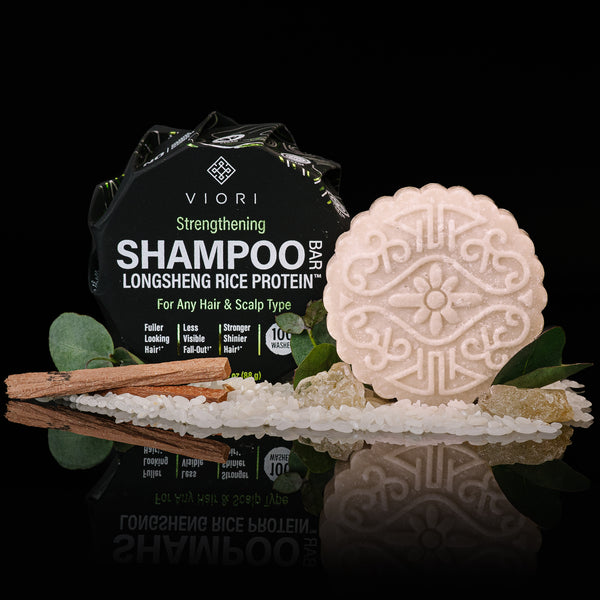
Viori harnesses this ancient Longsheng rice water tradition in their formulations, combining centuries-old wisdom with modern formulation science.
The pH Balance Crisis: A Technical Aspect Most Brands Overlook
Let me share some numbers that will change how you think about your hair care:
- Your scalp's natural pH: 4.5-5.5 (slightly acidic)
- Most traditional bar soaps: 8-10 (alkaline)
- Optimal shampoo bar pH: 5.5-6.5 (slightly acidic to neutral)
Why This Creates Problems
When pH rises above 7 (becoming alkaline), several damaging things happen:
- Hair cuticles open and swell, making hair porous
- Color molecules escape faster (if you have color-treated hair)
- Hair becomes prone to breakage and damage
- Your scalp's protective acid mantle gets disrupted
Here's the technical challenge: many traditional bar-making processes (like the saponification used in soap-making) inherently create alkaline products. Creating a truly pH-balanced bar requires:
- Non-soap surfactants (like SCI)
- Fatty alcohol buffers (cetyl alcohol, stearic acid)
- Acidic botanical extracts (fermented ingredients naturally lower pH)
Viori's formulations maintain pH balance through these sophisticated buffering systems, which is why the bars cleanse effectively without leaving hair feeling stripped, tangled, or dry.
The Hard Water Challenge: A Rarely Discussed Performance Issue
Here's something almost never mentioned in shampoo bar marketing, but absolutely critical to your experience: performance variation based on water hardness.
The Chemistry Explained
Hard water contains dissolved minerals-primarily calcium and magnesium. When these minerals interact with certain surfactants, they can form insoluble complexes commonly known as "soap scum."
The equation looks like this:
- Traditional soap bars + hard water = definite scum formation
- Well-formulated shampoo bars + hard water = minimal interaction
Why Surfactant Structure Matters
Not all cleansing agents react the same way with hard water:
Carboxylate-based surfactants (traditional soaps) - React strongly with hard water minerals, leaving that waxy, heavy feeling many people report.
Sulfonate/isethionate-based surfactants (like SCI) - Minimal reaction with hard water, maintaining performance regardless of your water quality.
Sulfate-free conditioning agents (like BTMS) - Excellent hard water tolerance, delivering consistent results.
This is why some people report that certain bars leave their hair feeling coated or heavy-it's often not the bar's formulation at fault, but rather a hard water incompatibility issue with the surfactant chemistry.
Professional Recommendation
If you live in a hard water area (you can check your water district's report online), look for bars formulated with:
- Isethionate-based cleansers
- Citric acid or other chelating agents that bind to minerals
- Conditioning ingredients that don't rely on traditional soap chemistry
The Environmental Impact: Beyond the Plastic-Free Promise
Let's examine the environmental benefits with technical precision, because the advantages go far deeper than just eliminating plastic bottles.
The Concentration Mathematics
A single 90g shampoo bar typically equals 3 bottles of 10oz liquid shampoo.
Here's the math:
- Liquid shampoo: approximately 80-90% water
- Shampoo bar: only 5-10% moisture content
- Therefore: 90g of concentrated bar = approximately 900ml of liquid equivalent
The Carbon Footprint Calculation
What brands rarely discuss are these hidden environmental wins:
Transportation Emissions - Bars weigh roughly 1/10th of equivalent liquid products, meaning you can ship 10 times more product per container-dramatically reducing transportation emissions.
Production Energy - Bar manufacturing typically requires 40-60% less energy than liquid production because there's no need for heating and cooling cycles to create water-based emulsions.
Packaging Waste Timeline:
- Paper/cardboard bar packaging: biodegrades in 2-6 weeks
- Plastic shampoo bottles: persist for 450-1000 years
The Self-Preservation Advantage
Here's an environmental benefit that deserves more attention: bar formats preserve naturally without synthetic preservatives.
Liquid formulas require preservatives like parabens, phenoxyethanol, or methylisothiazolinone. Why? Water enables microbial growth. Remove the water, and you eliminate the primary preservation challenge entirely.
Bar products are essentially "self-preserving" through dehydration, which means fewer synthetic chemicals entering our waterways after they wash down your drain-an environmental benefit that extends far beyond plastic reduction.
WHAT CUSTOMERS ARE SAYING
Real reviews for Rice Water Shampoo Bar – All Hair Types | VIORI
The Protein-Moisture Balance: Advanced Hair Science
Here's an advanced concept that separates professional-grade formulations from basic cleansing bars: understanding the protein-moisture equilibrium.
The Technical Reality
All hair needs both:
- Protein (keratin, rice protein, hydrolyzed wheat protein) - for strength, structure, and elasticity
- Moisture (humectants, emollients) - for flexibility, softness, and manageability
The balance is crucial:
- Too much protein = brittle, straw-like, breaking hair
- Too much moisture = limp, overly soft, structureless hair
The Formulation Challenge in Bar Format
Achieving this balance in a solid bar requires precisely selected ingredients:
Hydrolyzed Proteins (broken into smaller peptides) - These molecular fragments can actually penetrate the hair cortex rather than just coating the surface.
Emollient Butters (cocoa butter, shea butter) - Provide surface protection and smoothness without weighing hair down.
Humectant Ingredients (aloe vera, vegetable glycerin) - Draw moisture from the air into the hair shaft, maintaining hydration.
Rice bran oil is particularly fascinating in this context-it contains:
- Gamma-oryzanol - An antioxidant that protects hair proteins from oxidative damage
- Vitamin E - A fat-soluble antioxidant that protects cell membranes
- Ferulic acid - Provides UV protection for hair
This is why rice-based formulations like Viori's can deliver both strengthening and moisturizing benefits simultaneously-they're formulated with this protein-moisture balance as a foundational principle.
The Scent Science: Fragrance Chemistry You Should Understand
Let me address a technical aspect rarely discussed honestly in the "natural beauty" space: fragrance oils versus essential oils.
The Chemistry Distinction
Essential Oils - Volatile plant extracts that can oxidize quickly and are potential allergens. They're completely natural but not always gentle.
Nature-Identical Fragrance Compounds - Synthetically created molecules that match natural scents exactly at the molecular level, but without problematic compounds.
The Controversial Truth
Many "natural" essential oils are actually MORE allergenic and irritating than well-formulated nature-identical fragrances. Consider:
- Citrus essential oils contain furocoumarins (phototoxic compounds that can cause burns in sunlight)
- Lavender oil contains linalool (a common contact allergen)
- Tea tree oil contains terpinen-4-ol (can cause significant scalp irritation in sensitive individuals)
Viori's approach uses fragrance oils that are molecular matches to natural scents but formulated without problematic compounds. They're rigorously tested to be:
- Free from carcinogens
- Free from mutagens
- Free from reproductive toxins
- Free from organ toxins
This is actually a MORE sophisticated approach than simply adding essential oils to a formula-it's precision fragrance chemistry designed for both sensory pleasure and safety.
The Functional Fragrance Concept
Take Viori's Citrus Yao scent as an example. The citrus compounds aren't just about creating a pleasant smell-citric acid from citrus extracts serves multiple functional purposes:


