
Let's get something straight right from the start: if you have natural red hair, you're dealing with completely different chemistry than 98% of the population. And chances are, your shampoo was never formulated with you in mind.
After twenty years behind the chair working with clients of every hair color imaginable, I can tell you that natural redheads face challenges that go far beyond "color fading." We're talking about fundamental molecular differences that most hair care products completely ignore.
So while people might search for products their favorite red-haired celebrities use, the real story here is far more fascinating-and practical. Let's dive deep into the chemistry of red hair and why it changes everything about how you should be washing your hair.
Red Hair Isn't Just a Different Color-It's Different Chemistry
Here's what most people don't understand: red hair contains a completely different type of pigment molecule called pheomelanin. Brown and black hair? That's eumelanin. And these two pigments behave as differently as oil and water.
These red pigment molecules are larger and more loosely attached within your hair's inner structure (the cortex) than the darker pigments. Think of it like the difference between a tightly woven basket and a loosely woven one-the loose weave lets things escape much more easily.
This creates three major vulnerabilities:
- Lightning-fast oxidation: The sulfur bonds in red pigment break down incredibly fast when exposed to UV light, heat, and even the minerals in your tap water
- Rapid color fade: Red pigment can fade up to eight times faster than darker colors
- Porosity issues: Natural redheads typically have thicker individual hair strands but fewer of them overall, and these strands are more porous-meaning the outer protective layer (cuticle) lifts up more easily
In practical terms? Every time you wash your hair with the wrong product, you're not just cleaning it-you're actively stripping away pigment molecules that can never be replaced.
The pH Factor: Why Most Shampoos Fail Red Hair
Here's where things get technical, but stay with me because this is crucial.
Most conventional shampoos have a pH between 5.5 and 7.0. That's fine for most hair types. But for red hair? The optimal range is much narrower: pH 4.5 to 5.0.
Why does this matter so much?
NOT SURE WHICH PRODUCT IS RIGHT FOR YOU?
TAKE THE QUIZTakes 30 seconds · 134,000+ customers matched
- When pH rises above 5.5, your hair cuticle opens wider, allowing those precious red pigment molecules to escape during washing
- When pH drops below 4.5, you risk making your hair brittle and damaged
The problem is that most commercial shampoos are formulated for the "average" consumer-someone with brown or black hair containing stable eumelanin pigment. They simply don't account for how chemically fragile pheomelanin really is.
The Ancient Solution Hiding in Plain Sight
This is where things get interesting. For over 2,000 years, the Red Yao women of Longsheng, China, have maintained incredibly healthy, long hair using fermented rice water. While their hair is naturally dark, the chemistry of their traditional recipe turns out to be uniquely beneficial for red-pigmented hair.
The Fermentation Factor
When rice is fermented-as Viori does with their Longsheng Rice™-something remarkable happens. The fermentation process produces elevated levels of a compound called inositol (also known as Vitamin B8).
For high-porosity red hair, inositol is a game-changer. Clinical studies show it strengthens the layer between your hair cells, essentially helping to seal that lifted cuticle and lock pigment inside. Unlike silicones (which many "color-safe" shampoos rely on), inositol doesn't build up on your hair because it's water-soluble.
Even better? Fermentation naturally lowers pH, creating exactly that acidic environment red hair needs to retain its pigment.
The Hidden Threat Nobody Warns You About
Let me share something I've observed over two decades that rarely gets discussed: metal ions and red hair.
The copper and iron ions in your tap water bind more aggressively to red hair than any other color. Why? Because of pheomelanin's sulfur content. These metal ions latch onto those sulfur bonds and cause:
- Oxidative stress that accelerates fading
- "Brassy oxidation" where your beautiful red shifts toward orange
- Dramatically increased damage from chlorine
The Solution?
Your shampoo needs ingredients that can grab onto these metal ions before they grab onto your hair. This process is called chelation, and it's not just about cleaning-it's about preventing the chemical reactions that destroy your natural red color.
Rice protein naturally contains phytic acid, a powerful chelator. When you use a rice-based formula like Viori's shampoo bars, you're not just washing your hair-you're actively preventing metal-induced pigment degradation.
The bamboo extract in these bars adds another layer of protection by creating a barrier against metal ion penetration.
Why "Sulfate-Free" Actually Matters (It's Not Just Marketing)
The sulfate-free trend isn't just hype-especially for redheads. Let me break down the chemistry.
Common sulfates like Sodium Lauryl Sulfate (SLS) and Sodium Laureth Sulfate (SLES) are powerful cleaning agents with a pH typically around 7.5 to 8.5. That alkalinity forces your hair cuticle open aggressively.
For already-porous red hair, this creates what I call a "double opening" effect-your naturally lifted cuticle gets forced even wider, and pigment pours out exponentially faster.
Viori uses Sodium Cocoyl Isethionate instead-a gentler surfactant with a pH profile around 5.5 to 6.0. It cleans effectively without aggressively lifting your cuticle. For natural redheads who need to wash frequently, this difference is enormous over time.
The Protein Puzzle: Red Hair's Unique Structural Needs
Here's something that surprises most people: red hair has a different protein structure than other hair colors.
The key differences:
- Lower overall protein density
- Thicker individual strands but fewer total strands
- Greater susceptibility to "hygral fatigue" (damage from repeatedly swelling and contracting when wet and dry)
Your hair needs protein reinforcement, but here's the catch: the size of the protein molecule matters tremendously.
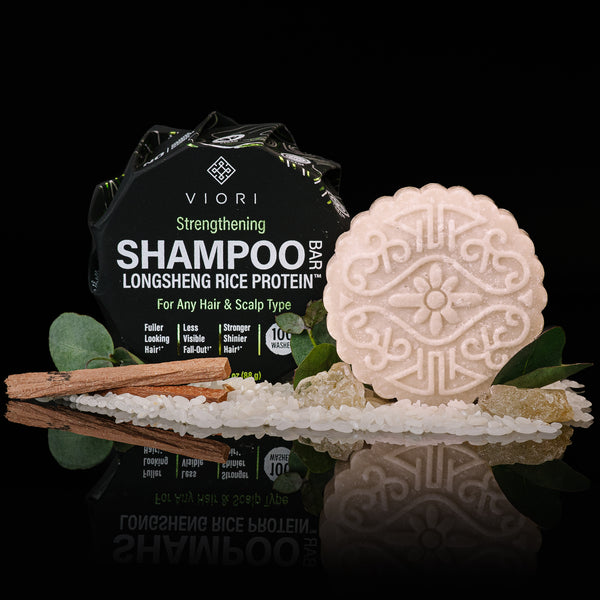
Hydrolyzed rice protein-a key ingredient in Viori's shampoo bars-has a molecular weight between 150 and 2000 Daltons. This is the "Goldilocks zone" for red hair. It's small enough to penetrate your porous hair cortex but large enough to actually strengthen the structure.
Larger proteins (like some keratin treatments) just sit on the surface. Smaller proteins rinse away without providing any benefit. Rice protein hits that sweet spot perfectly for red hair.
The Temperature Factor You're Probably Ignoring
Here's something I've noticed working with redheaded clients for years: they often report their hair feels different depending on the water temperature they use for washing.
There's a scientific reason for this.
Pheomelanin has a lower thermal stability than eumelanin. It starts breaking down at around 160°F, but shows measurable structural changes even at 110°F with prolonged exposure.
What this means for you:
Hot water opens your cuticle MORE aggressively when you have red hair. Combined with an alkaline shampoo, you're creating maximum conditions for pigment loss.
Even if you're using a pH-balanced, gentle shampoo, washing with very hot water will cause fading. The temperature matters just as much as the product.
Red Hair Creates Its Own Oxidative Stress
This might be the most fascinating (and troubling) aspect of red hair chemistry: pheomelanin generates more reactive oxygen species when exposed to UV light than eumelanin does.
In plain English? Your red hair literally creates its own oxidative stress in sunlight. It's attacking itself from the inside out.
This means an ideal shampoo for natural redheads absolutely must include antioxidants:
Vitamin E (tocopherol): Neutralizes the free radicals your hair generates. Viori includes Vitamin E Acetate specifically for this purpose.
Bamboo extract: Contains flavonoids and other antioxidant compounds that protect against oxidative damage.
Rice bran oil: High in gamma-oryzanol, a potent antioxidant found specifically in rice that's remarkably effective at protecting hair.
These aren't luxury ingredients-they're addressing a real chemical vulnerability unique to red pigment.
The Conditioning Catch-22
Natural redheads face a paradox: your hair needs more conditioning than other colors, but it's also more prone to conditioning overload.
Why?
- Thicker individual strands mean more surface area for conditioning agents to coat
- Higher porosity means faster absorption of conditioning ingredients
- But fewer total strands means buildup happens faster and weighs down your hair more noticeably
This is where the solid bar format actually offers a technical advantage. With Viori's shampoo and conditioner bars, you have precise control over how much product you use. You can modulate the amount easily, and you're much less likely to over-apply compared to squeezing out liquid products.
Plus, the friction of applying a bar directly to red hair's thicker strands provides better, more even distribution.
The Hard Water Multiplier Effect
If you live in an area with hard water (high mineral content), you're facing an accelerated battle.
Here's the mechanism:
Calcium and magnesium ions in hard water bind to your negatively charged hair shaft. On red hair's more porous structure, this binding is extensive. It creates a mineral coating that not only dulls your color but actually oxidizes pheomelanin through photo-catalytic reactions when exposed to light.
Essentially, hard water creates a layer on your hair that continues damaging your pigment even after you've finished washing.
The Rice Water Advantage
Fermented rice water contains compounds that combat this. Sodium lactate (present in Viori's formula) acts as a humectant that competes with mineral binding. The slightly acidic pH helps prevent mineral deposition in the first place. And rice proteins coat your hair shaft, creating a protective barrier against mineral accumulation.
WHAT CUSTOMERS ARE SAYING
Real reviews for Rice Water Shampoo Bar – All Hair Types | VIORI
The Math of Fading: Every Wash Counts
Let me show you some calculations that might shock you.
Each wash cycle removes approximately 2-4% of pheomelanin pigment. Compare that to just 0.5-1% for darker eumelanin pigment. Now add up the additional losses:
- Hot water washing: +1-2% additional loss
- Alkaline shampoo: +2-3% loss
- Hard water: +1-2% loss
Worst case cumulative loss: up to 9% of your pigment per wash.
Now think about how often you wash your hair.
But Here's the Hopeful Part
A protective formulation can dramatically reduce these losses:
- pH-balanced shampoo: reduces loss by ~3%
- Sulfate-free surfactants: reduces loss by ~2%
- Antioxidant ingredients: reduces loss by ~1-2%
- Chelating agents: reduces loss by ~1-2%
Switching from a conventional shampoo to a specialized formulation like Viori's could theoretically reduce per-wash fading by 40-50% for natural redheads.
Over months and years? That's the difference between maintaining vibrant red and watching it fade to strawberry blonde or even light auburn.
Seasonal Adjustments: Your Hair Changes Throughout the Year
Something I've documented with long-term clients: natural red hair behaves differently across seasons.
Summer Challenges
- UV exposure increases pheomelanin oxidation by 300-400%
- Chlorine and salt water are devastating to red hair's sulfur bonds
- Higher humidity causes more swelling and damage in already-porous red hair
Winter Challenges
- Indoor heating reduces humidity, making red hair brittle
- Static electricity is worse due to thicker strands and lower strand count
- Sebum (natural oil) production decreases in cold weather, affecting red hair more dramatically than other colors
Viori's approach of offering different formulations (Citrus Yao for oily hair, Terrace Garden and Hidden Waterfall for dry/normal hair) lets you adapt your routine. A natural redhead might use Citrus Yao in summer when scalp oil production increases, then switch to Terrace Garden in winter for maximum moisture retention.
Natural Red vs. Color-Treated Red: A Critical Distinction
Having worked with both clients who color their hair red and those with natural red, I can tell you the maintenance chemistry is surprisingly different.
Artificial Red Pigment
- Typically larger molecules (direct dyes)
- Sits primarily in the cuticle layer
- Fades through simple washing out
Natural Pheomelanin
- Bound within the cortex
- Fades through oxidative degradation
- Cannot be "refreshed" with gloss treatments the same way
This means products marketed for "color-treated red hair" often miss the mark for natural redheads. They're formulated to prevent wash-out, not to prevent oxidative degradation-two completely different processes.
If you have natural red hair, you need products addressing oxidation, not just deposit retention.
The Genetic Reality: MC1R and Hair Structure
The MC1R gene that gives you red hair also influences your hair structure in ways that affect which products work best.
Associated characteristics:
- About 90,000 hair strands versus 120,000 for brunettes
- Individual strand diameter of 70-80 microns versus 60-70 for brown hair
- Often lower sebaceous gland activity
What This Means for Your Shampoo Routine
You need less total product than standard formulas assume. You require gentler cleansing because you produce less natural oil. And you benefit from protein treatments more dramatically than other hair types.
The Viori bar format gives you control to adjust for these individual variations. You decide exactly how much product contacts


