
Twenty years behind the chair teaches you things beauty blogs won't mention. Like this: when a client shows me her latest shampoo bar purchase, I can predict whether she'll love it or hate it before she even gets it wet. Not because I'm psychic-because I understand the chemistry happening on her hair shaft, and most brands are betting you won't.
Right now, everyone's talking about shampoo bars. The conversation is all sustainability and zero-waste packaging, which is great. But here's what frustrates me: almost nobody's discussing what actually determines whether these bars will give you gorgeous hair or leave you with a waxy, tangled mess.
After two decades of cutting, coloring, and fixing hair disasters, I've learned that beautiful results aren't about following trends. They're about understanding the science. So let's have the honest conversation about shampoo bars that the beauty industry doesn't want you to hear.
The Question Nobody's Asking: What Type of Bar Is It Really?
Here's what might shock you: not all shampoo bars are remotely the same product. In fact, there are two completely different categories on the market, and the difference between them will make or break your entire hair care experience.
Most people think a shampoo bar is just solid shampoo. That's like saying all four-wheeled vehicles are the same thing. A Ferrari and a tractor both have four wheels, but I know which one I'd rather drive to work.
The Soap Bar Problem (And the Chemistry Behind That Waxy Nightmare)
Walk into most boutique shops, and those "natural" shampoo bars you see? Many are actually just soap-saponified oils pressed into a bar shape. Sounds beautifully simple and natural, right?
The problem is that soap and hair are chemically incompatible. Let me break this down in terms that matter to your actual hair:
Your hair has a pH of about 4.5 to 5.5-slightly acidic. This acidic environment keeps your hair cuticle lying smooth and flat, like shingles on a roof. That's what creates shine, prevents tangling, and protects against damage.
True soap has a pH of 8 to 10-decidedly alkaline. When you wash your hair with something that alkaline, your hair cuticle swells and lifts up like those roof shingles standing on end. This creates:
NOT SURE WHICH PRODUCT IS RIGHT FOR YOU?
TAKE THE QUIZTakes 30 seconds · 134,000+ customers matched
- Rough, sticky texture that catches on everything
- Increased breakage from mechanical stress
- A surface that traps residue like Velcro
- Protein loss through those lifted, vulnerable cuticles
But here's the real chemistry nightmare that creates that infamous "waxy buildup" everyone complains about.
The Hard Water Reaction (This Is Where Things Get Really Bad)
If you have hard water-and about 85% of American homes do-soap-based bars create an unavoidable chemical disaster.
When soap (which is made of fatty acid salts) meets hard water minerals like calcium and magnesium, they react and form something called calcium stearate. This isn't marketing speak or my opinion-it's basic chemistry that happens whether you want it to or not.
Here's the kicker: calcium stearate is completely insoluble in water.
Read that again. That waxy, white film people describe isn't a rinsing issue. It's not a "detox period" your hair needs to go through. It's an irreversible chemical product that bonds to your hair shafts, and no amount of rinsing will remove it because it literally cannot dissolve in water. Period.
This is why you see people doing apple cider vinegar rinses after using soap-based bars-they're desperately trying to chemically dissolve the calcium stearate deposits that have glued themselves to every strand. But that's treating a symptom, not solving the actual problem.
The Solution: Syndet Bar Technology
Syndet bars-short for synthetic detergent bars-use surfactants instead of saponified oils. I know the word "synthetic" makes some people nervous, but this is one of those cases where modern cosmetic chemistry actually improves on what nature provides.
The key differences that matter to your hair:
- pH can be formulated to 4.5-6.5-perfectly compatible with your hair's natural acidity
- No reaction with hard water minerals-no waxy buildup, no calcium stearate nightmare
- Produces soluble cleaning byproducts that actually rinse away instead of cementing themselves to your hair
The gold standard surfactant for quality shampoo bars is Sodium Cocoyl Isethionate, or SCI. Yes, it's derived from coconut, but it's processed to create a gentle cleanser that works with your hair's chemistry instead of fighting against it.
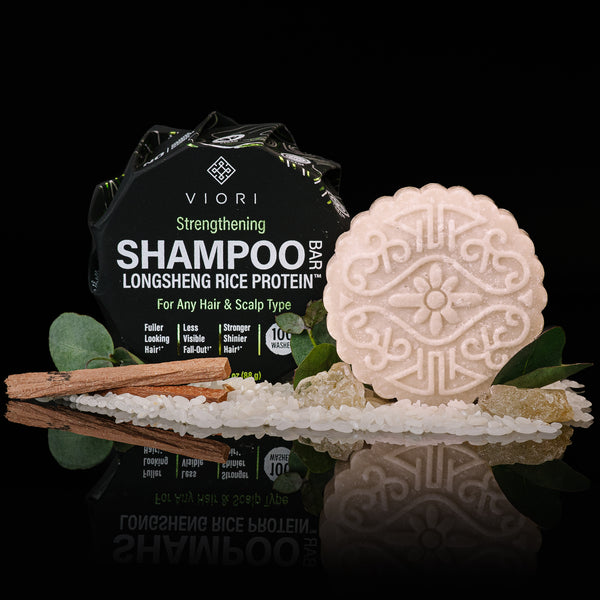
This is exactly what Viori uses in their bars-SCI as the primary cleanser, formulated at a hair-compatible pH. That's the technical foundation that makes their bars work without the buildup horror stories you read about with other brands.
Let's Talk About Fermented Rice Water (But Honestly This Time)
I know the Longsheng rice water story is compelling. Those women in China really do have remarkable hair. But after twenty years in this industry, I've learned to separate the romance from the reality.
What Fermented Rice Water Actually Does
When rice water ferments, it creates several documented beneficial compounds. Not folklore-actual science:
Inositol, a form of Vitamin B8, can penetrate the hair shaft and strengthen from within. Clinical studies back this up. It's one of the few ingredients with a small enough molecular structure to actually get inside your hair cortex.
Amino acids from rice protein break down during fermentation into smaller peptides. These are the right molecular size-150 to 1000 Daltons-to actually penetrate your cuticle and fill in damaged, porous areas.
Panthenol, or Provitamin B5, acts as a humectant that attracts moisture from the air and forms a protective film on your hair shaft.
These are real, measurable benefits. But here's where professional honesty matters.
The Concentration Question
Viori states openly that they use a "lower concentration of Longsheng rice water" to maintain pH balance. Some people see this as a weakness, like they're being shortchanged. From a formulation perspective, though, this is actually the scientifically sound approach.
Here's why: Pure fermented rice water has a pH that can drop to 3.0 or even lower as fermentation continues. That's too acidic for regular use-it would cause its own set of problems. High starch content can leave residue. Too much protein can make hair brittle and prone to breakage.
The goal isn't to use the most rice water possible-it's to use the right amount within a balanced formula. Rice water should be one beneficial component among many complementary ingredients, not the only thing in the bottle.
Viori balances their rice water extract with shea butter, cocoa butter, and vegetable glycerin. That's smart formulation chemistry, not corner-cutting.
The Factor That Determines Everything: Your Water
In twenty years of doing hair, I've learned that where you live matters as much as what you use. This is the single most overlooked factor in whether someone will love or hate a shampoo bar, and it drives me crazy that more professionals don't talk about it.
Understanding Water Hardness
Water hardness is measured in milligrams per liter of calcium carbonate:
- Soft water: 0-60 mg/L
- Moderately hard: 61-120 mg/L
- Hard: 121-180 mg/L
- Very hard: 180+ mg/L
You can find out your water hardness from your local water utility's website, or buy a test kit for under ten dollars. This single piece of information is more valuable than reading a hundred product reviews.
Why This Matters So Much
With soap-based bars, soft water users generally have good experiences. Hard water users almost universally report waxy buildup and hate their results. They're not wrong-they're experiencing actual chemistry.
With syndet bars like Viori's, performance stays consistent across all water hardness levels. No insoluble mineral deposits form. You don't need special rinses or workarounds or "transition periods" that last months.
This is why you'll see wildly different reviews of the same product online. People aren't lying or exaggerating-they're essentially using different products because their water chemistry is different. It's like one person is baking at sea level and another at 10,000 feet using the same recipe and wondering why the results don't match.
The Conditioning Bar Question: Why It Feels Weird (And Why That's Good)
I've had countless clients confused by how conditioning bars work. They expect it to feel like shampoo, and it doesn't. Let me explain why-and why that's actually a good thing.
It's About Electrical Charge (Really)
This might sound complicated, but stick with me because it's actually elegant once you understand it.
Behentrimonium Methosulfate-BTMS for short-is the key conditioning ingredient in quality conditioning bars. Despite its intimidating name and the word "sulfate" in there, it's NOT a sulfate in the way you're thinking.
Here's the chemistry: Sulfates like SLS are anionic-negatively charged. BTMS is cationic-positively charged. Your wet hair is anionic-negatively charged.
Opposite charges attract. That's it. That's the entire reason conditioner works.
BTMS doesn't need to lather or foam because it's not cleaning-it's depositing beneficial compounds onto your hair through electrostatic attraction. The creamy paste texture you feel when you apply a conditioning bar is the conditioner actually working, coating your hair shaft to smooth the cuticle, reduce static, and improve combability.
This is completely different from how shampoo works. Shampoo uses surfactants that create micelles-tiny bubbles-to surround and remove oil and dirt. Conditioner deposits fatty alcohols and quaternary compounds.
Different jobs require different chemistry. That's why they feel different, and that's exactly how it should be.
The Protein-Moisture Balance: Why Some Hair Types Struggle
This is perhaps my biggest professional concern with the one-size-fits-all approach most bar brands take. Not all hair is created equal, and pretending otherwise does customers a disservice.
Understanding Your Hair's Protein Needs
Not all hair responds the same way to protein-rich ingredients. After two decades of working with every hair type imaginable, I can tell you this matters enormously.
High porosity hair-damaged, color-treated, heat-styled hair-already has gaps and damage in the cuticle structure. It can become oversaturated with protein. Symptoms of protein overload include stiff, straw-like, brittle texture that actually breaks more easily. Rice protein, bamboo extract, and hydrolyzed proteins can cause this with overuse.
Low porosity hair-virgin, resistant, healthy hair-has a tightly sealed cuticle. It struggles to absorb moisture and treatments, can experience product buildup on the surface, and may need heat or longer processing time for conditioning to work.
Viori's formula includes both protein sources like Longsheng rice water, hydrolyzed rice protein, and bamboo extract, plus moisture sources like cocoa butter, shea butter, rice bran oil, aloe vera, and vegetable glycerin.
WHAT CUSTOMERS ARE SAYING
Real reviews for Rice Water Shampoo Bar – All Hair Types | VIORI
This is a moderate protein-to-moisture ratio, which works beautifully for most people. But if you're protein-sensitive, you might need to use it less frequently, focus the conditioner only on your ends, or clarify monthly to prevent buildup.
This isn't a flaw in the product-it's a fundamental reality of hair chemistry. Your individual hair structure determines how you should use any product, regardless of how perfect the formulation is.
The "Natural" Fragrance Debate: Let's Be Honest
Viori states that they use fragrance oils that are "either natural or mimic natural compositions." As someone who's been in this industry for decades, I actually appreciate this honesty more than brands claiming "100% essential oils" while conveniently leaving out the sustainability costs.
The Sustainability Paradox
Natural essential oils for scent require massive quantities of plants. It takes over 100 roses to produce a single drop of rose absolute. Sandalwood is endangered from overharvesting for perfumery. Many citrus oils cause phototoxicity-sun sensitivity that can lead to burns and hyperpigmentation.
Nature-identical synthetic fragrances are molecularly identical to natural scent compounds-same exact chemical structure-but they're created in a lab. This means:
- No environmental harvest impact
- Consistent, standardized scent
- Can exclude specific allergenic components
- More stable in formulation
- Same molecular formula as the "natural" version
A compound like linalool-the primary scent molecule in lavender-has the molecular formula C₁₀H₁₈O whether it comes from a lavender field in Provence or a laboratory in New Jersey. Your nose and your hair cannot tell the difference. They are chemically identical.
When Viori says their fragrances are "free from carcinogens, mutagens, reproductive toxins," they're describing IFRA compliance-International Fragrance Association standards-which actually applies to both natural and synthetic fragrances.
From a professional standpoint, I'd rather see this transparent approach than brands using unsustainably harvested rare plants just to claim "all natural" on their packaging while contributing to environmental destruction.
The Bar Format Advantage (Beyond the Environmental Story)
Yes, bars eliminate plastic bottles. Everyone knows that. But there are real technical advantages that rarely get quantified, and they matter for your hair.
The Concentration Mathematics
Liquid shampoo is typically 70-80% water, 10-15% surfactants (the actual cleaning agents), 5-10% conditioning agents and additives, and 5% preservatives, stabilizers, and thickeners.
Syndet bars are typically 0-5% water, 50-60% surfactants, 30-40% conditioning agents, butters, and oils, 5-10% active ingredients, and minimal preservatives needed.
What this means in real terms: A 90-gram shampoo bar contains the active ingredient equivalent of 300-400ml of liquid shampoo.
You're getting significantly higher concentrations of beneficial ingredients with every wash. There's just no room for fillers when you remove 70% of the water.
The Preservation Science
Here's a technical detail most people don't know: microorganisms need water to grow. Specifically, they need what chemists call "water activity"-abbreviated as aW-greater than 0.6. Shampoo bars with less than 5% water have a water activity below 0.3. Bacteria, mold, and yeast simply cannot proliferate in that environment.
This is why bars can have a 3-5 year shelf life compared to 2-3 years for liquid products, without heavy-duty synthetic preservatives like


