
Let's address one of the beauty industry's most persistent myths-and what it actually means for your hair's health.
After twenty years behind the salon chair, I've heard countless variations of the same question: "Which shampoo has no chemicals?" I understand the concern behind this question-really, I do. But here's something I need to share with you: the very idea of a "chemical-free" shampoo is scientifically impossible.
Before you click away thinking this is just semantics, stay with me. What I'm about to explain will completely change how you think about hair care-and help you make genuinely better choices for your hair's health.
Everything Is Made of Chemicals (Yes, Even Water)
Water-the main ingredient in any shampoo-is a chemical. Its formula is H₂O. Every single ingredient in your shampoo, whether it was grown in an organic garden or created in a laboratory, is composed of chemicals. That rose oil? Chemicals. That coconut extract? Chemicals. Even the air you're breathing right now? You guessed it-a mixture of chemical compounds.
So when we talk about wanting "chemical-free" products, what we're actually seeking is products without harsh synthetic sulfates, parabens, silicones, phthalates, and certain preservatives that can damage the hair cuticle or irritate our scalp.
The real question isn't "which shampoo has no chemicals?" It's: "Which shampoos use ingredients that work harmoniously with my hair's structure and scalp's natural chemistry?"
Let me show you exactly what that means.
What People Really Mean by "Natural" Hair Care
When clients sit in my chair asking for "chemical-free" products, we have an honest conversation about what they're really concerned about. Usually, it comes down to avoiding ingredients that:
NOT SURE WHICH PRODUCT IS RIGHT FOR YOU?
TAKE THE QUIZTakes 30 seconds · 134,000+ customers matched
- Strip natural oils too aggressively
- Disrupt the scalp's delicate pH balance
- Build up on the hair shaft causing dullness
- Cause scalp sensitivity or irritation
- Require harsh preservatives
These are valid concerns! But addressing them requires understanding how different ingredients actually interact with your hair's protein structure, porosity levels, and your scalp's sebum production patterns.
This is where things get interesting.
The Bar Shampoo Revolution: A Game-Changing Format
Here's something most beauty articles won't tell you: bar shampoos represent a fundamentally different approach to hair cleansing compared to liquid formulations.
Think about it from a formulation perspective. Traditional liquid shampoos require approximately 70-80% water content. All that water creates a breeding ground for bacteria and mold, which means manufacturers must add preservatives, emulsifiers, and stabilizers to keep the product safe and prevent ingredient separation.
Bar shampoos flip this entire equation on its head.
Because of their low moisture content, properly made bar shampoos are self-preserving-immediately eliminating an entire category of synthetic additives that liquid formulas require. This isn't just a minor difference; it's revolutionary from a formulation standpoint.
Take Viori's approach, for example. Their bars utilize Sodium Cocoyl Isethionate (SCI)-a coconut-derived cleanser that cosmetic chemists affectionately call "baby foam" because of its exceptional gentleness. Unlike traditional sulfate-based cleansers that can spike to a pH of 8-10 (highly alkaline and damaging), properly formulated bar shampoos maintain a pH between 4.5-5.5.
Why does this matter? Because that pH range matches your hair's natural acid mantle perfectly.
The pH Factor: Your Hair's Best-Kept Secret
Let me share one of the most important-yet overlooked-aspects of hair health: pH compatibility with your hair's structure.
Human hair has an isoelectric point around pH 3.67. This is the sweet spot where hair has zero net electrical charge and maximum structural integrity. Here's what happens when shampoo pH goes wrong:
At pH 8-10 (most commercial shampoos):
- Cuticle scales open significantly, like roof shingles lifting in a storm
- Moisture escapes easily, leading to dryness
- Hair develops a negative electrical charge (hello, frizz and static!)
- Protein leaches from the hair's inner cortex
- Color fades rapidly in treated hair
At pH 4.5-5.5 (properly formulated bars):
- Cuticle remains relatively flat and smooth
- Light reflects beautifully, creating natural shine
- Hair retains its structural proteins
- Moisture stays locked in
- Hair feels silky instead of rough
This is why Viori emphasizes their pH-balanced formulation. It's not marketing speak-it's fundamental hair biochemistry in action.
Ancient Wisdom Meets Modern Science: The Rice Water Secret
Now let's talk about something truly fascinating: fermented rice water. The mainstream beauty world has caught onto rice water recently, but most articles miss the actual science that makes it work.
The Red Yao women of Longsheng village have been using fermented rice water for centuries, and their hair tells the story-long, strong, and retaining color well into their elder years. But here's what's actually happening at a molecular level:
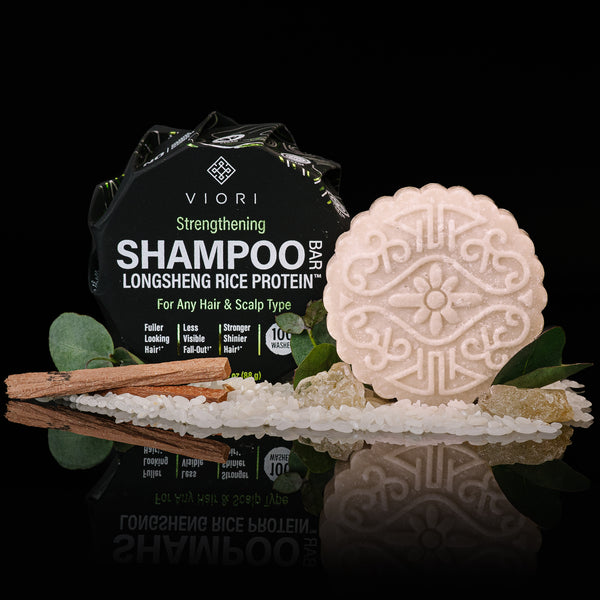
The fermentation process fundamentally changes the molecular structure of rice protein. During fermentation, complex carbohydrates break down into simpler compounds, producing two critical B-vitamins:
Inositol (Vitamin B8): This compound penetrates damaged hair cuticles and creates a protective shield that stays even after rinsing. Clinical studies show inositol can reduce surface friction on hair by up to 42%. Less friction means less breakage, less tangling, and smoother hair.
Panthenol (Vitamin B5): This humectant doesn't just sit on your hair's surface-it actually penetrates into the hair cortex because its molecular weight is small enough (205.25 g/mol) to slip through. Once inside, it binds to protein sites and attracts moisture at a molecular level.
When you use properly concentrated Longsheng rice water (as Viori does in their formulations), you're applying a carefully balanced profile of:
- Amino acids (the actual building blocks of your hair's keratin)
- Antioxidants (particularly oryzanol and gamma-oryzanol)
- Essential minerals (magnesium, manganese, selenium)
- Beneficial lipids (ceramides and fatty acids)
This isn't folk remedy territory-this is legitimate biochemistry that happens to have been discovered centuries ago through careful observation.
The Protein-Moisture Balance Your Hair Needs
Here's where professional hair knowledge really diverges from what most people understand: your hair needs both protein and moisture, but in specific ratios based on your hair's porosity.
Think of your hair like a sponge. Some sponges are tightly compressed (low porosity), while others are full of holes (high porosity). These different structures need different care approaches:
Low Porosity Hair (cuticle scales lay flat, resistant to moisture):
- Requires lighter products that won't sit on top
- Benefits from ingredients like citric acid that gently open the cuticle for product penetration
- Can actually become oversaturated with protein
- Best choice: Lighter formulations like Viori's Citrus Yao
High Porosity Hair (damaged cuticle with gaps in the structure):
- Desperately needs both protein and moisture
- Benefits from heavier conditioning agents
- Requires ingredients that "patch" the gaps in damaged cuticles
- Best choice: More intensive formulations like Viori's Terrace Garden or Native Essence
The genius of rice protein is its molecular weight (10,000-20,000 Daltons)-it's small enough to penetrate the hair cortex but large enough to provide substantive strengthening. Hydrolyzed rice protein attaches to damaged keratin sites through ionic bonding, essentially acting as a "filler" for damaged areas.
It's like spackling holes in a wall before painting-you're repairing the structure, not just covering it up.
The Alcohol Confusion: When "Alcohol" Actually Moisturizes
Here's a distinction that causes enormous confusion: not all alcohols are created equal, and some are actually essential for hair health.
When people see "alcohol" on an ingredient list, they often panic. But there are two completely different categories:
Drying Alcohols (SD alcohol, ethanol, isopropyl alcohol):
- Low molecular weight
- Evaporate quickly
- Strip away natural oils
- Disrupt the protective lipid barrier
- These are the ones to avoid
Fatty Alcohols (cetyl alcohol, stearyl alcohol, behenyl alcohol):
- High molecular weight
- Derived from vegetable sources like coconut
- Act as emollients and conditioning agents
- Actually seal moisture into the hair shaft
- These are beneficial ingredients!
Viori's formulation includes cetyl alcohol (derived from coconut) and stearic acid (from vegetable sources). These fatty alcohols create a protective barrier that prevents moisture loss-the exact opposite of what people fear when they see "alcohol" on a label.
It's like the difference between rubbing alcohol that stings when you clean a cut, versus a rich hand lotion that happens to contain cetyl alcohol as a smoothing ingredient. Same word, completely different function.
Breaking the Sulfate Confusion
Let me clear up another point of massive confusion: behentrimonium methosulfate is NOT a sulfate in the way people fear.
I know, I know-it has "sulfate" right there in the name! But here's the chemistry:
Harsh Sulfates (SLS, SLES, ammonium lauryl sulfate):
- Anionic surfactants that strip aggressively
- Remove lipids indiscriminately
- Create high negative charge, leading to tangling
- Typically have a pH of 8.5 or higher
Behentrimonium Methosulfate (BTMS):
- Cationic surfactant with opposite behavior
- Derived from colza (rapeseed) plant
- The "methosulfate" portion just refers to how the salt formation is created
- Actually acts as a conditioning agent, not a harsh cleanser
- pH neutral to slightly acidic
The professional haircare industry accepts BTMS as "sulfate-free" precisely because its surfactant behavior is fundamentally different from strip-cleansing sulfates. It's actually one of the gentlest conditioning ingredients available-I use it extensively in my salon treatments.
The Sebum Cycle: Why Your Hair Gets Greasy So Fast
Here's a professional secret that changes everything: most people overwash their hair because their shampoo triggers a sebum overproduction cycle.
Here's how it works: Harsh sulfates strip ALL oil from your scalp-not just the excess, but everything. Your sebaceous glands interpret this as an emergency situation and dramatically increase sebum production to compensate. Within 24-36 hours, your hair feels greasy, so you wash again with that same harsh shampoo, reinforcing the cycle.
You're essentially stuck on a hamster wheel of your own making.
WHAT CUSTOMERS ARE SAYING
Real reviews for Rice Water Shampoo Bar – All Hair Types | VIORI
When you switch to a gentler cleanser (like SCI-based bars), here's the timeline of what actually happens:
Week 1-2: You may experience an "adjustment period" where your hair feels different as your sebum production recalibrates. This is normal-your scalp is confused because it's been in crisis mode.
Week 3-4: Your sebaceous glands normalize production to appropriate, healthy levels.
Week 5+: Most people can extend their washing intervals by 1-2 days because their scalp isn't constantly in crisis-compensation mode.
The citric acid in formulations like Viori's Citrus Yao provides an additional benefit for oily scalps: it acts as a mild alpha-hydroxy acid (AHA) that gently exfoliates the scalp, preventing sebum oxidation (which causes that heavy, greasy feeling).
The Preservation Problem in Liquid Shampoos
Nobody talks about this, but the preservative system in liquid shampoos is actually one of the most problematic aspects of conventional formulations.
Any product with significant water content requires broad-spectrum preservatives to prevent some truly nasty contamination:
- Bacterial contamination (E. coli, Pseudomonas)
- Fungal growth (Candida, Aspergillus)
- Yeast proliferation
Common preservative systems include:
- Parabens (methylparaben, propylparaben)
- Phenoxyethanol
- Formaldehyde releasers with concerning names like DMDM hydantoin
- Methylisothiazolinone (MIT), a known sensitizer
The bar format eliminates this entire category of additives through what's called "low water activity." With proper drainage between uses (just let it dry on a soap dish with drainage), bars are self-preserving.
The sodium lactate in Viori's formulation (derived from fermented corn or beet sugars) acts as a mild antimicrobial and humectant, but it isn't needed for primary preservation-it's there for additional scalp benefits and texture. That's a huge difference from liquid formulas that require aggressive preservative systems to remain safe.
The Botanical Extract Reality Check
Here's an uncomfortable truth I've learned from working with product formulators: most botanical extracts in liquid shampoos are present at concentrations too low to provide real benefits.
When you see "chamomile extract" or "lavender oil" listed on a liquid shampoo bottle, it's typically there at 0.01-0.1% concentration-essentially homeopathic levels that sound good on the label but can't provide therapeutic benefits. The rinse-off nature of shampoo further reduces contact time and absorption.
Bar formulations can incorporate significantly higher concentrations of beneficial ingredients because:
- There's no water dilution factor
- Bars are used more slowly, creating longer contact time


