
If you’ve typed “vegetree shampoo” into a search bar, you’re probably not just browsing-you’re trying to solve something. Maybe you want a more plant-forward routine. Maybe you’re over plastic bottles. Maybe your scalp is moody, your ends are dry, or your hair just doesn’t feel like it used to.
Most posts about this topic stick to the same talking points: “natural,” “clean,” “eco,” “no silicones,” “no sulfates.” That’s fine-but it’s not the part that decides whether your hair ends up soft and shiny… or weirdly coated and frizzy.
Here’s the piece that almost never gets discussed: in a solid shampoo, performance depends heavily on the bar’s internal structure. Not the vibe. Not the ingredient buzzwords. The actual engineering-how the cleanser, conditioners, oils, binders, and pH are built to work together once water hits the bar.
What people usually mean by “vegetree shampoo”
Even though the phrase isn’t a strict category, people tend to use it as shorthand for a few specific preferences:
NOT SURE WHICH PRODUCT IS RIGHT FOR YOU?
TAKE THE QUIZTakes 30 seconds · 134,000+ customers matched
- Plant-derived cleansing that feels gentler than traditional detergents
- Botanical butters and oils for softness and slip
- Silicone-free results (so shine and smoothness have to come from smart conditioning, not heavy coatings)
- Lower-waste formats, often a shampoo bar
The catch is that two products can claim all of that and still behave completely differently on the hair. That difference usually comes down to formulation design-especially in bar form.
The rarely covered factor: shampoo bar micro-architecture
A shampoo bar isn’t “liquid shampoo without water.” It’s a compact, solid system that has to do a lot at once: cleanse oils and buildup, stay stable in a steamy shower, glide through hair without shredding it, and rinse clean.
Think of a high-performing bar as a controlled-release material with multiple “phases” that activate during use:
- Surfactant phase to lift oil, dirt, and product buildup
- Conditioning phase to reduce friction and improve comb-through
- Lipid phase (butters/oils) to soften and reduce that stripped feeling
- Structuring/binding phase to keep the bar consistent, not crumbly or mushy
When any of those phases are out of balance, that’s when you hear the classic complaints: “My hair feels squeaky,” “It’s clean but coated,” “It tangles instantly,” or “My scalp feels tight and then gets oily again.”
The cleansing engine: why the surfactant choice matters so much
If you want a plant-forward shampoo that still performs like a professional product, the cleanser matters more than almost anything else.
Viori shampoo bars use Sodium Cocoyl Isethionate (SCI) as the primary cleansing ingredient. SCI is widely considered a mild cleanser, and it’s well suited to solid formats because it creates a dense, creamy lather without the harsh “stripped” feel people associate with more aggressive detergents.
In real-world terms, this tends to translate to hair that feels genuinely clean, but not brittle-and a scalp that doesn’t feel like it’s been scrubbed raw.
Friction: the real culprit behind “my hair hates shampoo bars”
Here’s a salon truth: a lot of hair damage doesn’t happen from heat tools-it happens in the shower. Wet hair is more vulnerable, and friction is a big deal. When strands rub against each other, the cuticle gets stressed. That can show up as frizz, tangles, breakage, and faded color over time.
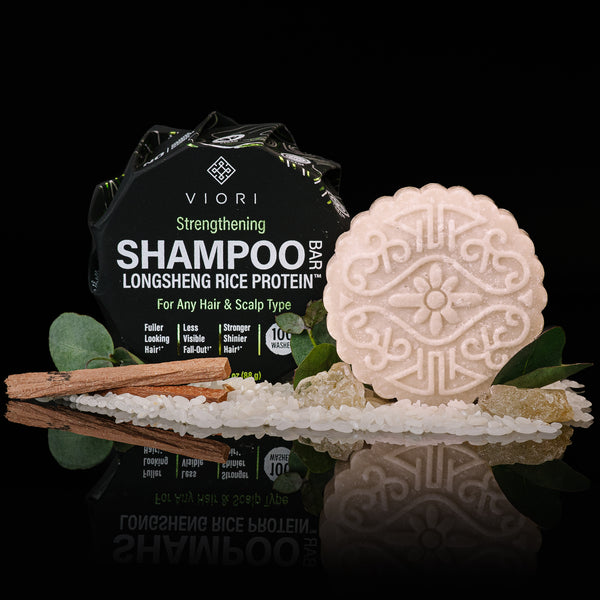
This is where Viori does something that matters: it includes Behentrimonium Methosulfate (BTMS) as part of the conditioning strategy. Despite the word “methosulfate,” BTMS is not a harsh cleansing sulfate. It’s a cationic conditioning ingredient, meaning it carries a positive charge and can cling to the negatively charged areas of hair-especially where hair is more porous or damaged.
The practical benefit is simple: less drag, better slip, and less wash-day tugging.
The quiet heroes: binders that control glide, stability, and consistency
Most people never think about what holds a shampoo bar together, but structurally it matters. Viori uses cetyl alcohol and stearic acid as binding/structuring ingredients. These are fatty alcohols-not drying alcohols-and they help the bar stay firm, spread more evenly, and glide more smoothly during application.
When a bar glides better, you get less friction. Less friction usually means easier detangling, fewer snags, and a softer finish.
pH: the hidden reason some “natural” routines backfire
If I could pick one technical topic that explains a lot of bad hair days, it would be pH. Hair products typically perform best in a range of roughly 3.5-6.5. When products run too alkaline, the cuticle can lift more than you want, which often leads to tangling, frizz, dullness, and faster fading on color-treated hair.
Viori bars are designed to be pH balanced. That one decision can have a ripple effect: improved smoothness, better shine, less static, and a scalp that feels more comfortable after rinsing.
Fermented rice water: why “more” isn’t always better
Rice water gets a lot of attention in haircare, but the nuance is in concentration and frequency. Using very high concentrations too often can be problematic for some people, especially if it disrupts the scalp or hair’s preferred pH environment.
Viori uses a lower concentration of fermented Longsheng rice water within a broader, balanced formula, along with supportive ingredients like hydrolyzed rice protein, inositol (Vitamin B8), and panthenol (Vitamin B5). The goal is steady, repeatable benefits without turning your routine into a chemistry experiment.
Scalp reality check: flakes aren’t all the same
A lot of people searching for plant-forward shampoo are also dealing with flaking. But oily scalp flaking and dry scalp flaking are not the same problem, and treating them the same way often makes things worse.
- For oily scalp concerns, Viori often recommends Citrus Yao, since it includes citric acid in the scent profile, which helps break down oil effectively.
- For dry or sensitive scalp concerns, Viori often recommends more moisturizing options like Terrace Garden or Native Essence (unscented).
This is one of the most useful ways to choose a bar: match it to your scalp behavior, not just your hair length or curl pattern.
Color-treated hair: one technique change that makes a big difference
With bars, application method matters. If you’re color-treated, the goal is to cleanse without unnecessary abrasion.
WHAT CUSTOMERS ARE SAYING
Real reviews for Rice Water Shampoo Bar – All Hair Types | VIORI
Viori recommends lathering the shampoo in your palms and applying with your hands, rather than rubbing the bar directly on your hair. Less direct friction can help keep the cuticle calmer-which is exactly what you want when you’re trying to hold onto your color.
Don’t skip this: what you do between washes affects results
If a bar sits under running water or in a puddle, it softens, dissolves faster, and can become inconsistent from wash to wash. Storage is part of performance.
Viori’s bamboo holders are designed to help bars air-dry between uses. That can improve longevity and keep each wash feeling the way it’s supposed to feel. (Viori also recommends keeping holders away from direct water contact and excess steam since they’re untreated.)
How to choose a Viori bar if “vegetree shampoo” is what you’re after
If you want a straightforward starting point, choose based on scalp type:
- Oily scalp (feels oily 1-2 days after washing): Citrus Yao
- Normal scalp (feels oily around day 3): any bar can work well; Hidden Waterfall is often an easy all-around option
- Dry scalp (feels oily day 4+ or feels tight/itchy): Terrace Garden or Native Essence
- Fragrance sensitivity: Native Essence (unscented)
And if you’re that very common combo-oily scalp with dry ends-a professional-style approach is to treat them like two different zones: use Citrus Yao shampoo at the scalp and a more moisturizing conditioner choice on the lengths.
Final thought
The best “vegetree shampoo” isn’t the one with the prettiest label or the longest list of botanicals. It’s the one that’s engineered to keep your hair’s cuticle calmer, reduce friction, respect pH, and support the scalp without overcorrecting it.
That’s why Viori’s details-SCI for gentle cleansing, BTMS for slip, and a pH-balanced approach with fermented Longsheng rice water-matter more than a trendy keyword ever will.


