
When clients settle into my salon chair and ask about "PC shampoo," I've learned not to assume I know what they mean. Over my 20 years in the beauty industry, I've watched this simple two-letter abbreviation evolve to represent four completely different concepts-each one crucial to understanding modern hair care.
Today, I'm pulling back the curtain on the hidden chemistry, environmental considerations, and formulation science that most brands don't talk about. Whether you're shopping for your next shampoo bar or trying to decode ingredient labels, understanding these four interpretations of "PC" will transform how you think about hair care.
The Four Hidden Meanings of "PC" in Your Shampoo
Meaning #1: Protein Concentration-Why More Isn't Always Better
Let's start with the least discussed but most technically important interpretation: protein concentration in your shampoo formula.
You've probably seen "hydrolyzed rice protein" or similar ingredients on labels and assumed that more protein equals stronger, healthier hair. I wish it were that simple.
The Protein Paradox
Here's what most people don't realize: your hair has an optimal protein absorption threshold. Cross that line, and you're doing more harm than good.
Too much protein can cause:
- Hygral fatigue: Your hair shaft swells when wet and contracts when dry. Repeat this cycle with excessive protein, and your hair becomes brittle and prone to breakage
- Moisture-protein imbalance: Your hair needs both protein and moisture. Tip too far toward protein, and you'll end up with straw-like, inflexible strands
- Cuticle disruption: Especially problematic if you have high-porosity hair that's already vulnerable
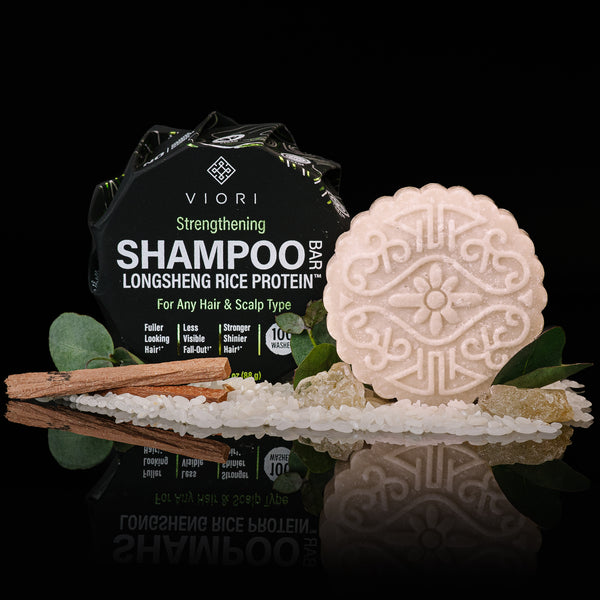
This is why sophisticated formulations-like those in Viori's shampoo bars-use deliberately low concentrations of rice protein. It's not a cost-cutting measure; it's smart chemistry.
Instead of overwhelming your hair with protein, Viori's fermented Longsheng rice water provides what I call "protein catalysts"-ingredients like inositol (Vitamin B8) and panthenol (Vitamin B5) that help your hair metabolize and use protein more effectively. Think of it as the difference between force-feeding someone and helping them digest nutrients better.
The Molecular Weight Factor Nobody Talks About
NOT SURE WHICH PRODUCT IS RIGHT FOR YOU?
TAKE THE QUIZTakes 30 seconds · 134,000+ customers matched
Here's a pro tip that'll make you sound like a chemist at your next salon visit: not all proteins are created equal. Hydrolyzed rice protein comes in different molecular weights:
- Low molecular weight (under 1,000 Daltons): Small enough to penetrate into your hair's cortex
- Medium molecular weight (1,000-5,000 Daltons): Adheres to your cuticle surface
- High molecular weight (over 5,000 Daltons): Creates a protective film on your hair shaft
Shampoo bars typically use medium-weight proteins because the solid format requires structural stability. The concentration becomes critical: too much creates that dreaded waxy buildup, too little provides inadequate strengthening.
This is formulation artistry at its finest-balancing protein size, concentration, and delivery method to give your hair exactly what it needs without overwhelming it.
Meaning #2: Polyquaternium-Cationic Complexes-The Conditioning Secret
Stay with me here, because this chemistry is fascinating and explains why your conditioner actually works.
The Charge Differential Mystery
Your hair carries a negative electrical charge when wet (approximately -40 to -50 millivolts, if we're being technical). Traditional cleansing ingredients are anionic, meaning they increase this negative charge during washing. This is why your hair feels rough and tangles easily when you've only shampooed-it's literally repelling itself.
Conditioners solve this with cationic surfactants (positively charged molecules) that neutralize the negative charge and create what chemists call "substantivity"-basically, the ability to stick to your hair.
How Conditioning Actually Works
Let me break down what happens when you apply conditioner with ingredients like Behentrimonium Methosulfate (BTMS)-a key conditioning agent in Viori's conditioner bars:
- Electrostatic attraction: The positive charge bonds to your negatively charged hair
- Hydrophobic tail orientation: The molecular "tail" smooths down your cuticle layer
- Lateral spreading: The conditioner spreads evenly across each strand
- Rinse resistance: The bond is strong enough that some conditioning stays even after rinsing
Now here's something that confuses everyone: Behentrimonium Methosulfate contains "sulfate" in the name. Isn't that what we're supposed to avoid?
The Great Sulfate Confusion
This drives me crazy when I see fear-mongering about BTMS. Yes, it has "methosulfate" in the name, but it's chemically nothing like the harsh sulfates (SLS/SLES) you want to avoid.
Think of it this way: sodium chloride is table salt-totally safe to eat. But chlorine gas is toxic. Same element, completely different behavior. The sulfate group in BTMS is covalently bonded to a quaternary ammonium structure, making it chemically impossible to act like the harsh sulfates that strip your hair.
In fact, BTMS is one of the gentlest, most effective conditioning agents available. It's cationic (positive), not anionic (negative) like stripping sulfates.
The Solid Bar Concentration Puzzle
Here's something counterintuitive: professional liquid conditioners typically use 2-4% BTMS, but solid conditioner bars require 40-60% BTMS as their base. Sounds super concentrated, right?
But the application method changes everything. When you use a solid bar, you're relying on friction and limited water activation, which results in lower effective deposition than liquid formulas. This is why quality conditioner bars like Viori's produce a paste-like consistency rather than foam-they work through mechanical adhesion rather than chemical emulsification.
This is actually superior for many hair types because you get targeted conditioning exactly where you apply it, without over-conditioning fine hair at the roots.
Meaning #3: Post-Consumer Recycled Content-The Sustainability Question
Now we're shifting gears entirely. "PC" in environmental circles stands for Post-Consumer Recycled content, and this is where things get complicated.
The Bamboo Holder Reality Check
Viori offers untreated bamboo holders for their bars, which sounds perfectly sustainable-and bamboo is indeed rapidly renewable. But there's a catch that their FAQs honestly address: untreated bamboo in humid bathroom environments can develop mold.
The chemistry behind this is straightforward. Untreated bamboo contains:
- Hemicellulose: A favorite food source for mold
- Natural sugars: More nutrients for microbial growth
- Hygroscopic properties: It absorbs and retains moisture, creating the perfect environment for fungal colonization
The recommended solution-curing with olive oil and heat-is actually creating a polymerization barrier. When you heat oil, it undergoes oxidative polymerization, creating a protective film. It works, but it does compromise the "untreated" aspect of the marketing claim.
This is the kind of honest complexity I appreciate. Perfect sustainability is hard, and brands that acknowledge the trade-offs earn my respect.
The Paper Packaging Problem Nobody Mentions
Viori uses recycled paper packaging, which sounds straightforward. But here's what most people don't know: paper that needs to withstand moisture requires wet-strength additives, which typically include chemicals that aren't readily biodegradable.
The claim of "biodegradable, sustainable, and recyclable" packaging requires nuance. The paper itself can be all three, but the treatment chemicals often aren't. This is the hidden complexity of post-consumer packaging claims-they exist on a spectrum rather than as absolute truths.
I'm not saying this to discourage you. Paper packaging is still vastly better than plastic. But as educated consumers, we should understand these nuances rather than accepting simplified marketing claims.
Meaning #4: pH-Controlled Formulation-The Silent Critical Factor
This might be the most underestimated aspect of hair care chemistry, and it's absolutely crucial to how well products work.
The pH Balancing Act
Your hair has an optimal pH range of 4.5-5.5. When products fall outside this range-especially if they're too alkaline-your cuticle lifts, leading to:
- Increased porosity
- Moisture loss
- Color fading
- Frizz and tangles
- Damage susceptibility
Traditional soap bars have a pH of 9-11 because saponification produces alkaline salts. This is why old-fashioned soap can leave your hair feeling stripped and tangled.
Modern syndets (synthetic detergents) like Sodium Cocoyl Isethionate-the primary cleanser in Viori's bars-naturally sit around pH 5-6. Much better! But maintaining that pH in a solid bar presents extraordinary technical challenges.
The Buffering System
This is where buffering agents come in. Viori uses Sodium Lactate (derived from fermented corn or beets) as their primary buffer, and it's brilliant for several reasons:
- pH buffering: Creates a stable pH zone between 4-5
- Moisture retention: Maintains bar moisture content at 10-12%, preventing crumbling
- Antimicrobial properties: Inhibits bacterial growth during storage
- Chelation capacity: Binds metal ions from hard water that could oxidize ingredients
The concentration typically ranges from 1-3% in solid bars. Too little fails to buffer effectively; too much creates bars that are too soft and dissolve rapidly.
The Fermented Rice Water Challenge
Here's something fascinating: fermented rice water is naturally acidic (pH 4.5-5.5), which helps with pH balancing. But it also creates a protein stability problem.
Proteins denature at extreme pH levels. The beneficial inositol and panthenol from fermentation are most stable at pH 5-6, creating a narrow formulation window. This is likely another reason why Viori uses lower concentrations of rice water-not just for safety, but for protein stability optimization.
Why Citrus Yao Works Better for Oily Hair
WHAT CUSTOMERS ARE SAYING
Real reviews for Rice Water Shampoo Bar – All Hair Types | VIORI
Viori's FAQ mentions that their Citrus Yao scent is best for oily hair because "citric acid breaks down oil really well." This reveals sophisticated formulation thinking that goes way beyond fragrance.
Citric acid in the fragrance creates three functional effects:
- pH adjustment: Lowers final pH to 4.5-5.0, optimal for oily scalps
- Chelation: Binds calcium and magnesium from hard water that contributes to oily buildup
- Keratin modification: Temporarily tightens your cuticle, reducing how much sebum adheres to the surface
This explains why scent choice matters even though the base formula is the same-the fragrance components have secondary chemical functions beyond just smelling nice. That's formulation elegance.
How These Four "PC" Meanings Interconnect
What makes this analysis unique is recognizing that these four interpretations of "PC" don't exist in isolation. They create what I call a formulation constraint matrix-a complex puzzle where improving one factor can negatively impact another.
Consider these competing demands:
- Protein concentration must remain low to prevent buildup, BUT proteins provide strengthening benefits
- Cationic conditioning systems need sufficient concentration for effectiveness, BUT too much positive charge can bind excess protein to hair
- Sustainable packaging reduces environmental impact, BUT may offer less barrier protection against oxidation
- pH control must maintain protein stability, BUT can affect how well cationic surfactants function
This is the invisible formulation puzzle that every quality brand must solve. When you see a well-formulated product like Viori's shampoo bars that addresses all four considerations, you're looking at serious cosmetic chemistry.
The Deep Chemistry Insights You Won't Find Elsewhere
Let me share some professional-level insights that rarely get discussed:
The Fermentation Time-Temperature Secret
Viori's rice fermentation takes 7-10 days at "optimal temperature levels," but they don't explain the enzymatic cascade this triggers:
- Days 1-3: Amylase enzymes break down starches into simple sugars
- Days 4-7: Bacterial fermentation produces lactic acid and lowers pH
- Days 7-10: Secondary metabolites (inositol, biotin) reach peak concentration
Temperature control is critical:
- Too cold (<15°C/59°F): Incomplete fermentation, lower beneficial compounds
- Optimal (20-25°C/68-77°F): Maximum B-vitamin production
- Too warm (>30°C/86°F): Off-flavors, potential ethanol production
This fermentation window creates natural batch-to-batch variability. Solid bars help standardize this better than liquid formulas, where rice water concentration directly impacts viscosity and performance.
The RSPO Palm Oil Complexity
Viori acknowledges using RSPO-certified palm-derived ingredients like Cetyl Alcohol and Stearic Acid. This is good-RSPO certification indicates sustainable sourcing. But there's complexity here worth understanding.
RSPO has four certification levels:
- Identity Preserved (IP): Highest standard, traceable to specific sustainable farms
- Segregated (SG): Mixed sustainable sources, no conventional palm
- Mass Balance (MB): Mix of sustainable and conventional, tracked administratively
- Book & Claim: Credits purchased, physical product may be conventional palm
Most cosmetic suppliers use Mass Balance, meaning the actual palm derivatives might be only partially from sustainable sources. The RSPO credit system allows "mathematical sustainability" without complete physical segregation.
This isn't a criticism-RSPO certification is still vastly better than uncertified palm. But "ethically sourced" exists on a gradient rather than as an absolute. As professionals, we should understand and acknowledge these


