
If you’ve been Googling “Earthling Co reviews”, you’re probably not just looking for a yes-or-no verdict on one company. Most people are trying to answer a more personal (and more useful) question: “Will a shampoo bar actually work for my hair?”
And as someone who’s spent the last 20 years doing hair, I’ll tell you what I wish more review roundups said out loud: the biggest wins and worst disappointments in shampoo bar reviews usually have less to do with “the bar” and more to do with variables-your water, your technique, your porosity, your scalp’s oil pattern, and whether your routine includes enough conditioning.
This post breaks down what shampoo bar reviews are really describing, why two people can have totally opposite results, and how to use that information to build a routine that actually behaves consistently. I’ll also point out where Viori has made specific formulation and usage choices that help prevent the most common problems people complain about in bar reviews.
The pattern hiding in plain sight: “bad reviews” usually aren’t about cleansing
Across the internet, negative shampoo bar reviews tend to repeat the same phrases-different writers, same frustrations. When you see them, don’t read them as random complaints. Read them as clues.
- “My hair feels waxy.”
- “It’s coated or heavy.”
- “My hair gets tangly while I wash.”
- “My scalp feels itchy or tight.”
- “It worked… then it stopped.”
Most of the time, those issues come from a very specific trio: deposition (what’s left behind on the hair), friction (how the bar is applied), and water chemistry (especially hard water). Once you understand those three, reviews start making a lot more sense.
NOT SURE WHICH PRODUCT IS RIGHT FOR YOU?
TAKE THE QUIZTakes 30 seconds · 134,000+ customers matched
Why “waxy hair” happens: deposition + hard water + how you apply the bar
The waxy/coated feeling is one of the most common shampoo bar complaints online. People often assume it means the bar didn’t clean their hair-but technically, it’s more often a sign that something is being left behind or interacting on the hair surface.
1) Deposition: too much product in the wrong places
A bar is solid, so it transfers product through friction. If you rub the bar directly on your head, it’s easy to repeatedly hit the same zones (crown, hairline, top layer) and load them heavier than everything underneath.
Viori’s guidance here is simple and smart: build lather in your hands and apply with your palms instead of dragging the bar along the hair. It helps with more even distribution and reduces the “hot spots” that can feel coated later.
2) Hard water: the silent factor most reviews never mention
Hard water changes how product rinses, how hair feels after drying, and how easily your lengths build up that dull, draggy sensation. It’s one of the biggest reasons you’ll see polar opposite reviews for the “same” type of product.
Here’s a quick tip for reading reviews like a pro: when someone mentions “film,” “waxy,” “never feels clean,” or “I needed a rinse to reset it,” you’re often reading a water chemistry story, not a simple product performance story.
3) Porosity mismatch: when your hair holds onto the wrong thing
Low-porosity hair (tight, resistant cuticle) is especially prone to feeling coated because product tends to sit on the surface instead of absorbing evenly. High-porosity hair can have the opposite problem-absorbing fast but losing moisture quickly-so it may feel rough unless the conditioning step is dialed in.
Shampoo bars change the physics of washing: friction is a bigger deal than people think
Liquid shampoo spreads quickly. A bar doesn’t-it has to be transferred. That transfer process adds mechanical action, and mechanical action affects the cuticle.
Too much friction can:
- Lift the cuticle slightly (hello, tangles)
- Create uneven cleansing (roots overloaded, ends underdone-or the reverse)
- Make fragile, processed hair feel rough mid-wash
This is why technique matters more with bars than with bottles. Reviews rarely mention technique, but technique is often the difference between “obsessed” and “never again.”
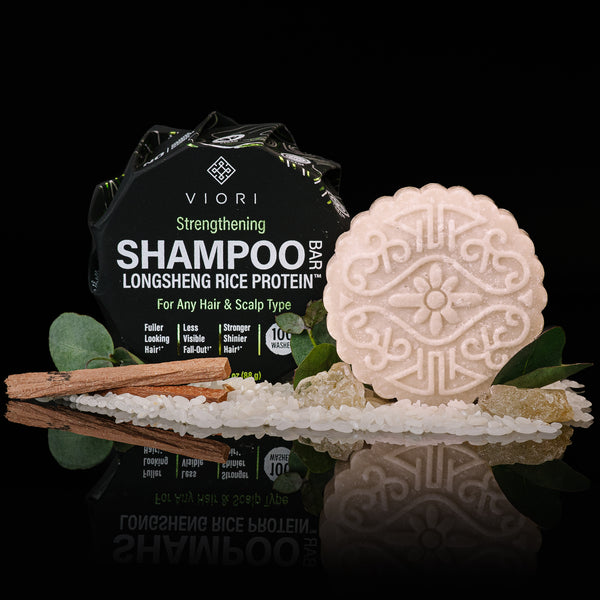
“This scent works better”-sometimes that’s not in your head
One of the most interesting review patterns is when people say one version performs better than another. It’s easy to dismiss… but it can be real when small functional components shift how the formula behaves.
Viori explains this more clearly than most: Citrus Yao contains citric acid, which helps break down oil effectively and can help some people go longer between washes. That’s a meaningful lever for normal-to-oily scalps and for hair that’s prone to feeling weighed down.
The most underrated way to filter reviews: porosity (not curl pattern)
Most review sections sort people into “curly” or “straight,” “fine” or “thick.” Helpful-but not always the most predictive. In practice, porosity is often the deciding factor for whether a bar feels lightweight and clean or heavy and coated.
Viori even shares a simple porosity test you can do at home:
- Brush your hair.
- Take one clean strand and place it in a glass of water.
- If it floats, you’re likely low porosity.
- If it stays mid-glass, you’re likely medium porosity.
- If it sinks, you’re likely high porosity.
In general terms, low-porosity hair tends to do better with lighter routines and careful application. High-porosity hair usually needs more supportive conditioning and gentler handling to keep the cuticle behaving.
pH: why some bars feel “salon-soft” and others feel like straw
Here’s the technical point that almost never gets explained properly in review culture: pH affects the cuticle. If a product is too alkaline, it can swell the hair fiber and lift the cuticle, which shows up as frizz, tangles, roughness, and dullness.
Viori notes that hair products should typically be in a range of about pH 3.5-6.5, and that overly alkaline products can cause long-term dryness and damage. Viori also states their bars are pH balanced-a key detail in bar-format haircare, especially since many consumers assume any “bar” must behave like soap.
The “transition period” isn’t always detox-it’s often routine recalibration
You’ll see this story constantly: “It took a few weeks.” Online, that gets labeled as a detox. Behind the scenes, what’s usually happening is more straightforward:
- Your scalp adjusts to a different cleansing profile
- Your lengths adjust to a different conditioning/deposition pattern
- Your technique improves (even if you don’t realize it)
Viori’s recommendation to give it 2-3 months before giving up is actually practical. Hair and scalp routines often need consistency to settle-especially when you’re changing both product format and application method.
The rarely discussed truth: conditioner performance is electrostatic
This is one of those stylist details that changes how you interpret “conditioner bar” reviews. Hair-especially damaged hair-tends to carry a stronger negative charge. Conditioners are typically formulated with positively charged conditioning agents so they can bind where the hair needs support.
Viori describes this in an accessible way: cleansing removes some protective sebum, and conditioner helps protect the strand until that natural protection returns. That’s also why skipping conditioner often shows up in reviews as “frizzy,” “rough,” or “hard to detangle.”
One more important nuance Viori points out: conditioner bars won’t lather like shampoo. They’re meant to feel more paste-like, and they work best when you give them a little contact time before rinsing.
How to read shampoo bar reviews like a stylist (in 60 seconds)
If you want to know whether a review will actually apply to you, scan for these details. If they’re missing, the review may be honest-but it’s not complete enough to be predictive.
WHAT CUSTOMERS ARE SAYING
Real reviews for Rice Water Shampoo Bar – All Hair Types | VIORI
- Scalp oil timeline: does their scalp feel oily in 1-2 days (oily), around 3 days (normal), or 4+ days (dry)?
- Water type: hard vs soft water dramatically changes results.
- Application method: bar-to-head rubbing vs hand-lathering isn’t a small difference-it’s huge.
- Conditioner use: did they condition, and did they apply it mids-to-ends?
- Porosity/processing: bleach, highlights, heat styling, and chemical services change how hair responds.
Translating review patterns into a Viori routine
Once you know what to look for, reviews become useful. Here’s how common “review complaints” map to a smarter Viori approach.
If reviews mention “oily fast” or “can’t go long between washes”
That’s usually a sign you need better oil management at the scalp. Viori commonly recommends Citrus Yao for normal-to-oily scalps, since the citric acid component helps break down oil effectively.
If reviews mention “dry scalp flakes,” “tightness,” or “irritation”
This tends to do better with gentler, more moisturizing options. Viori frequently points people toward Terrace Garden, Hidden Waterfall, or the fragrance-free Native Essence-especially if the scalp is sensitive.
If reviews mention “oily scalp but dry ends”
This is one of the most common combinations I see in real life. It often works best as a split approach: cleanse the scalp for oil control, then condition the ends for softness.
- Shampoo the scalp with Citrus Yao
- Condition mids-to-ends with Hidden Waterfall, Terrace Garden, or Native Essence
Sustainability notes that matter (and why bar storage changes the experience)
Searches that include “earthling” usually signal that sustainability is part of the decision. Viori states their packaging is paper-based and recyclable, and that many customers get 60+ washes per bar-though longevity depends heavily on storage.
If a bar lives in standing water or constant spray, it’ll soften and disappear faster. Keeping it dry between uses (for example, on a holder that allows airflow) is one of the simplest ways to make the experience better and more consistent.
The takeaway: reviews are only useful when you know what they’re actually measuring
When you zoom out, shampoo bar reviews aren’t really judging one product in isolation. They’re describing how a formula interacts with a specific scalp type, a specific porosity, a specific water supply, and a specific technique. Change any one of those, and the outcome can change dramatically.
If you want, I can help you translate this into a routine that feels predictable. Start with these three questions: How many days until your roots feel oily? Do you have hard water? Is your hair color-treated or heat-styled often? With that, it’s much easier to choose the right Viori bar and use it in a way that avoids the issues that dominate shampoo bar reviews online.


