
I've spent twenty years behind the salon chair, and I can't tell you how many times I've watched clients walk in with damaged hair from products they bought online based on five-star reviews. Here's the uncomfortable truth: shopping for shampoo bars on major online marketplaces is like navigating a minefield blindfolded. The products with thousands of glowing reviews? Many of them are causing microscopic damage that won't show up for months.
I'm not saying this to scare you. I'm saying it because after two decades of formulating products and fixing other brands' mistakes, I've learned that the gap between marketing hype and actual hair science is wider than ever. Today, I'm sharing the professional insights that product descriptions conveniently leave out.
The Soap vs. Shampoo Problem Nobody's Talking About
Let me start with something that genuinely keeps me up at night: most people can't tell the difference between a shampoo bar and a soap bar marketed as shampoo. And trust me, your hair knows the difference even if you don't.
Here's the science. Real soap has a pH between 9 and 11-extremely alkaline. Your hair's sweet spot? Between 3.5 and 5.5. When you wash with something that alkaline, you're forcing your hair cuticles to lift up like angry porcupine quills. That roughened surface becomes a magnet for mineral deposits from your water, creating that sticky, waxy coating that makes people swear off bars forever.
The worst part? Most people think they're experiencing a "detox period" or purging buildup from old products. Nope. That's soap scum bonding to your hair shaft because the chemistry is fundamentally incompatible.
A properly formulated shampoo bar should sit between 4.5 and 6.5 on the pH scale. This one factor determines whether you'll love or hate the experience. But good luck finding that information in a product listing optimized for keywords and pretty photos.
At Viori, pH testing isn't an afterthought-it's an obsession. We formulate every bar to work with your hair's natural biology, not against it. Because we've seen too many people give up on bars entirely after one bad experience with glorified soap.
The Sulfate-Free Confusion (And Why Scary-Sounding Ingredients Aren't Always Bad)
Everyone's searching for "sulfate-free" these days, and I get it. Sodium Lauryl Sulfate and Sodium Laureth Sulfate can be harsh and stripping. But here's where the marketplace has created a massive problem: the sulfate-free trend left a cleansing power vacuum that many formulators have no idea how to fill.
Some bars are so gentle they barely clean. Others include ingredients with "sulfate" in the name that sound terrifying but are actually perfectly safe. This creates panic in the ingredient list that's completely unwarranted.
NOT SURE WHICH PRODUCT IS RIGHT FOR YOU?
TAKE THE QUIZTakes 30 seconds · 134,000+ customers matched
Let me decode the chemistry:
Sodium Cocoyl Isethionate (SCI) is derived from coconut and is genuinely sulfate-free, despite what the confusing name suggests. It cleanses effectively at a hair-compatible pH without the damage of SLS or SLES. It's gentle enough for daily use but actually powerful enough to clean your hair properly.
Behentrimonium Methosulfate causes total freakouts because of "sulfate" in the name. But here's what the ingredient lists don't tell you: this is a conditioning agent, not a harsh surfactant. The chemistry is completely different. That "sulfate" portion is actually a conditioning molecule with a positive charge that helps it attach to damaged areas of your hair and repair them. The "metho-chain" makes it non-irritating.
This is why professional formulations can be both "sulfate-free" and contain behentrimonium methosulfate-they're solving entirely different chemical problems.
Viori uses SCI specifically because it solves the cleansing challenge without compromising hair health. We're not just slapping "sulfate-free" on the label-we're addressing the actual chemistry your hair needs.
The Hard Water Reality That Online Reviews Completely Ignore
This one drives me crazy from a professional standpoint. Someone reviewing a shampoo bar in Seattle (soft water) and someone reviewing the identical bar in Phoenix (extremely hard water) are experiencing fundamentally different chemical reactions. Yet both reviews carry equal weight when you're trying to decide what to buy.
Hard water is loaded with calcium and magnesium ions. When these minerals interact with certain bar formulations-especially soap-based ones-they form insoluble salts. That's the waxy coating I mentioned earlier, and it's not necessarily product failure. It's chemistry inevitability if the bar wasn't engineered for mineral-rich water.
Professional formulations address this through:
- pH balancing in the 4.5-6.5 range where mineral bonding is minimized
- Chelating agents that bind to mineral ions before they can attach to your hair
- Cationic conditioning that creates a protective barrier preventing mineral adhesion
The problem? Product listings don't let you filter by water hardness compatibility, even though it's one of the most critical variables in whether a bar will work for you. You can check your local water quality report online to see if you have hard water. If you do, you need a bar specifically formulated with this challenge in mind-not just whatever has the most stars.
Why "Packed With Protein" Might Actually Be a Warning Sign
I see this claim everywhere: "Loaded with rice protein for stronger hair!" Sounds amazing, right?
As a formulator, this actually makes me concerned about the product.
Here's what most people don't understand: protein in hair products works through precise balance, not maximum concentration. Your hair shaft can only absorb so much protein before it becomes oversaturated. Too little provides no benefit. Too much causes protein overload-making hair brittle, straw-like, and prone to breakage. This is especially problematic for fine or chemically treated hair.
Professional formulators use controlled, moderate concentrations of hydrolyzed proteins-meaning they're broken down into smaller molecules that can actually penetrate the hair shaft rather than just sitting on the surface doing nothing.
When a brand brags about "high concentrations" of protein, they're often advertising a formulation mistake, not a benefit.
Viori uses traditionally fermented Longsheng rice water, which naturally increases protein bioavailability through the fermentation process. But we carefully balance the concentration because we understand that your hair doesn't need more protein-it needs the right amount, in the right form, at the right molecular weight.
Scent Chemistry Actually Affects Performance (Not Just Preference)
Most people think choosing a scent is purely aesthetic. But here's something I learned during my formulation training: fragrance chemistry actually impacts how a product performs on different hair types.
Citrus-based fragrances typically contain citric acid, which lowers pH and helps break down sebum. This means citrus-scented bars often work better on oily scalps-not because of the scent itself, but because of the chemistry behind it.
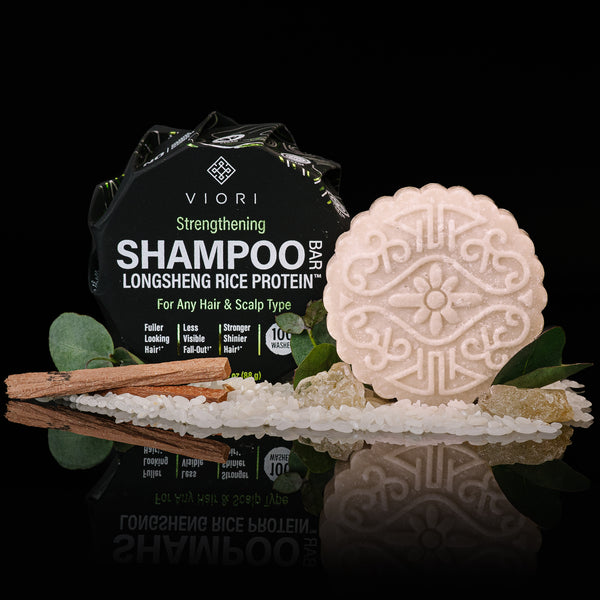
Vanilla, amber, and musk fragrances often include heavier molecular-weight compounds that add slight weight to hair strands, improving moisture retention. This makes them more suitable for dry or coarse hair types.
This is intentional formulation science, not just making things smell pretty.
Our Citrus Yao formulation at Viori isn't randomly scented-the citrus elements actively assist with oil control, which is why we recommend it for oily scalp types. Our Terrace Garden and Hidden Waterfall scents contain floral and musky notes that contribute to moisture retention, making them ideal for dry to normal hair.
Understanding this connection helps you choose not just what smells good, but what will actually work best with your specific needs.
The Fermentation Advantage Nobody Explains Properly
This is perhaps the most overlooked technical factor in shampoo bar quality: fermentation fundamentally changes the bioavailability of nutrients. It's not just some trendy buzzword.
When rice is fermented, enzymatic processes break down starches and proteins into smaller, more easily absorbed molecules. This process increases concentrations of:
- Inositol (Vitamin B8): Clinically shown to strengthen hair follicles and reduce shedding
- Panthenol (Vitamin B5): Improves hair elasticity and moisture retention
- Amino acids: The building blocks your hair needs for keratin repair
The Red Yao women of Longsheng have perfected this fermentation process over nearly 2,000 years. The specific temperature control, timing, and heirloom rice strains create a nutrient profile that modern laboratory synthesis simply cannot replicate.
Yet when you're shopping online, a bar made with basic rice extract and one made with traditionally fermented Longsheng rice water can look identical. The descriptions might sound similar. The prices might even be comparable.
This is where technical education becomes crucial. The difference isn't visible in product photos-it's in the formulation science and traditional preparation methods that take years to perfect.
At Viori, we've built our entire philosophy around honoring this 2,000-year-old tradition because we understand the chemistry behind why it works. It's not about romanticizing ancient wisdom-it's about respecting a fermentation process that creates genuinely superior bioavailability.
Why Your Conditioner Bar Feels Different (And Why That's Good)
Here's a common complaint I see: "The conditioner bar is too soft!" or "It crumbled after two weeks!"
This reveals a fundamental misunderstanding of conditioner bar physics that needs clarification.
Shampoo bars contain surfactants that create structural rigidity. Conditioner bars are primarily made of butters, oils, and emollients-ingredients that naturally have lower melting points and softer textures.
A conditioner bar that's rock-hard probably contains excessive binding agents or waxes that will coat your hair rather than penetrating it. A properly formulated conditioner bar should feel slightly softer than a shampoo bar-that softness indicates it's rich in actual conditioning ingredients, not filler.
The solution isn't finding a harder conditioner bar. It's proper storage (keeping bars dry between uses on a well-draining soap dish) and adjusting your expectations about texture based on actual formulation science.
The Transition Period: What's Actually Happening to Your Scalp
Perhaps the most technically misunderstood aspect of switching to bars is the adjustment period. Let me explain the actual biology.
Your scalp's sebaceous glands have been trained by years of harsh shampoos. When conventional shampoos strip away natural oils, your scalp responds by overproducing sebum to compensate. This creates a dependency cycle-the harsher your shampoo, the oilier your scalp becomes, which makes you feel like you need harsh shampoo.
When you switch to a pH-balanced, gentler bar, your scalp doesn't immediately recognize it should reduce oil production. This recalibration process takes 2-6 weeks depending on your individual biology, water quality, and previous product history.
During this period, your hair might feel greasier or just "different." This isn't product failure-it's sebaceous gland re-education.
The challenge is that many people give up during this window, assume the product doesn't work, and leave negative reviews before their scalp has had time to adjust.
My professional recommendation? Commit to 2-3 months before making a final judgment. This timeline aligns with the hair growth cycle and allows for complete scalp microbiome adjustment.
I know this requires patience, but the biological reality of your scalp doesn't care about convenience-it has its own timeline.
The Color-Treated Hair Concern: Technique Matters More Than Format
"Stripped my color!" is one of the most common warnings I see about shampoo bars.
WHAT CUSTOMERS ARE SAYING
Real reviews for Rice Water Shampoo Bar – All Hair Types | VIORI
Let me set the record straight: bar format doesn't inherently strip color any more than liquid shampoo. The issue is usually friction and dye quality.
When you rub a bar directly on your head, you create mechanical friction that can lift the hair cuticle. If you've used semi-permanent dye, toner, or box color-which sit on the cuticle rather than penetrating the cortex-this friction can remove color faster than gentler application methods.
The solution isn't avoiding bars. It's changing your application technique.
Professional technique for color-treated hair: Lather the bar in your hands first, then apply the foam to your hair with your palms. This eliminates direct bar-to-hair friction while maintaining cleaning efficacy.
Additionally, permanent dyes that penetrate the hair cortex (the professional salon option) are significantly more resistant to any removal method. If your color is fading quickly with any cleansing method, it's likely an indicator of poor-quality dye choice rather than your shampoo.
At Viori, we specifically recommend palm-lathering for color-treated hair and suggest professional permanent color for best longevity. These are the kinds of technical details that make the difference between success and frustration.
What Star Ratings Can't Capture About Hair Chemistry
After two decades in this industry, here's my honest professional assessment: the five-star rating system cannot capture the nuanced, individual, and chemistry-dependent nature of hair care.
A bar that's perfect for someone with soft water, normal-to-dry scalp, and fine hair might be completely wrong for someone with hard water, oily scalp, and thick hair. Yet both people are reading the same reviews and making decisions based on averaged stars that don't account for their specific variables.
The technical sophistication required to formulate a truly effective shampoo bar-pH balancing, surfactant selection, conditioning agent chemistry, protein concentration, water hardness compatibility, and scalp type customization-is almost entirely invisible in product listings optimized for keywords and pretty photos.
This is why professional guidance and transparent education matter more than ever.
The best shampoo bar for you isn't the one with the most reviews, the prettiest packaging, or even the lowest price. It's the one formulated by people who understand the complex chemistry of hair, who respect traditional preparation methods that modern shortcuts can't replicate, and who are willing to provide honest technical education about what their products can and cannot do.
Why Viori Takes a Different Approach
At Viori, we've built our brand on a principle that seems almost radical in today's marketplace: complete transparency about formulation science combined with deep respect for time-tested traditional methods.
We don't just make shampoo bars-we bridge 2,000 years of Red Yao hair care wisdom with modern cosmetic chemistry to create products that actually work with your hair's biology.
Our bars feature:
- pH-balanced formulations (4.5-6.5) that work with your hair's natural acidity, not against it
- Sulfate-free cleansing using SCI that's gentle enough for daily use but actually cleans your hair
- Traditionally fermented Longsheng rice water with enhanced bioavailability of vitamins, minerals, and amino acids
- Carefully calibrated protein levels that strengthen without overloading
- Intentional scent formulations designed for different scalp types, not just aesthetic preference
- Hard water compatibility built into the base formulation
But perhaps most importantly, we're committed to education. We believe you deserve to understand the why behind the what-the actual science that makes our bars work differently than the countless options filling online marketplaces.
Your Professional Shopping Checklist
Shopping for shampoo bars


