
Twenty years of working with curly hair has taught me one thing: the right question isn't "which hydrating shampoo should I use?" It's "why does my curly hair stay thirsty no matter what I use?"
If you're exhausted from trying every moisturizing product on the market only to watch your curls turn crispy by midday, I need you to understand something important-you haven't failed. The conventional approach to curly hair hydration has been fundamentally incomplete.
Today, I'm pulling back the curtain on what actually happens when you put "hydrating" products on curly hair, and why the solution has less to do with moisture and more to do with structure than anyone's been telling you.
Your Curls Aren't Just Textured-They're Architecturally Different
Let's start with what makes your hair different at the microscopic level, because this changes everything.
Straight hair has cuticle layers that lie relatively flat, like shingles on a roof. Curly hair? Every twist and coil forces those cuticle layers to lift away from the hair shaft. It's not damage-it's geometry. Your curl pattern literally prevents your cuticles from sealing tightly.
This means curly hair is naturally more porous than straight hair, even when it's perfectly healthy. Those lifted cuticles create pathways where moisture can escape, which is why your curls can feel parched an hour after conditioning.
Understanding this architectural reality is step one. Step two is understanding why most "hydrating" products actually make this problem worse.
The Moisture Trap: How Hydrating Ingredients Create Thirsty Hair
Here's what's really happening when you slather your curls with that conditioning treatment.
The Initial Rush
When you apply conditioner loaded with humectants-glycerin, honey, aloe-these ingredients latch onto your hair proteins and pull water into your hair shaft. Your curls feel amazing. Soft, defined, touchable. This is what I call the honeymoon phase.
The Environmental Betrayal
But humectants don't just pull moisture in. They create an ongoing exchange between your hair and whatever humidity level surrounds you.
NOT SURE WHICH PRODUCT IS RIGHT FOR YOU?
TAKE THE QUIZTakes 30 seconds · 134,000+ customers matched
In humid weather, they keep pulling moisture from the air into your already-saturated curls. Result? Frizz, swelling, loss of definition.
In dry environments-winter heating, summer air conditioning, arid climates-those same humectants reverse course. They release moisture from your hair into the drier air around you.
The Damage Cycle
Here's where it gets insidious. Every time your hair swells with moisture then contracts as it dries, those naturally-lifted cuticles on your curly hair get roughed up even more. Over time, you've created additional porosity on top of your hair's natural structural porosity.
Your hair becomes even more desperate to grab moisture, so you reach for heavier products, which contain more humectants, which create more swelling and contracting, which damages your cuticle structure further.
You're not maintaining moisture. You're creating a dependency.
The Real Solution Isn't More Moisture-It's Better Structure
Think of it this way: you can keep pouring water into a bucket with holes, or you can patch the holes so the bucket holds water on its own.
That's the difference between humectant-based hydration and protein-based moisture retention.
Water-based moisture practices that ignore protein structure are like filling that leaky bucket over and over. Your curls might feel temporarily hydrated, but they're not actually holding onto anything.
Why Rice Protein Changes Everything
Hydrolyzed rice protein works at a structural level. These proteins are small enough to penetrate your hair shaft and temporarily patch into the gaps in your cuticle and cortex.
This doesn't just add moisture-it helps your hair maintain the moisture it already has by reinforcing the structure that's supposed to hold it.
At Viori, we've watched this principle in action through traditional practices of the Red Yao tribe. These women use fermented rice water on hair that often has natural texture and wave, and their hair remains incredibly strong and hydrated well into their eighties. Not because they're constantly adding moisture, but because they're supporting their hair's ability to retain it.
The Fermentation Factor: Why Ancient Methods Solve Modern Problems
There's real science behind why fermented rice water has been a hair care staple in Asian cultures for centuries.
The Inositol Difference
During fermentation, rice releases a carbohydrate molecule called inositol. Unlike humectants that create that problematic moisture exchange with your environment, inositol actually penetrates your hair shaft and stays there-even after rinsing. Research shows it continues protecting through multiple wash cycles.
This is a completely different kind of hydration. You're not attracting water from outside sources that you'll lose as soon as conditions change. You're improving your hair's internal capacity to maintain moisture balance regardless of the weather.
The Panthenol Boost
Fermentation also increases panthenol content (Vitamin B5), which converts to pantothenic acid inside your hair shaft. This improves your hair's ability to bind and hold water at the cellular level.
This is why properly fermented rice water creates different results than products with basic rice extract. The fermentation process develops a specific nutrient profile that addresses the structural needs of curly hair rather than just temporarily influencing its water content.
The pH Factor Nobody Talks About
Here's a technical detail that completely changes how hydration works on curly hair: the pH of your products.
How pH Affects Your Cuticle
Hair has an isoelectric point around pH 3.67. At this pH level, your cuticle naturally contracts and lies flatter. Most shampoos range from pH 5-7, and many moisturizing formulas trend even higher because formulators mistakenly think this is gentler.
For curly hair, this is backwards.
When you cleanse at pH 6-7, you're opening the cuticle. For straight hair with naturally tight cuticles, this temporary opening isn't catastrophic. For curly hair with already-lifted cuticles, you're making the fundamental moisture-retention problem worse.
The Right pH Approach
A genuinely hydrating routine for curls should include:
- Cleansing at pH 5.5 or lower to minimize cuticle raising
- Conditioning at pH 3.5-4.5 to encourage cuticle closure when you're most vulnerable
- Protein treatments at pH 4.5-5.5 for optimal penetration without excessive swelling
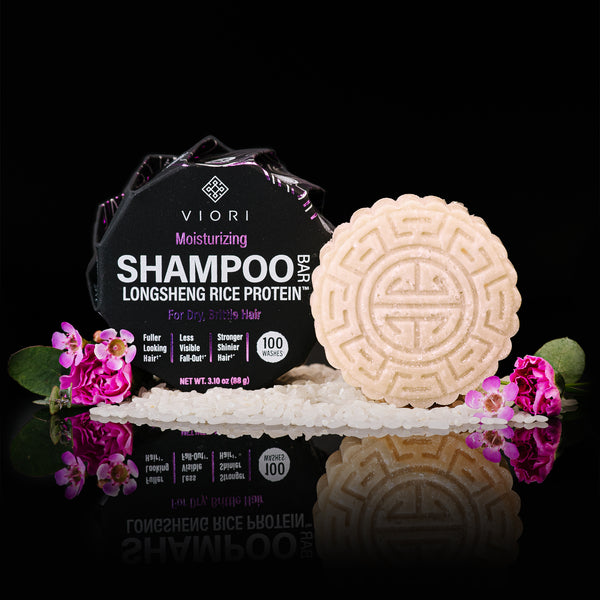
Viori shampoo and conditioner bars are formulated with this pH consideration in mind, maintaining a slightly acidic pH that works with your curl structure instead of against it.
Why Your Products Work in Fall But Fail in Summer
Professional curl specialists understand something most marketing ignores: there's no universally perfect hydrating product for curly hair. There's only the right formula for your current environment.
Understanding Dew Point
Humidity percentage is misleading. What actually matters for curly hair is the dew point-the temperature at which air can no longer hold moisture. This determines whether humectants will pull moisture into or out of your hair.
Here's the framework:
High Dew Point (60°F/15°C and above): Heavy humectants like glycerin cause excessive moisture absorption, leading to frizz and lost definition. You need products with film-forming ingredients like panthenol that provide hydration without hygroscopic extremes.
Moderate Dew Point (40-60°F/4-15°C): The sweet spot where most hydrating products actually work as promised.
Low Dew Point (below 40°F/4°C): Traditional humectants will dehydrate your curls. You need moisture-sealing ingredients and structural proteins that help hair hold onto internal water without relying on environmental exchange.
Most people use the same products year-round, wondering why they work beautifully in spring but fail in July and January. The dew point is why.
Porosity Matters More Than Curl Type
Controversial opinion from twenty years in the salon: the curl typing system (3A, 3B, 4C) is nearly useless for selecting hydrating products. Porosity is what actually matters.
The Three Types of Porosity
Curly hair can have multiple types of porosity happening simultaneously:
- Structural porosity: Based on your natural cuticle pattern (curly hair inherently has more)
- Damage-induced porosity: From chemical treatments, heat, or mechanical stress
- Hygroscopic porosity: Created by repeated swelling and contracting from humectant overuse
That last type is the one nobody discusses, and it's incredibly common among people who've been following moisture-heavy routines for years.
Matching Products to Your Porosity Type
For healthy curls with primarily structural porosity, you don't need heavy, penetrating moisture. You need cuticle-smoothing ingredients that work with your natural structure. Rice protein excels here-it coats and smooths without forcing hydration.
For curls with damage-induced porosity, you need actual gap-fillers: hydrolyzed proteins small enough to penetrate, along with ingredients that can temporarily fill damaged areas.
For hygroscopic porosity (which many curl enthusiasts have developed without realizing), you need to reset your moisture balance by backing off heavy humectants and focusing on structural repair for 6-8 weeks.
The Sebum Problem: Why Curly Hair Is Biochemically Drier
Let's talk about something that undermines every product's efforts: curly hair has a sebum distribution problem that's architectural, not fixable with topical products alone.
The Geometry of Oil Flow
Your scalp produces sebum-a complex oil mixture designed to coat and protect your hair. On straight hair, this oil easily travels down the hair shaft via gravity and surface tension.
On curly hair, every curl and kink interrupts this flow.
This means curly hair is biochemically drier from root to tip, especially at the ends. No amount of conditioner can fully compensate for this architectural sebum deficiency.
This is why professionals focus on moisture retention rather than just moisture addition.
The Biomimetic Approach
Rather than fighting this reality with heavy humectants, a smarter approach mimics what your hair isn't getting naturally.
Rice bran oil contains gamma-oryzanol and tocotrienols that closely mimic some protective properties of sebum, specifically for reducing surface friction and preventing moisture loss.
The fermented rice approach isn't just about adding moisture-it's about creating a protective environment where your hair can maintain its own moisture balance despite the geometric challenges of your curl pattern.
The Temperature Technique: A Professional Secret
Here's something I teach in advanced workshops that you won't find in typical hydration guides: the temperature at which you rinse your conditioner determines how effectively your curls hold onto hydration.
WHAT CUSTOMERS ARE SAYING
Real reviews for Moisturizing Rice Water Shampoo Bar – Dry Scalp | VIORI
The Professional Rinse Method
Warm water during conditioning allows ingredients and proteins to penetrate more effectively-heat temporarily increases cuticle permeability.
But the temperature gradient as you rinse determines the final cuticle position.
Try this:
- Condition with warm water, allowing products to penetrate for 2-3 minutes minimum (curly hair is denser and needs more time)
- Begin rinsing with warm water to remove excess product
- Gradually decrease temperature to cool (not cold-that's a shock to the scalp)
- Final rinse should be at the coolest temperature comfortable for your scalp
This temperature gradient causes the cuticle to gradually contract rather than snap shut. For curly hair, this creates a tighter seal that reduces moisture loss without trapping so much product that you get buildup.
When Dry Curls Need Less Moisture, Not More
This confuses even experienced curl enthusiasts: sometimes the solution to dry, dehydrated curls is less moisture and more protein.
Understanding Hygral Fatigue
When curly hair is constantly exposed to moisture-from over-washing, daily wetting, or heavy humectant use-the hair shaft experiences repeated swelling and contracting. This is called hygral fatigue, and it causes:
- Increased porosity from constant cuticle movement
- Weakened elasticity as protein structures become overstretched
- Paradoxical dryness because damaged structure can't hold moisture
The solution isn't more conditioner. It's protein reinforcement to restore the structural integrity that allows hair to hold moisture properly.
Why Rice Protein Works Differently
Hydrolyzed rice protein is uniquely suited for curly hair because of its molecular size distribution:
- Small fragments penetrate the cortex to reinforce internal structure
- Medium fragments fill gaps in the cuticle layer
- Larger fragments coat the surface for immediate smoothing
This multi-level approach addresses the specific protein needs of curly hair better than single-size protein molecules.
When combined with fermented rice water components like inositol and panthenol, you're reinforcing structure while improving intrinsic moisture retention-not just temporarily adding water.
Your Scalp Microbiome Affects Your Curls' Hydration
Here's cutting-edge thinking that's barely touched mainstream advice: your scalp microbiome directly influences how well your curls maintain hydration.
The Moisture Gradient Problem
Recent research shows that scalp microbiome imbalance (often from harsh sulfates or pH-inappropriate products) leads to increased water loss from the scalp itself.
This doesn't just cause dry scalp-it creates a moisture gradient that pulls moisture from your hair shafts back toward your dehydrated scalp tissue.
For curly hair, where moisture distribution is already challenged, this creates a no-win situation: your hair loses moisture both to the environment (through lifted cuticles) and to your own scalp.
Fermented Ingredients and Scalp Health
Fermented rice water contains postbiotics-beneficial compounds created during fermentation-that support a balanced scalp environment without disrupting the microbiome like antibacterial ingredients do.
A healthy scalp microbiome maintains proper moisture levels in scalp tissue, eliminating that moisture-stealing gradient. This is hydration support from the inside out.
A Better Framework: How to Actually Hydrate Curly Hair
Based on this technical understanding, here's how to approach curly hair hydration more effectively:
Step 1: Assess Your True Need
Ask yourself:
- Is my hair structurally compromised (needs protein)?
- Is my scalp environment healthy (microbiome balanced)?
- What's my climate's dew point this season?


