
If you’ve been eyeing a rosemary nettle shampoo bar, you’re probably hoping for that holy grail combo: a cleaner scalp, less oil, fewer flakes, and hair that feels stronger (maybe even looks like it’s growing faster). Rosemary and nettle absolutely have a long history in hair rituals-but here’s the truth I’ve learned after 20 years working with every hair type imaginable: in a shampoo bar, the herbs are rarely the main reason you love (or hate) the results.
What matters most is the stuff most people never talk about: how the botanicals are extracted, whether the bar is pH-appropriate for hair, and how the formula controls friction and residue. Get those right and a bar can feel like a dream. Get them wrong and even the prettiest “herbal” bar can leave hair rough, dull, or oddly coated.
Why rosemary + nettle is more complicated than it sounds
Shampoo is a rinse-off product. That means you’re typically giving it 30 to 90 seconds to do its job. So the real question isn’t “Are rosemary and nettle good for hair?” It’s this: Can the formula deliver anything meaningful in a short contact time without irritating your scalp or roughing up your cuticle?
Most of what people attribute to rosemary or nettle-oil control, shine, softness, “my hair feels thicker”-is often driven by the bar’s cleanser system and pH, not the herbs themselves.
NOT SURE WHICH PRODUCT IS RIGHT FOR YOU?
TAKE THE QUIZTakes 30 seconds · 134,000+ customers matched
Rosemary in a shampoo bar: which rosemary are you actually getting?
“Rosemary” on a label can mean very different things. And in haircare, those differences matter because they change how the ingredient behaves in water, how it feels on the scalp, and whether it’s likely to linger after rinsing.
1) Rosemary essential oil (aromatic, oil-loving)
This is the version people recognize instantly-the fresh, spa-like rosemary scent. It’s potent and concentrated, and it tends to bring more of the aromatic compounds than the water-soluble polyphenols.
What I see in real life: this can feel invigorating and “cleansing,” but it’s also the form most likely to annoy a very reactive scalp if it’s used heavily or if your scalp barrier is already stressed.
2) Rosemary water or glycerin extracts (water-loving)
These are more likely to carry rosemary’s polyphenol side-compounds that get discussed in “scalp care” circles for their antioxidant potential. In theory, this is a better match for people chasing “calm scalp” benefits.
The catch: a rinse-off formula has to be designed for deposition (getting ingredients to stick around) or most of that benefit disappears down the drain.
3) Rosemary powder (the “looks natural” option)
Powdered herbs are popular in bars because they’re easy to add and they look the part. But the extraction you get in a quick shower wash is often limited.
What almost no one mentions: plant powders can also increase drag if the bar isn’t engineered for slip, which can translate to more tangling-especially in long, porous, curly, or color-treated hair.
Nettle in a shampoo bar: supportive, but usually not the “main character”
Nettle has a reputation for “balancing” the scalp. People also love to associate it with hair growth. Botanically, nettle contains a mix of compounds that can be supportive in scalp care routines-but in a shampoo bar, the sensation you notice most often (that extra-clean feel or reduced oil) is frequently coming from the bar’s cleansing strength rather than nettle itself.
When someone tells me a nettle bar “fixed” their oily scalp, I start thinking about the formula around it: the cleanser system, the rinse feel, and whether the bar is leaving residue that makes the scalp feel dirty again sooner.
The part that actually decides whether you’ll love the bar: pH + cleanser system
This is the crossroads where shampoo bars either become a permanent switch-or an expensive experiment you give up on after two weeks.
Not all bars are built the same. Some are essentially soap-like and can lean alkaline. Others are designed more like modern shampoo, using mild cleansing agents that allow the formula to stay in a hair-friendly pH range.
Why pH matters: hair generally behaves best in a mildly acidic environment. When a cleanser is too alkaline, the cuticle can lift more easily, and that tends to show up as tangling, frizz, and dullness. It can also be rough on color-treated hair.
Viori emphasizes that its bars are pH balanced, which is a big deal for long-term hair quality. Their shampoo bars use a mild cleanser system (including Sodium Cocoyl Isethionate) rather than harsh sulfates, and they’re designed to cleanse without leaving hair feeling stripped.
The “missing” topic online: deposition (aka, what stays on your hair after you rinse)
If you want a unique lens on rosemary nettle shampoo bars, this is it. People talk endlessly about ingredients, but almost nobody talks about delivery.
Hair-especially damaged hair-tends to carry more negative charge on the surface. Formulas that include positively charged conditioning materials can bind more readily, improving slip and reducing friction. That “glide” matters because friction during washing is one of the quietest causes of breakage I see in everyday routines.
Viori uses Behentrimonium Methosulfate (a conditioning ingredient, despite the scary-sounding name) as part of its system. In practical terms, it helps hair feel smoother and more manageable-so you’re less likely to over-scrub, over-detangle, or overwork the hair while it’s most vulnerable.
Let’s talk scalp reality: oil, flakes, itch, and the rebound cycle
A lot of people reach for rosemary and nettle because they’re dealing with oil and irritation-and they want something “gentle but effective.” That’s a smart goal, but it’s also where people accidentally create a cycle.
- Over-cleansing can leave the scalp tight and reactive.
- A stressed scalp can trigger oil rebound (your scalp tries to compensate).
- Oil + residue can create more itch and visible flaking for some people.
So if you’re chasing that “balanced scalp” feeling, the win isn’t necessarily more herbs-it’s finding a formula that cleans well, rinses clean, stays pH-appropriate, and doesn’t leave your scalp feeling stripped.
WHAT CUSTOMERS ARE SAYING
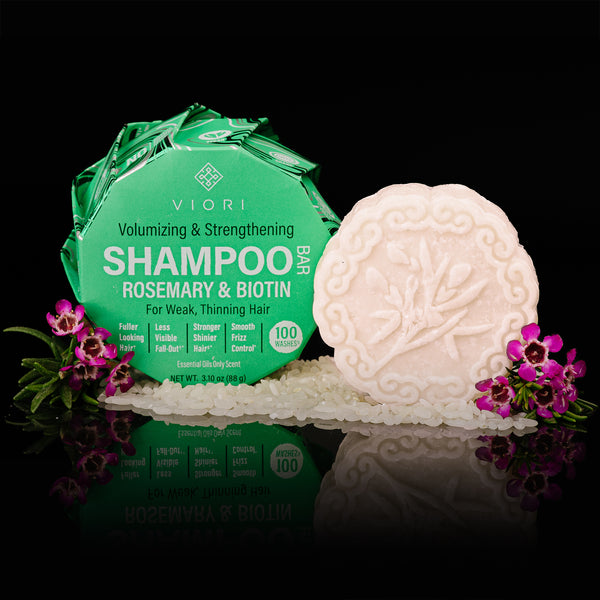
Real reviews for Rosemary Biotin Shampoo Bar – Thinning Hair | VIORI
Hair growth expectations: what a shampoo bar can (and can’t) do
I’m always careful with “growth” conversations because hair growth is biology, and shampoo is not medication. That said, shampoo choices can absolutely influence whether your hair retains length-and that’s what many people interpret as “my hair is growing faster.”
Here’s what a well-formulated bar can realistically support:
- Less breakage (stronger-feeling hair, fewer snapped ends)
- Better scalp comfort (less scratching and inflammation behaviors)
- Cleaner follicles for people who struggle with oil and buildup
- Improved manageability, which reduces aggressive brushing and heat damage
Viori’s approach leans into hair resilience with its fermented Longsheng rice water and supporting ingredients like vitamin B5 (panthenol) and vitamin B8 (inositol), which are widely used in haircare for strengthening and improved feel. It’s a more realistic pathway to the “my hair looks fuller” effect: healthier strands behave better and break less.
How to use a shampoo bar so it behaves like a high-end cleanse (not a wrestling match)
If you only change one thing, change this: reduce friction. Most bar complaints I hear-tangles, roughness, color fading-trace back to how the bar is applied.
- Lather in your hands first, then apply the foam to your scalp. This is especially important if your hair is color-treated.
- Massage with finger pads, not nails, for 30-60 seconds.
- Rinse thoroughly. Many “my scalp feels itchy” moments are actually leftover residue around the hairline and nape.
- Follow with a conditioner. Viori recommends using conditioner after cleansing, and from a chemistry standpoint it makes sense: conditioner helps restore slip and protection after you remove sebum and debris.
If you like the rosemary + nettle idea, here’s how to choose within Viori
Even though Viori doesn’t label a bar specifically as “rosemary nettle,” you can choose based on the same end-goal most people want from that herbal combo-balanced scalp, clean roots, healthy lengths.
- For oilier scalps: Viori Citrus Yao is typically the best starting point, and Viori notes that citric acid in that scent profile helps break down oil.
- For normal hair/scalp: Viori Hidden Waterfall is a flexible, all-around option.
- For dry scalp, frizz, or hair that needs moisture: Viori Terrace Garden or Native Essence.
- For fragrance sensitivity or very reactive scalps: Viori Native Essence (unscented) is the gentlest choice.
Bottom line: in a bar, “herbal” is a concept-performance is engineering
A rosemary nettle shampoo bar can be a great idea, but the best results don’t come from the herbs in theory. They come from a formula that’s built for hair: pH balanced, mild but effective cleansing, and a smart system for slip and deposition so your hair doesn’t pay the price in tangles and breakage.
If you want a more tailored recommendation, start with two quick details: how many days after washing your scalp starts feeling oily, and whether your hair is color-treated. From there, it’s easy to narrow down the best Viori match and adjust technique so you get that “clean, balanced, healthy” finish people are really chasing when they say rosemary + nettle.


