
Most conversations about shampoo for gray hair start and end with one goal: “get the yellow out.” And yes, toning can help. But in the salon, I’ve seen something far more common-clients with beautiful gray or white hair that still looks a little tired, hazy, or wiry even when the color is technically fine.
The reason is surprisingly simple: gray hair isn’t just a pigment change. It’s a surface and structure change. When that surface isn’t smooth and well-conditioned, light doesn’t bounce cleanly-so hair can look dull, flat, or even slightly yellowed no matter what you do.
In this post, we’re going to take a more interesting route than the usual “use a toning shampoo” advice. We’ll focus on what I call optical quality: the science of getting gray hair to look bright, polished, and intentionally silver-because it’s reflecting light the right way.
NOT SURE WHICH PRODUCT IS RIGHT FOR YOU?
TAKE THE QUIZTakes 30 seconds · 134,000+ customers matched
Gray Hair Is a Different Fiber (Not Just a Different Shade)
When melanin fades, the strand often changes in ways you can feel and see. Some people notice their gray comes in coarser. Others find it gets frizzier, drier, or more stubborn to style. These shifts are real, and they’re not just “in your head.”
Here’s what’s going on behind the scenes:
- Internal light scatter increases: as hair loses pigment, the way light travels through the fiber changes. Even clean white hair can look “matte” if light is scattering instead of reflecting cleanly.
- The cuticle shows wear more easily: rough cuticles scatter light. Dark hair can visually hide a bit of texture; gray hair doesn’t.
- Friction becomes more noticeable: less lubrication and more surface roughness can translate into that classic “wiry” gray feel.
The Under-Discussed Goal: Optical Quality
If you’ve ever said, “My gray looks dull,” what you’re really describing is optical quality-how smoothly your hair reflects light.
Think of it like this: a smooth surface reflects light like a mirror; a rough surface reflects light like frosted glass. Gray hair tends to look its best when the cuticle lies flatter and the strand is well-lubricated, because the light reflection becomes cleaner and more uniform.
Why Gray Hair Yellows (Even If You’re Doing Everything “Right”)
Yellowing is frustrating because it can come from multiple sources at once-and many of them have nothing to do with your hair “getting dirty.”
- UV-related oxidation: sunlight can trigger chemical changes in the hair fiber that read as yellow over time.
- Hard water minerals and trace metals: deposits can cling to the cuticle and create a dull, yellow cast-especially noticeable on white hair.
- Product residue: buildup changes how light hits the strand and can make gray hair look cloudy instead of crisp.
The takeaway? A smart shampoo routine for gray hair isn’t only about color-correcting. It’s also about keeping the hair surface clean, smooth, and reflective.
pH: The Quiet Power Move for Gray Hair
One of the quickest ways to make gray hair look rougher is to use products that push the cuticle in the wrong direction. When the cuticle stays lifted, you’ll often notice more tangling, more frizz, and less shine.
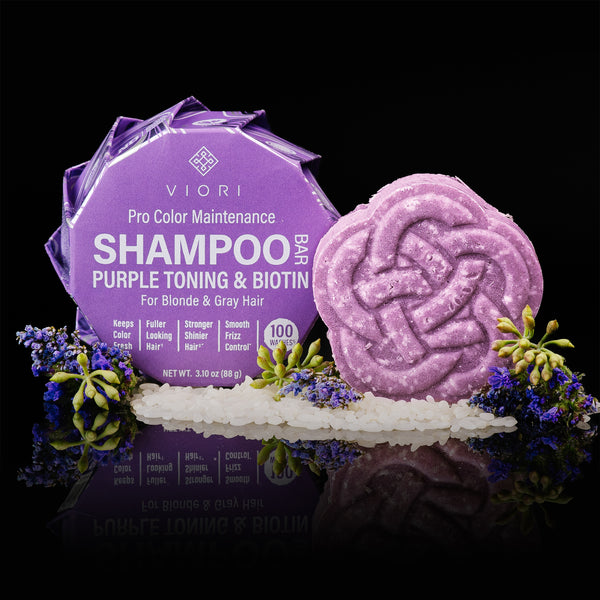
That’s why pH balance matters so much. Hair generally performs best in a mildly acidic range, which supports a flatter cuticle and better light reflection. Viori bars are pH balanced, and that can be a big deal for gray hair because it helps protect the surface qualities that make silver hair look luminous instead of dull.
Protein for Gray Hair: It’s Not a Yes/No Question
Online, protein gets framed like a villain or a miracle. In reality, it’s more like seasoning: dose and context are everything.
Gray hair often has mixed porosity-for example, stronger, more resistant strands near the crown paired with more weathered, porous ends. That’s why the same routine can feel amazing for one person and too heavy (or too drying) for another.
Viori uses a low concentration of rice protein, which tends to be a helpful “middle ground” for many people: enough to support strength and shine, without pushing hair into that stiff, brittle feeling that can happen when protein is overdone.
The Metric That Matters Most: Friction
If you want one professional-level clue that you’re on the right track, watch for this: How does your hair feel when it’s wet?
When wet hair feels grabby, squeaky, or tangly, that usually signals high friction-and high friction is where a lot of gray-hair frustration begins. Over time, friction contributes to micro-wear on the cuticle, which can lead to more frizz, more dullness, and more breakage.
That’s also why conditioner matters so much. Conditioner is designed to improve slip and reduce friction, helping hair feel smoother and look shinier. Viori’s conditioner bar includes behentrimonium methosulfate, a conditioning ingredient that helps provide that “slip” gray hair often needs to behave.
WHAT CUSTOMERS ARE SAYING
Real reviews for Purple Shampoo Bar with Biotin – Blonde & Gray | VIORI
Using Shampoo Bars on Gray Hair: Technique Changes Results
This is a detail most people skip-and it’s one of the easiest ways to protect gray hair’s shine.
With bar shampoo, repeated rubbing directly on the length can create unnecessary mechanical wear. A gentler approach helps preserve the cuticle, which preserves brightness.
A salon-style wash method (especially good for gray hair)
- Thoroughly saturate hair with water.
- Create lather in your palms using the Viori shampoo bar.
- Apply lather to the scalp and cleanse with the pads of your fingers (avoid nails).
- Let the suds rinse through the mid-lengths rather than scrubbing the ends.
- Apply conditioner from mid-lengths to ends and rinse well.
Which Viori Bar Makes Sense for Gray Hair?
Here’s the truth: “gray hair” isn’t a scalp type. The best match usually depends more on your oil level and sensitivity than the color of your hair.
- If your scalp runs oily: Viori Citrus Yao is commonly preferred for oil control.
- If your scalp is normal-to-dry: Viori Terrace Garden, Hidden Waterfall, or Native Essence tend to be more moisture-supportive options.
- If you’re fragrance-sensitive: Viori Native Essence is the unscented choice and is often the gentlest route.
- If you have oily roots and dry ends: consider “zoning” your routine-cleanse the scalp for oil control, and keep conditioning focused on the ends.
How Long Does It Take to Notice a Difference?
Some people feel a shift in softness quickly, but the most meaningful improvement for gray hair-shine, smoothness, manageability-often builds over time because it’s tied to the cuticle’s condition. Viori commonly recommends giving a routine 2-3 months before judging it, and that’s consistent with what I see when hair is transitioning into a healthier, smoother pattern.
One Last Note (Because It Matters)
Haircare can dramatically improve how gray hair looks and feels, but it isn’t medical treatment. If you’re dealing with sudden shedding, scalp inflammation, or major texture changes, it’s worth checking in with a qualified healthcare professional.


