
After two decades behind the chair, I've learned that the most important conversations in hair care are often the ones nobody wants to have. Today, we're diving into one of them: why purple (or silver) shampoo bars remain one of the most significant unsolved problems in sustainable hair care-and what this reveals about the fascinating, complex world of hair chemistry.
If you're blonde, silver-haired, or gray and trying to maintain your color while reducing plastic waste, this is the article you've been looking for. Because the truth is, understanding why something doesn't work yet is the first step toward finding solutions that actually do.
Let's Start With What We're Actually Trying to Do
Before we dive into the technical challenges, let's establish the basics. Traditional liquid purple shampoos work through a beautifully simple principle: chromatic cancellation.
Yellow and purple sit opposite each other on the color wheel. When violet pigments temporarily deposit onto blonde or gray hair, they optically neutralize those brassy yellow tones that develop between salon visits. It's not magic-it's just color theory meeting hair chemistry.
But here's what most people don't realize: making this work requires an incredibly precise balance of pigment suspension, controlled release, adequate contact time, and the correct pH level. In liquid formulations, chemists have spent decades perfecting this. In bar format? We're essentially starting from square one, and the challenges are more fundamental than most brands want to admit.
The Solid-State Problem Nobody's Talking About
The core issue with silver shampoo bars comes down to how pigments behave in solid versus liquid form. Let me break this down in a way that makes sense:
In Traditional Liquid Purple Shampoos:
- Purple pigments (typically direct dyes) float suspended in water
- Surfactants help distribute the pigment evenly across every strand
- The liquid format ensures uniform contact with your hair
- Concentration can be controlled with incredible precision
- pH levels stay consistent, keeping hair cuticles slightly lifted for pigment penetration
In Solid Shampoo Bars:
- Pigments must be locked into a solid matrix of surfactants, oils, and binding agents
- The pigment doesn't release evenly-it depends on your water temperature, how hard you rub, and even your local water quality
- The paste-like lather of bars (versus the foam of liquids) means coverage is inherently uneven
- You get "hot spots" of concentrated pigment in some areas, while others receive no toning at all
- The friction required to work with bars can actually close the hair cuticle, preventing the very pigment penetration you're trying to achieve
Think of it like trying to paint a wall evenly with a solid paint stick versus a liquid paint with a brush. The format fundamentally changes how the product can be applied.
The Chemistry Challenge: When Good Ingredients Work Against Each Other
Let's look at what makes a quality shampoo bar effective for cleansing-and why those same ingredients create problems for toning.
NOT SURE WHICH PRODUCT IS RIGHT FOR YOU?
TAKE THE QUIZTakes 30 seconds · 134,000+ customers matched
Well-formulated cleansing bars (like those from Viori) typically contain:
- Conditioning agents like Behentrimonium Methosulfate
- Moisturizing fatty alcohols like Cetyl Alcohol
- Nourishing plant butters like cocoa and shea
- Strengthening agents like hydrolyzed proteins
These ingredients are excellent for hair health. They condition, moisturize, and protect. But they also create what I call the hydrophobic barrier problem.
Purple pigments are hydrophilic-they're water-loving molecules. When you surround them with oils, butters, and fatty alcohols in a solid bar, you're essentially coating the pigment in a barrier that prevents proper release and deposition onto the hair shaft.
It's like trying to mix oil and water. The very ingredients that make shampoo bars nourishing are actively working against the toning function.
The pH Balancing Act Gets Even More Complicated
Quality shampoo bars are pH balanced to protect hair health-typically somewhere between 3.5 and 6.5, which is the natural range for healthy hair and scalp. This is great for cleansing. For toning? It creates a dilemma:
- Lower pH (3.5-4.5): Your hair cuticle seals tight, protecting the hair but preventing pigment penetration. Result? Minimal to no toning effect.
- Mid pH (5-5.5): This is optimal for hair health and allows moderate pigment deposition-but only under ideal application conditions that are hard to achieve with bars.
- Higher pH (6-6.5): Better for pigment uptake, but when combined with the friction required to use a bar, this can actually damage hair over time.
Traditional liquid purple shampoos can sit comfortably at 5.5-6 because they don't require friction-you simply apply and let sit. Bars force you to choose: you need the friction to release product, but that friction at higher pH can compromise hair health, while lower pH prevents the toning effect you're seeking.
The Water Factor Everyone Forgets
Here's something that affects you directly but rarely gets discussed: shampoo bars perform dramatically differently based on your local water quality, and this issue is magnified tenfold with pigmented formulas.
If you live in an area with hard water (high in calcium and magnesium minerals), you're dealing with two additional problems:
Soap scum formation: The fatty acids in bars react with hard water minerals to create an insoluble film. When this film contains purple pigment, you get uneven, patchy deposits that are extremely difficult to rinse out completely.
Reduced lather: Hard water makes it harder to create lather, meaning you need more friction and more product-dramatically increasing your risk of over-depositing purple pigment in some areas while completely missing others.
A person using the same silver bar in Phoenix (very hard water) versus Seattle (very soft water) would have completely different experiences. This variability is exactly why professional stylists hesitate to recommend pigmented bars-we can't predict or control the results.
The Porosity Problem: Your Hair Isn't Uniform
Here's something I explain to every color client: your hair's porosity varies significantly from root to tip, especially if you've been coloring, lightening, or heat-styling for years. The ends are always more porous-more damaged, more open, more ready to grab onto color.
Traditional liquid purple shampoos can compensate for this through:
- Even distribution during application
- Formulations that include porosity-balancing ingredients
- Professional guidance on sectioning and timing
But bar shampoos have no mechanism to account for these porosity differences. The friction-based application means the areas where you scrub hardest (usually the crown and top layers) receive the most pigment-regardless of whether that's where your hair actually needs toning.
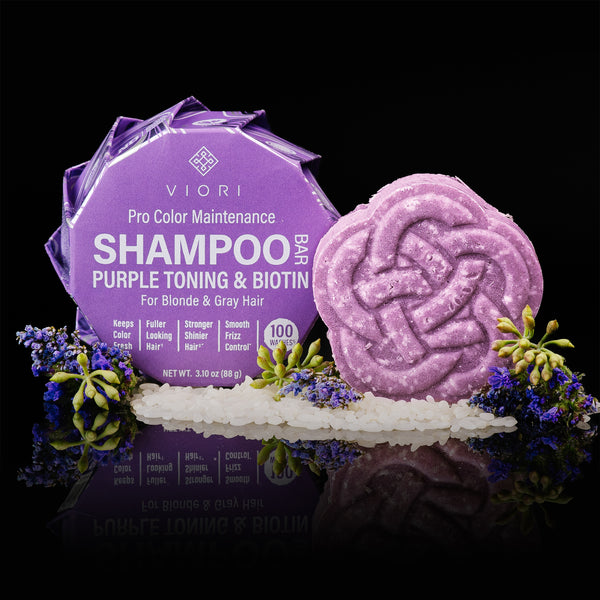
Meanwhile, your most porous areas (typically your ends, where brassiness is often worst) may receive less pigment simply because they're farther from where you're rubbing the bar against your scalp.
The result? Purple roots and brassy ends-exactly the opposite of what you need.
The Daily Use Dilemma
Quality shampoo bars are designed to be gentle enough for frequent use. But if you add purple pigment to that bar, you've created what I call the frequency trap:
- Blonde and silver hair typically needs purple toning only 1-3 times per week
- Using purple shampoo more frequently causes purple or gray discoloration
- With a toning bar, you can't easily "skip" the toning-if purple pigment is in your daily shampoo bar, you're getting some toning every single wash
- This forces you to purchase two separate bars (regular cleansing plus occasional toning), which defeats the convenience factor that makes bars appealing in the first place
Professional color-care systems separate cleansing from toning for exactly this reason. The bar format's "all-in-one" approach becomes a limitation rather than an advantage.
Why Professional Lines Stay Away From Silver Bars
I attend industry trade shows regularly, and here's what's telling: every sustainable and natural brand showcases extensive bar collections. Silver or purple bars are conspicuously absent from professional lines.
This isn't an oversight-it's because their research and development teams understand that the chemistry doesn't work reliably enough to put their reputation behind.
The few silver bars that do exist tend to come from smaller indie brands or general consumer companies. If you read reviews carefully, you'll see consistent patterns:
- "Worked great for two weeks, then turned my hair gray"
- "Doesn't tone nearly as well as liquid purple shampoo"
- "Created weird purple spots throughout my hair"
- "I had to use so much product that the bar only lasted three weeks"
These aren't necessarily formulation failures by inexperienced chemists-they're fundamental format limitations that even experienced formulators struggle to overcome.
The Economic Reality Behind Innovation
Here's the business side that impacts you as a consumer: developing a truly functional silver shampoo bar would require proprietary technology that makes it economically challenging for most brands.
To create a silver bar that actually works consistently, you'd need:
- Microencapsulation technology to protect pigment molecules and control their precise release
- Novel surfactant systems that create liquid-like, even lather from a solid format
- Specialized pigment distribution mechanisms that ensure uniformity across the entire bar
- Extensive testing across different water types, hair types, porosity levels, and use patterns
The research and development investment would be substantial. And while the purple shampoo market is loyal and growing, it's still relatively niche compared to general shampoo. Most brands find it more profitable to offer excellent standard bars and let customers add a separate toning treatment.
What Actually Works: The Hybrid Approach
For clients committed to reducing waste who also need regular toning, here's what I actually recommend in my salon:
Use a quality shampoo bar matched to your specific scalp type (like the targeted formulations Viori offers for different hair needs), then add a separate concentrated purple treatment.
Here's why this hybrid approach works better:
- Use your shampoo bar for cleansing 2-3 times per week
- Apply a concentrated toning treatment separately on damp, freshly cleansed hair
- Control the contact time precisely based on your specific brassiness (anywhere from 1-5 minutes)
- Rinse thoroughly
This method gives you:
- Significant waste reduction (one small concentrated treatment lasts months)
- Precise control over toning intensity
- Even, predictable application
- No compromise on your bar shampoo's cleansing performance
- The ability to tone only when needed, not every wash
What The Future Could Hold
As someone who's consulted with cosmetic chemists about this exact problem, here's what a truly functional silver bar would need:
Dual-Chamber Technology
Imagine a bar with physically separated cleansing and toning sections-perhaps a purple stripe running through a neutral base. Users could control toning intensity by how much they engage each section during use.
Soluble Film Coating
Microencapsulated purple pigment in a pH-triggered coating that only dissolves once it contacts wet hair, preventing premature release during the bar's lathering phase.
Strategic Ingredient Selection
A formula that removes competing ingredients in the toning section, giving pigment molecules unobstructed access to the hair shaft.
Application Innovation
Perhaps an included sustainable application tool (like a silicone brush or specialized comb) that helps create even, liquid-like distribution of the bar's lather-eliminating the friction variable entirely.
WHAT CUSTOMERS ARE SAYING
Real reviews for Purple Shampoo Bar with Biotin – Blonde & Gray | VIORI
These aren't fantasy solutions-they're achievable innovations. They just require significant R&D investment that hasn't been justified by market size yet.
Here's What I'd Actually Recommend Instead
If a brand truly wanted to serve the blonde and silver-haired community while staying committed to sustainability, here's what I'd suggest:
Don't try to make a silver shampoo bar. Create a solid purple conditioning treatment bar instead.
Think about it: a bar you apply after cleansing with your regular shampoo bar, massage through your hair, let process for 3-5 minutes, then rinse. This approach:
- Removes all the pigment-dispersal problems that plague cleansing bars
- Allows proper cuticle penetration without friction interference
- Lets conditioning ingredients work with the pigment instead of against it
- Gives users precise control over toning intensity and frequency
- Maintains all the waste-reduction and sustainability benefits
- Could actually improve on liquid purple conditioners by providing slower, more controlled release
The conditioning bar format could potentially deliver better toning results than liquid alternatives because the solid format naturally provides longer, more even contact time with the hair.
The Honest Truth About Innovation and Sustainability
The clean beauty and zero-waste movements are among the most important shifts happening in our industry. I'm completely supportive of reducing plastic waste-my salon has made significant changes in this direction.
But we serve our clients better by being honest about where sustainable technology genuinely delivers results versus where we're still developing effective solutions.
Silver shampoo bars aren't yet ready for professional recommendation-not because bars are inferior or the concept is flawed, but because the specific chemistry of purple pigment deposition fundamentally conflicts with the physics of solid surfactant delivery in ways that haven't been solved at consumer-accessible price points.
This doesn't mean you have to choose between your values and your hair. It means being strategic about where you make sustainable swaps.
The Most Sustainable Approach Right Now
Here's what I recommend to my blonde, silver, and gray-haired clients who want to reduce their environmental impact:
Make the switch to a high-quality shampoo bar for your regular cleansing needs. Choose one specifically formulated for your scalp type rather than a one-size-fits-all approach. Viori's system, for example, offers different bars targeted to specific needs-hydration for dry scalps, clarifying for oily scalps, supporting for thinning hair.
Then pair it with a minimal, concentrated toning treatment used 1-2 times per week. Look for:
- Powder-based treatments you mix fresh (minimal packaging, long shelf life)
- Highly concentrated liquid treatments (a little goes a long way)
- Conditioning-based purple treatments rather than shampoo-based
This approach gives you approximately 90% plastic waste reduction while maintaining the color integrity and hair quality that takes months of investment to achieve and maintain.


