
Let's talk about "hair care juice." Not because it's trending on TikTok, but because after two decades behind the salon chair, I've watched too many clients make the same expensive mistake: they're treating their hair like it needs surface moisture when what it actually craves is cellular transformation.
You know that moment when your hair feels incredible right after applying a water-based treatment, then somehow ends up more damaged three weeks later? That's not bad luck. That's biochemistry working against you.
Today, I'm sharing what actually happens at the molecular level when you apply liquid treatments to your hair-and why understanding this changes everything about the products you choose.
Your Hair Is Dead (And Why That Matters More Than You Think)
Here's the uncomfortable truth nobody mentions: the hair you can see and touch is dead protein. Not metaphorically dead-biologically dead. The only living part is the follicle hidden beneath your scalp.
Every strand you're trying to "hydrate" is essentially a complex protein structure that can't heal itself, can't produce moisture, and depends entirely on what you give it externally.
When I talk about hydrating hair with clients, we're really navigating three distinct zones:
- The cuticle layer - those overlapping outer "shingles" you've probably seen in magnified photos
- The cortex - the internal protein structure that determines strength and elasticity
- The medulla - the innermost core (which fine hair doesn't even have)
Here's what most brands won't emphasize: the majority of "hair juices" and water-based treatments only touch zone one. They create what I call false hydration-temporary swelling and shine that actually compromises your hair's structural integrity with repeated use.
Want to know why? We need to talk about molecular weight.
The Molecular Weight Secret That Determines Everything
This is the technical game-changer that rarely appears in mainstream hair advice: the size of molecules determines whether they sit on your hair or actually penetrate it.
Think of your hair cuticle like security gates. Those gaps between the overlapping "shingles" are approximately 0.5-1.0 nanometers when closed. For any ingredient to get inside and strengthen the cortex-where real damage and repair happen-it needs to be small enough to slip through, but substantial enough to do something once it arrives.
NOT SURE WHICH PRODUCT IS RIGHT FOR YOU?
TAKE THE QUIZTakes 30 seconds · 134,000+ customers matched
Here's what the numbers tell us:
- Pure water molecules: 18 g/mol (too small, creates swelling and what's called hygral fatigue)
- Glycerin (common in hair juices): 92 g/mol (great humectant, but mostly surface-level action)
- Standard proteins in commercial products: 10,000-50,000 g/mol (way too large, just sits on the surface)
Now here's where it gets fascinating: fermented rice water creates hydrolyzed proteins in the 200-1,500 g/mol range-the Goldilocks zone for actual penetration.
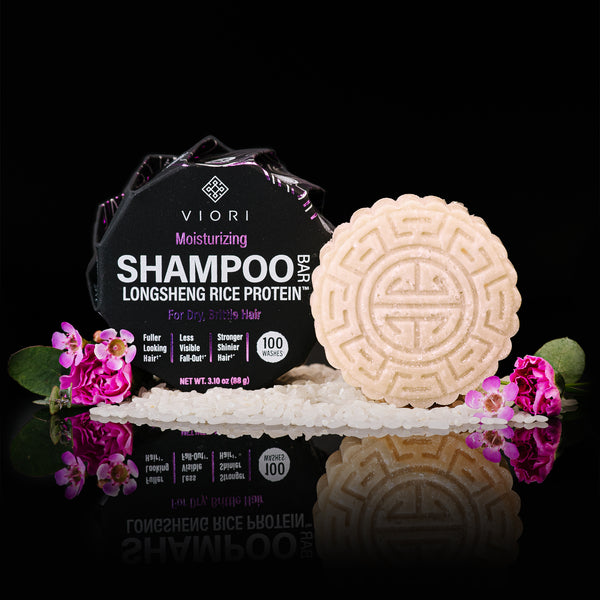
This is why Viori's approach using traditional Longsheng fermented rice water creates fundamentally different results than regular "hair juice" applications. The fermentation process breaks down proteins and nutrients into their most bioavailable, penetrable forms. You're not just coating hair-you're actually reaching the cortical structure where strength and elasticity live.
The pH Factor That Changes Everything
Let me get technical for a moment, because this will completely change how you evaluate liquid hair treatments.
Your hair has an isoelectric point around 3.67 pH. This is the pH level where hair carries a neutral electrical charge. Go below this number, and hair becomes positively charged. Above it? Negatively charged.
Most commercial water-based treatments sit at 5-7 pH-right in a zone where the cuticle is slightly raised (hello, frizz), negative charge is increasing (making hair repel ingredients), and you're in the danger zone for gradual cuticle degradation.
The fermentation process in traditional rice water methods naturally creates a pH of approximately 4-5-right in the permeability sweet spot where:
- The cuticle lifts just enough for ingredient penetration
- The negative charge is minimized (resulting in smoother hair)
- The cortical structure isn't being compromised
This is biochemistry, not marketing hype. The pH of your "hair juice" determines whether it helps or hurts, regardless of what else is in the bottle.
Viori's fermented rice water formulations maintain this optimal pH range, which is why they work with your hair's natural chemistry rather than fighting against it.
The Osmotic Pressure Problem Nobody Talks About
Here's a concept that should be part of every hair care conversation but almost never is: osmotic pressure gradients.
When you apply pure water or heavily diluted water-based products to your hair, you create an osmotic imbalance. Water rushes into the hair shaft, causes swelling (which temporarily feels like hydration), and then evaporates-leaving behind microscopic fissures in the cuticle layer.
This phenomenon is called hygral fatigue, and it's the hidden reason why:
- Your hair feels amazing when wet but becomes progressively more damaged
- You need more and more product to achieve the same results
- Your hair becomes increasingly porous over time
The solution isn't avoiding water-it's creating isotonic or slightly hypertonic solutions where the dissolved nutrients match or slightly exceed the osmotic pressure inside your hair shaft.
This is where fermented rice water reveals its brilliance. Through fermentation, you're not applying plain water to hair-you're applying water enriched with dissolved starches, hydrolyzed proteins, B-vitamins (especially B5 and inositol), and minerals. This creates a nutrient exchange system that doesn't disrupt cellular structure.
You're hydrating without destroying. Nourishing without swelling. Working with biology instead of against it.
Understanding Your Hair's Protein Loading Capacity
Every hair strand has a maximum capacity for protein absorption. Cross that line, and you go from strengthening to brittleness in a hurry. This is the critical distinction between treatments that build hair up versus ones that make it snap.
Yet most "hair juice" products use a one-size-fits-all protein concentration that works beautifully for some people and damages others.
Here's the breakdown based on porosity:
Low Porosity Hair (cuticles tightly closed)
- Maximum 0.5-1% protein concentration before overload occurs
- Needs smaller molecules and mild acidity to open the cuticle
- Benefits tremendously from fermented solutions that create permeability
Medium Porosity Hair
- Optimal range: 1-2% protein concentration
- The "easiest" hair type that tolerates most formulations
- Still benefits from balanced protein-moisture ratios
High Porosity Hair (damaged, color-treated, chemically processed)
- Can handle 2-3% protein before brittleness sets in
- Needs repair, not just moisture
- Requires ingredients that actually reconstruct cuticle structure
Here's what's remarkable: fermented rice water naturally contains hydrolyzed rice protein at 0.8-1.5% concentration after proper fermentation-right in the sweet spot for most hair types. This is why traditional rice water works across different porosity levels while commercial high-protein "juices" create such inconsistent results.
Why Fermentation Is the Game-Changer
Let's talk about why fermentation matters-because it's the difference between applying nutrients to hair and applying nutrients your hair can actually absorb and use.
During the traditional 7-10 day fermentation process (the Red Yao method that inspired Viori's formulations), natural enzymes create what I call "pre-digestion":
- Complex starches → Simple sugars (humectants that attract and hold moisture)
- Large proteins → Peptide chains (small enough to penetrate the cortex)
- Phytic acid → Inositol (penetrates deeply to strengthen from within)
- B-complex vitamins → Bioavailable forms (actually usable by hair proteins)
You're not hoping ingredients penetrate-you're applying ingredients that have already been broken down into their most absorbable, usable forms.
No mass-produced commercial "hair juice" undergoes this level of preparation because fermentation is time-intensive (7-10 days minimum), temperature-sensitive (requires specific conditions), difficult to scale for large production, and requires quality control at every stage.
It's easier to bottle water with some proteins and call it "hair juice." But it's not remotely the same thing.
The Buildup Problem With Most Liquid Treatments
Here's a salon-level insight that explains why so many leave-in treatments eventually make hair look worse: hair is naturally negatively charged, especially when damaged. To make ingredients stick, formulators add cationic (positively charged) surfactants. Opposites attract, so ingredients adhere.
Sounds logical, right?
The problem: these cationic ingredients create buildup, prevent future moisture from entering, and create the illusion of conditioning while actually forming an impermeable barrier that slowly dehydrates the hair shaft. You feel short-term smoothness while causing long-term damage.
Rice water's natural composition sidesteps this entirely. The inositol and amino acids create a mild positive charge without synthetic cationic surfactants-ingredients adhere without creating barriers.
This is why Viori products can be used daily without the typical buildup, heaviness, or diminishing returns you experience with most leave-in "juices."
How to Choose Hair Care Juice for Your Specific Needs
Given everything we've covered, here's how to evaluate liquid hair treatments based on your hair reality:
For Low Porosity Hair
What you need: Smaller molecules plus mild acidity to create cuticle permeability
Why fermented rice water works: Fermentation reduces molecular size and creates optimal pH for penetration
What to avoid: Thick "juices" with large proteins that sit on the surface creating buildup
For High Porosity Hair
What you need: Cuticle repair and sealing, not just hydration
Why fermented rice water works: B-vitamins and inositol actually repair cuticle structure-they reconstruct, not just moisturize
What to avoid: Pure water-based sprays that increase hygral fatigue in already-compromised cuticles
For Oily Scalp with Dry Ends
What you need: Scalp balance without adding oils, moisture for lengths without heaviness
Why fermented rice water works: Natural acids regulate sebum while hydrating lengths
What to avoid: Oil-heavy "juices" that exacerbate scalp issues while claiming to hydrate
For Fine Hair
What you need: Lightweight protein-moisture balance that doesn't flatten
WHAT CUSTOMERS ARE SAYING
Real reviews for Moisturizing Rice Water Shampoo Bar – Dry Scalp | VIORI
Why fermented rice water works: Optimal protein concentration (0.8-1.5%) strengthens without weight
What to avoid: Heavy leave-in juices that eliminate volume
Ancient Wisdom That Modern Science Finally Validates
The Red Yao women of Longsheng village in China have maintained floor-length, healthy hair well into their 80s using fermented rice water for centuries.
For a long time, this was dismissed as anecdotal or genetic. But when you understand the biomechanics we've explored-molecular weight, pH optimization, osmotic pressure, protein loading capacity, and enzymatic pre-digestion-you realize this isn't folk wisdom.
It's sophisticated biochemistry that happens to predate our scientific instruments.
The fermentation process creates exactly what hair needs: the right molecular size for penetration, the optimal pH for cuticle health, the perfect protein concentration for strength without brittleness, the isotonic balance that hydrates without damaging, and the bioavailable nutrients that hair can actually use.
Viori's approach of honoring this traditional preparation method while ensuring consistency, purity, and accessibility represents what I believe is the future of hair care: working with fermentation and natural processes to create solutions that your hair can use at a cellular level.
Surface Cosmetics vs. Cellular Transformation
After two decades in this industry, I've learned to distinguish between products that make hair look good for a day and formulations that make hair fundamentally healthier over time.
The "hair care juice" trend points toward something consumers intuitively understand: hair needs hydration and nourishment in liquid form. But without the science we've explored today, you're likely getting surface coating that looks good initially but prevents real penetration, osmotic imbalances that create hygral fatigue and damage, wrong pH levels that keep cuticles raised and frizzy, protein concentrations that don't match your hair's capacity, and molecules too large to actually reach the cortex where repair happens.
What you actually need is properly sized molecules (200-1,500 g/mol) that penetrate the cortex, pH-optimized solutions (4-5 pH) that work with your hair's chemistry, isotonic nutrient delivery that hydrates without swelling, bioavailable proteins from enzymatic breakdown, and natural formulations that don't create buildup barriers.
This is the difference between hair care and hair transformation. One treats symptoms cosmetically; the other addresses the fundamental biological needs of your hair shaft.
Your Hair Deserves Science, Not Just Trends
The next time you see a "hair juice" product, ask yourself: What's the molecular weight of the active ingredients? What pH does this create on my hair? Has this been fermented or enzymatically prepared for bioavailability? Does this match my hair's porosity and protein needs? Will this penetrate or just coat?
These questions separate effective treatments from expensive water bottles.
Understanding your hair at this level-the cellular, molecular, biomechanical level-changes everything. You stop chasing trends and start making informed decisions based on what your specific hair actually needs.
And sometimes, the most effective solution isn't the newest product with the flashiest marketing-it's a centuries-old fermentation process that modern science is only now beginning to fully understand and validate.
Your hair is complex, sophisticated, and deserving of treatments that respect its biology. That's not a trend. That's transformation.


