
After twenty years behind the chair, I've seen every hair loss miracle product imaginable. Clients arrive with shopping bags full of expensive shampoos, eyes filled with hope, asking the same question: "Will this one actually work?"
The answer is more complex-and more interesting-than the marketing promises suggest.
Today, I'm pulling back the curtain on the rarely discussed science of hair loss shampoos. What I'm about to share might change how you think about hair growth products forever.
The Contact Time Problem Nobody Talks About
Here's the uncomfortable truth that the hair care industry doesn't want you to know: most hair loss shampoos can't possibly work the way they claim to.
Why? It comes down to simple mathematics.
Think about your shower routine. You lather up your shampoo, massage it in, maybe enjoy the sensation for a minute or two, then rinse. Total contact time with your scalp? Maybe 2-3 minutes maximum.
Now here's the problem: the active ingredients commonly found in hair loss shampoos-biotin, caffeine, saw palmetto, even prescription ketoconazole-require substantially longer to penetrate deep enough to reach your hair follicles.
The Scalp Barrier: Your Hair's Fortress
Your scalp has a protective outer layer called the stratum corneum. It's specifically designed to keep things out of your body-which is great for protection, but terrible for topical treatments trying to get in.
NOT SURE WHICH PRODUCT IS RIGHT FOR YOU?
TAKE THE QUIZTakes 30 seconds · 134,000+ customers matched
For any shampoo ingredient to actually influence your hair follicles (which sit 3-5 millimeters beneath your scalp surface), it needs to:
- Break through the stratum corneum barrier (typically requires 20-30 minutes of sustained contact)
- Navigate through multiple skin layers without breaking down
- Reach the dermal layer where your follicle stem cells live
- Achieve a high enough concentration to trigger a biological response
See the problem? If an ingredient needs 20 minutes to penetrate, but you rinse it away after 2 minutes, you're getting roughly 10% of the required exposure time.
To compensate, manufacturers would need to use ingredient concentrations ten times higher than scientifically proven amounts-which would either irritate your scalp or make the product ridiculously expensive.
This is why most hair loss shampoos rely more on marketing magic than cellular mechanics.
The Ancient Exception: Why Fermented Rice Water Is Biochemically Different
This is where things get scientifically fascinating.
The Red Yao women of China's Longsheng region have been using fermented rice water on their hair for centuries, with many maintaining floor-length, remarkably healthy hair well into old age. But the traditional explanation-"it's full of vitamins"-misses what's actually happening at the molecular level.
Recent dermatological research has uncovered something remarkable about fermented rice water that explains why it might succeed where modern formulations fail.
The Fermentation Advantage
When rice undergoes the traditional Red Yao fermentation process (which takes 7-10 days), something biochemically significant happens:
Inositol Enhancement: Fermentation dramatically increases inositol (vitamin B8) concentration. Unlike biotin, which has a molecular weight too large for effective scalp penetration, inositol is smaller and possesses amphipathic properties-meaning it can navigate both water-based and fat-based environments in your skin.
This allows inositol to penetrate the scalp barrier significantly faster than most hair growth actives. We're talking about achieving in 3 minutes what other ingredients can't accomplish in 20.
Panthenol Production: Fermentation also produces panthenol (vitamin B5), which converts to pantothenic acid once it penetrates your skin. This matters because pantothenic acid serves as a precursor for Coenzyme A-a critical component in the cellular energy metabolism of your rapidly dividing follicle cells.
Essentially, you're providing your follicles with the biochemical fuel they need for the energy-intensive process of building hair.
The Protein Fragment Factor
Here's where it gets really sophisticated: fermented rice water contains hydrolyzed rice protein fragments with very specific molecular weights. These fragments are small enough to actually penetrate into the hair shaft itself-not just coat the surface like most conditioning proteins.
Once inside, they can:
- Create structural crosslinks with your existing hair keratin
- Increase the diameter of individual strands (making hair look and feel thicker)
- Strengthen the protective cuticle layer to prevent breakage
This is critical because what many people perceive as "hair loss" is actually excessive breakage creating the appearance of thinning.
The pH Factor That Changes Everything
Let me share something most stylists learn but rarely explain to clients: your shampoo's pH might matter more than its active ingredients.
Your scalp's optimal pH is 4.5-5.5 (slightly acidic). At this pH level:
- Your scalp's protective acid mantle guards against harmful bacterial overgrowth
- Hair cuticles lie flat, minimizing breakage
- Sebum production stays balanced
Here's the problem: most commercial shampoos have a pH of 6-8 (alkaline) because alkaline formulations create better lather and stronger cleansing action.
But an alkaline environment creates a cascade of problems:
- Lifted cuticles (making hair mechanically weaker and prone to breakage)
- Disrupted scalp microbiome (triggering inflammatory responses that damage follicles)
- Excessive oil production (as your scalp desperately tries to restore its acid mantle)
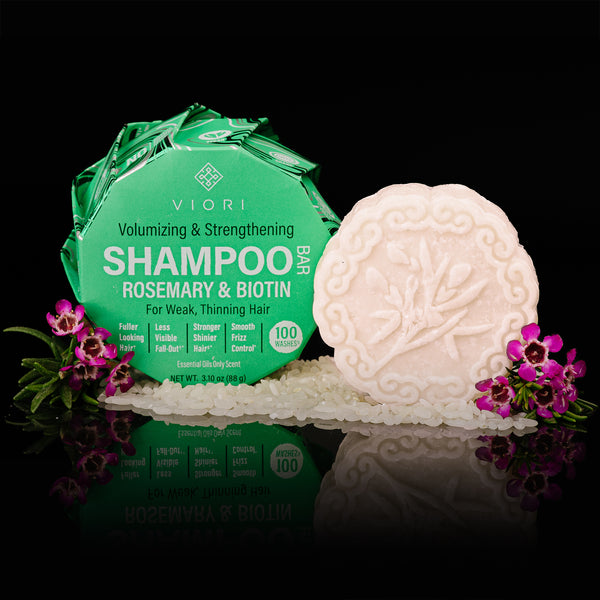
Viori's shampoo bars are formulated within that optimal 4.5-5.5 pH range. This seemingly simple factor may be more important for preventing hair loss than any exotic ingredient, because it addresses the environmental conditions your follicles experience rather than trying to force a pharmaceutical response.
Think of it this way: you can add all the fertilizer you want to a plant, but if the soil pH is wrong, that plant won't thrive. Your hair works the same way.
The Sulfate Question: What Science Actually Reveals
The conventional wisdom says sulfates are terrible and cause hair loss. The reality? It's more nuanced and far more interesting.
Traditional harsh sulfates like sodium lauryl sulfate are anionic surfactants that can strip away not just oil, but also:
- Your scalp's natural antimicrobial peptides
- Ceramides that maintain barrier function
- The protective lipid layer around your hair cuticles
What makes Viori's approach different is the use of sodium cocoyl isethionate (SCI)-a coconut-derived surfactant with fundamentally different structural chemistry.
SCI has a larger hydrophobic tail than traditional sulfates, which means:
- It requires lower concentrations to be effective
- It causes less disruption to your scalp's natural protective proteins
- It maintains excellent cleansing while having a safety profile comparable to baby shampoos
The technical term is "mild surfactancy"-effective cleansing without compromising the biological infrastructure your follicles depend on.
The Hair Growth Timeline: When Biology Meets Marketing
Here's where I need to be completely honest with you, because the industry certainly won't be.
No shampoo alone will reverse advanced pattern baldness. That requires actual follicle miniaturization reversal, which needs pharmaceutical intervention like minoxidil or finasteride.
However, a well-formulated shampoo system can:
- Prevent accelerated loss from environmental damage, inflammation, or mechanical breakage (potentially slowing loss by 20-40%)
- Optimize existing follicle performance (helping miniaturized hairs achieve their maximum genetic potential)
- Reduce breakage-related density loss (which can improve appearance by 15-30%)
- Create scalp conditions that maximize the efficacy of pharmaceutical treatments
If we're being scientifically honest about realistic timelines:
- Weeks 1-4: Reduced breakage, improved texture (your existing hair responding)
- Weeks 4-8: Potentially reduced shedding (if scalp inflammation was a contributing factor)
- Weeks 8-16: Possible density improvements (existing follicles producing fuller shafts)
- Months 4-6: Maximum benefit plateau (your follicles operating at genetic capacity)
Anyone promising dramatic results faster than this timeline is selling hope, not science.
The Cutting Edge: Your Scalp Microbiome
This is perhaps the most exciting frontier in hair loss science: emerging research suggests that your scalp microbiome composition may be as important as genetic factors in hair thinning.
Your scalp hosts entire populations of bacteria that can either protect or damage your follicles:
- Protective bacteria: Certain beneficial strains produce short-chain fatty acids with anti-inflammatory effects
- Damaging bacteria: Overgrowth of harmful strains can trigger chronic low-grade inflammation that gradually miniaturizes follicles
Natural, pH-balanced formulations like Viori's support beneficial microbial balance by:
- Not disrupting the acid mantle that good bacteria require
- Avoiding harsh preservatives that kill both beneficial and harmful bacteria indiscriminately
- Providing fermented ingredients that may serve as prebiotics for healthy scalp flora
This microbiome-preservation approach may explain why some users report improvements that seem disproportionate to the active ingredients alone-they're not just feeding their hair, they're cultivating the ecological conditions for follicular health.
WHAT CUSTOMERS ARE SAYING
Real reviews for Rosemary Biotin Shampoo Bar – Thinning Hair | VIORI
The Practical Protocol: Maximizing Your Results
Based on everything we've discussed, here's an evidence-informed approach to using your shampoo for optimal hair health:
For Shampooing:
- Thoroughly wet your hair (warm water opens cuticles for better penetration)
- Create lather in your palms first (this minimizes direct friction on fragile hair)
- Apply to scalp with gentle massage (increases circulation without creating damaging shear forces)
- Leave on for 3-5 minutes if possible (approaching minimum effective contact time)
- Rinse with cool water (closes cuticles, minimizes breakage)
For Conditioning:
- Focus on mid-lengths to ends initially (prevents root area from getting too heavy)
- Apply sparingly to scalp (yes, your scalp benefits from conditioning too, just in smaller amounts)
- Consider leaving a tiny amount as leave-in (especially if you have porous or damaged hair)
- Use a wide-tooth comb for distribution (minimizes mechanical damage during detangling)
Frequency Recommendations:
- Oily scalp: Daily washing may actually help by controlling sebum-related inflammation
- Normal scalp: Every 2-3 days allows natural sebum distribution while preventing buildup
- Dry scalp: Every 3-4 days prevents overdrying
The Bar vs. Liquid Consideration
Here's a practical factor rarely discussed: the physical format of your shampoo affects your hair mechanically.
When you rub a bar directly on wet hair, you create temporary high-friction zones. For hair that's already compromised or thinning, this could theoretically increase mechanical breakage.
This is why Viori recommends lathering in your palm first, then applying to hair-it's not just a preference, it represents a sophisticated understanding of hair mechanics.
By creating lather separately, you:
- Reduce direct friction on hair shafts
- Ensure more even product distribution
- Minimize tangling during cleansing
- Decrease mechanical stress on fragile, miniaturizing hairs
This simple application method can prevent the "shedding from breakage" that people often mistake for accelerated hair loss when switching products.
The Bioavailability Reality Check
Let's get technical for a moment about something the industry rarely quantifies: how much of each ingredient actually reaches your follicles.
Common hair loss shampoo ingredients and their approximate scalp penetration rates:
- Biotin: ~2-5% (molecular weight too high)
- Caffeine: ~12-18% (but washes out rapidly)
- Saw Palmetto: ~8-15% (struggles in water-based delivery)
- Ketoconazole: ~20-25% (requires minimum 5-minute contact)
Compare this to fermented rice water components:
- Inositol: ~30-40% (smaller molecule, amphipathic properties)
- Panthenol: ~25-35% (converts to active form after penetration)
- Amino acids from hydrolyzed rice protein: ~40-60% (very small peptides)
The superior bioavailability means that even with short contact time, you're achieving more actual follicular delivery than with conventional hair loss ingredients.
The Honest Assessment
Hair loss shampoos that truly "work" aren't reversing your genetics-they're optimizing your biological environment to allow your genetics to express their best possible outcome.
Viori's rice water-based system represents a legitimate, science-backed approach grounded in:
- Biochemical enhancement through traditional fermentation
- Respect for your scalp's natural barrier function
- pH optimization for follicular health
- Minimal disruption of protective microbiomes
Will it regrow hair on a completely bald scalp? No-that's not biologically possible with any shampoo.
Can it slow loss, reduce breakage, and maximize the performance of your existing follicles? The biochemistry strongly suggests yes, but with realistic expectations tied to actual hair growth biology.


