
Rice water has a way of turning into a “miracle” the moment someone has a good hair week. And I get it-when your hair finally feels stronger, looks shinier, and stops snapping off at the ends, it’s tempting to call it hair growth and move on.
But if you’ve ever tried rice water and had the opposite experience-dryness, stiffness, tangles, an itchy scalp-you’re not alone. In my experience, the difference between “this is amazing” and “why is my hair mad?” usually has less to do with rice itself and more to do with what almost nobody tests: pH drift, fermentation variability, protein dose, and plain old friction.
This post walks you through a realistic, experiment-style way to test rice water for hair growth so you can tell whether it’s helping your follicles, improving your length retention, or just giving you a temporary cosmetic effect.
First: Decide what you mean by “hair growth”
Most people don’t separate growth from retention, and that’s where the confusion starts.
NOT SURE WHICH PRODUCT IS RIGHT FOR YOU?
TAKE THE QUIZTakes 30 seconds · 134,000+ customers matched
- True growth happens at the scalp (what the follicle produces over time).
- Length retention happens on the hair fiber (how much of that length you keep without breaking it off).
Here’s the key: a lot of “growth” success stories are really retention success stories. Hair grows at its usual pace, but you stop losing the length to breakage-so it finally looks like it’s taking off.
The rarely discussed dealbreaker: pH disruption
If you only take one technical point from this whole post, make it this one: an unstable or unfriendly pH can override everything else.
Hair products generally perform best in a hair-friendly pH range (commonly referenced around 3.5-6.5). When something pushes more alkaline, the cuticle can lift and swell, friction increases, tangling gets worse, and breakage becomes more likely over time. That damage can easily mask any strengthening you hoped rice water would deliver.
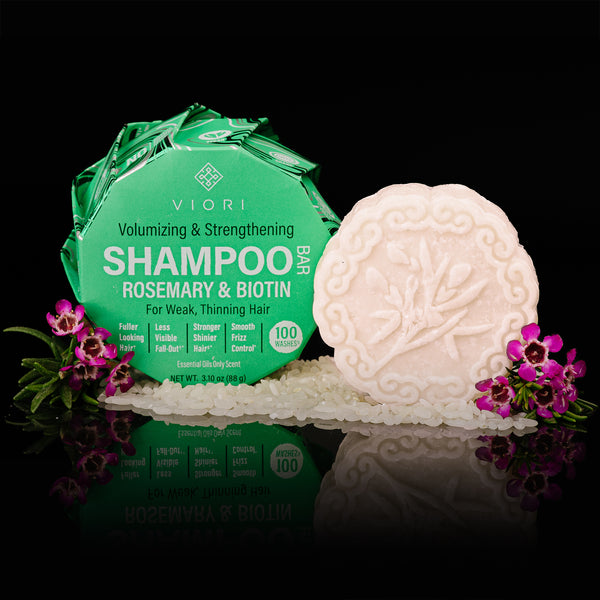
This is one reason Viori uses a lower concentration of Longsheng rice water in their formulas: higher concentrations of rice water, used too often or too much, can disrupt hair and scalp pH. Viori’s bars are made to be pH balanced and designed for regular use, which matters a lot if you’re trying to test results instead of rolling the dice.
Fermentation isn’t an ingredient-it’s a moving target
“Fermented” sounds like a single, consistent thing. In reality, fermentation is a process that can swing wildly depending on time, temperature, and storage conditions. Two batches can behave differently on the scalp and hair even if they started with the same rice.
Fermentation can be helpful because it can increase certain nutrients. In Viori’s educational materials, fermentation is connected with boosting levels of vitamin B8 (inositol) and vitamin B5 (panthenol), which are well-known in haircare for supporting resilience and conditioning. The problem with many DIY tests is that the “active profile” changes from batch to batch, so your experiment isn’t controlled.
You’re also running a protein experiment (whether you meant to or not)
This is the part that rarely gets explained clearly online: rice water testing often turns into a protein-dose trial.
Depending on concentration and how often you use it, rice-derived components can behave like a strengthening treatment. That can be great-until it becomes too much for your hair.
Signs your hair may be getting more protein than it likes can include:
- stiffness or a “crunchy” feel
- roughness that doesn’t improve with conditioning
- more tangling (especially at the ends)
- snapping that suddenly shows up mid-shaft
Viori addresses this by using low concentrations and including hydrolyzed rice protein in their bars (hydrolyzed proteins are typically more manageable because the molecules are smaller).
The growth pathway many people miss: scalp comfort
Not every “growth” improvement comes from stimulating follicles. Sometimes the win is that your scalp simply calms down.
If a routine improves dryness and irritation, you may scratch less, inflame the scalp less, and disrupt the barrier less. Over time, that can reduce shedding triggers and make hair feel fuller. Viori also positions their bars as being designed to support scalp health, with ingredients like aloe vera and bamboo extract included for comfort and conditioning support.
How to test rice water like a pro (without turning your life upside down)
If you want results you can trust, you need two things: consistency and clear measurements.
What to keep consistent (so you’re not chasing noise)
Try to keep these steady for the duration of your test:
- wash frequency
- water temperature
- detangling tools and how often you brush
- heat styling frequency
- tight hairstyles (ponytails, slick-backs, heavy extensions tension)
- chemical changes (avoid introducing new color/lightening during your test if possible)
What to measure (so you know what improved)
Track two endpoints so you can separate follicle growth from fiber retention:
- Root growth: take a photo every two weeks in the same lighting and angle, focusing on a consistent part line or hairline spot.
- Breakage/retention: track tangling, detangling ease, and whether you’re seeing lots of short snapped hairs versus full-length shed hairs.
A quick salon tip: shed hairs often have a tiny white bulb. Breakage usually doesn’t. People mix these up constantly, which is why so many “hair loss” conversations are actually breakage conversations.
A cleaner way to test rice water: use a consistent, pH-balanced system
If your goal is to test rice water benefits with fewer variables than DIY batches, a formulated routine is easier to evaluate. Viori bars are built around fermented Longsheng rice water with other supportive ingredients, in a pH-balanced format designed for regular use.
WHAT CUSTOMERS ARE SAYING
Real reviews for Rosemary Biotin Shampoo Bar – Thinning Hair | VIORI
Choosing a bar based on scalp type (this matters more than most people think)
- Citrus Yao: commonly preferred for normal-to-oily scalps; it contains citric acid in the scent profile, which helps break down oil.
- Terrace Garden, Hidden Waterfall, or Native Essence: often chosen for normal-to-dry scalps, with Native Essence as the unscented option for fragrance sensitivity.
The friction factor: don’t sabotage your results with rough application
One of the most overlooked confounders in hair experiments is mechanical friction. If you’re testing for reduced breakage, be mindful of how you apply products.
For color-treated hair especially, Viori recommends building lather in your hands and applying with your fingers rather than rubbing the bar directly on your hair. Less friction means fewer variables-and usually better retention.
How long to test before you decide
Hair is slow to tell the truth. Some people notice changes quickly, but for a meaningful test, give it time. Viori also recommends allowing 2-3 months before deciding whether the routine works for you. That window is long enough to see patterns in scalp comfort, breakage, and manageability-without overreacting to one good (or bad) wash.
How to read your results without overcalling them
At the end of a proper test, your results usually fall into one of these buckets:
- Better shine, softness, and manageability (cosmetic improvement that often supports retention)
- Less breakage and fuller-looking ends (retention improvement)
- Less itch or flaking (scalp barrier improvement, which can reduce shedding triggers)
- No meaningful change (still useful data)
- Negative response (often tied to too much protein exposure, pH issues, or friction)
Safety note (always worth saying)
If you develop persistent irritation, burning, or noticeable shedding that continues, stop the experiment and consult a qualified medical professional. And if you’re sensitive to fragrance, choosing an unscented option like Viori Native Essence can help keep your test cleaner and your scalp calmer.
If you want, tell me your scalp type, porosity, and whether your hair is color-treated, and I’ll map out a simple 12-week testing plan with realistic checkpoints-so you can get a clear answer instead of a guess.


