
Grey hair has a way of humbling even the most loyal haircare routine. One day your usual wash works fine; the next, your hair looks a little dull, feels a little wiry, and somehow picks up a yellow cast you swear wasn’t there last month.
When people search “natural shampoo for grey hair”, they’re often hoping for one simple solution. But grey hair rarely responds to simple-because the biggest issues aren’t only about color. They’re about surface chemistry, friction, and how light reflects off the strand.
After two decades behind the chair, here’s the truth I wish more articles would lead with: most “grey hair problems” are really an optical problem (how grey looks) plus a structural problem (how grey behaves). Once you separate those two, your routine gets a lot smarter-and your results get a lot more consistent.
The two goals people mix up: brightness vs. behavior
Let’s get specific about what you’re actually trying to fix. Grey hair concerns usually fall into two categories, and they don’t always require the same approach.
NOT SURE WHICH PRODUCT IS RIGHT FOR YOU?
TAKE THE QUIZTakes 30 seconds · 134,000+ customers matched
1) Optical improvement (how your grey looks)
- More brightness and clarity
- Less dullness or “flat” shine
- Less yellow or beige tone
2) Structural improvement (how your grey behaves)
- Less frizz and puffiness
- Less tangling and snagging
- Less wiry, stiff, or crunchy feel
- More softness and slip
If you’ve ever thought, “My hair is clean, but it doesn’t look bright,” that’s an optical issue. If you’ve thought, “It looks okay, but it feels rough,” that’s structural. Many routines fail because they treat both problems the same way.
Grey hair isn’t just hair without pigment
Yes, greying involves reduced melanin. But the reason grey hair often feels “different” goes beyond color. Many people experience changes in how the hair fiber responds to the environment and to styling-especially in texture and manageability.
In practical terms, grey hair frequently becomes more sensitive to friction. It may not be “drier” in the way most people assume; it’s often rougher at the surface, which makes it behave like it’s dry.
- Strands may feel less naturally lubricated
- Hair can snag more easily during detangling
- Static and flyaways become more noticeable
- Shine can drop because the cuticle doesn’t lay as smoothly
The rarely discussed reason grey looks dull: invisible film
Here’s an underappreciated reality: grey and white hair show buildup faster. Not necessarily because you’re doing anything wrong-just because there’s no pigment to camouflage what’s happening on the surface of the strand.
Common sources of “film” on grey hair include:
- Hard water minerals (calcium and magnesium deposits)
- Trace metals in water (often copper or iron)
- Pollution and environmental residue
- Leftover styling products
- Heat-related oxidation over time
What makes this especially important for grey hair is the optics: film changes how light reflects off the strand. Instead of crisp reflection (that pretty silver shimmer), you get a muted, matte look that reads as dull or yellowed-even when the hair feels freshly washed.
Why “natural shampoo” isn’t automatically grey-hair friendly: pH matters
If I could put one technical concept on a billboard for grey hair, it would be this: pH controls cuticle behavior.
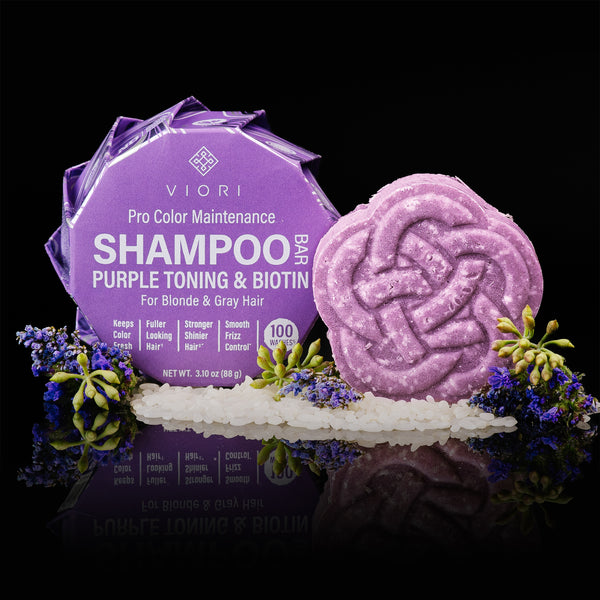
When hair products skew too alkaline, the cuticle can lift more easily. Lifted cuticles increase friction, tangling, and frizz-plus they scatter light, which makes grey look less bright.
Viori notes its bars are pH balanced, and that’s a meaningful detail for grey hair. A hair-friendly pH supports a smoother cuticle surface, which can translate to:
- Better shine and reflectivity
- Less roughness through the mid-lengths and ends
- Easier detangling and less snagging
The “bar shampoo” detail that changes everything: friction from application
This is where I see people unintentionally sabotage their results. With bar formats, technique matters-because mechanical abrasion can be the difference between glossy greys and crunchy greys.
If you rub a shampoo bar directly along your lengths, you can create localized friction that roughens the cuticle. Grey hair tends to advertise that roughness immediately as tangling and dullness.
Viori recommends building lather in your hands and applying it with your palms rather than dragging the bar over your hair. For grey hair, that’s not just a preference-it’s a genuinely smarter way to reduce unnecessary cuticle stress.
Conditioner isn’t just “nice to have” for grey hair-it’s surface engineering
Grey hair often improves dramatically when you treat conditioning as a technical step, not an optional extra. The hair fiber (especially when weathered) tends to carry a negative charge. Many effective conditioners use positively charged conditioning agents that adhere to the hair, improving slip and smoothing.
Viori’s conditioner includes behentrimonium methosulfate (BTMS), a conditioning ingredient widely used to increase slip and reduce friction. The name throws people off, but functionally, what matters is what it does on the hair:
- Helps reduce inter-strand friction (less “wire” feel)
- Improves combability and detangling
- Encourages a smoother cuticle surface (better shine)
For many grey-haired clients, that “slip factor” is what finally makes the hair feel like hair again-not like a bundle of stubborn threads.
Protein and grey hair: the “low-dose, consistent” approach
Protein is one of the most misunderstood topics in haircare. Hydrolyzed proteins can temporarily support the hair’s surface and improve feel, but too much protein (or the wrong balance) can make some hair feel stiff.
Viori notes it uses a low concentration of rice protein, designed to be safe for frequent use. In real-world terms, a lower, steadier protein approach is often more comfortable for grey hair because you get reinforcement without that brittle, over-structured feeling.
WHAT CUSTOMERS ARE SAYING
Real reviews for Purple Shampoo Bar with Biotin – Blonde & Gray | VIORI
A practical approach that works: split your routine into “brightness” and “texture” washes
Most people wash the same way every time. Grey hair often does better when you rotate your focus depending on what your hair needs that week.
Brightness-focused wash (for dullness and yellowing from film)
- Prioritize cleansing at the scalp
- Rinse thoroughly-leftover residue can mute shine
- Condition for smoothness, then rinse clean
Texture-focused wash (for wiry feel, frizz, and tangling)
- Give conditioner a little more time to sit
- Detangle gently while the hair is wet and slippery
- Finish with a cooler rinse if you tolerate it
Choosing a Viori option based on scalp needs (because scalp drives results)
One of the most overlooked parts of grey haircare is that your scalp condition influences how quickly film and buildup return.
- If your scalp runs more oily or you notice quicker buildup, Citrus Yao is commonly recommended for normal-to-oily scalp types.
- If your scalp runs dry or your hair feels rough and thirsty, Terrace Garden, Hidden Waterfall, or Native Essence tend to align better with dry-to-normal needs.
- If you’re fragrance sensitive or you’re simplifying to troubleshoot irritation, Native Essence is the unscented option.
Viori also uses fermented Longsheng rice water in a pH-balanced concentration-an important point, because overly concentrated rice-water routines can be irritating or destabilizing for some scalps when used too often.
The best grey-hair wash method (especially with bars)
If you want the biggest improvement with the least effort, focus on these fundamentals. They protect the cuticle, reduce friction, and help grey reflect light more cleanly.
- Soak your hair thoroughly before cleansing (this reduces friction while you work).
- Create lather in your hands and apply to the scalp first-avoid dragging the bar over lengths.
- Cleanse the scalp and let the suds rinse through mid-lengths and ends.
- Condition mid-lengths to ends, using your fingers or a wide-tooth comb to gently distribute.
- Let conditioner sit for 2-5 minutes for better slip and smoothing.
- Rinse extremely well (residue is a common cause of dull grey).
- Blot dry rather than rubbing aggressively to keep the cuticle lying flat.
What natural shampoo can’t promise-and what it can absolutely do
No shampoo can guarantee that grey hair will return to its original color. Pigment is largely controlled by follicle biology. But the right cleansing and conditioning system can absolutely improve what most people actually struggle with day-to-day: brightness, softness, manageability, and comfort at the scalp.
If your greys have been feeling dull or acting unruly, don’t assume it’s “just how grey hair is.” More often, it’s a solvable mix of film, friction, and cuticle management-and once you target those, silver hair can look intentionally beautiful instead of accidentally tired.


