
If you’ve been hunting for a non‑protein shampoo, you’re probably not doing it for fun. Most people land there after a string of bad wash days-hair that feels rough, tangles too easily, looks dull no matter what, or has that stubborn “straw” texture that won’t quit.
And I get it: the internet will tell you it’s protein overload, so you remove protein and hope for the best. But after 20 years doing hair, I’ll tell you the quiet truth I see over and over in the salon: what people call “protein sensitivity” is often a surface problem, not a protein problem.
In other words, the issue is usually friction, mineral buildup, and cuticle behavior-the stuff that changes how your hair feels from the outside in.
NOT SURE WHICH PRODUCT IS RIGHT FOR YOU?
TAKE THE QUIZTakes 30 seconds · 134,000+ customers matched
What “Non‑Protein Shampoo” Actually Means (and What It Doesn’t)
A non‑protein shampoo is straightforward: it’s a cleanser that doesn’t include intentionally added proteins (like hydrolyzed proteins or amino-acid blends) as part of the formula.
What it doesn’t automatically guarantee is softness, moisture, or “gentle” cleansing. Those results depend far more on the shampoo’s overall design-especially the cleanser system, pH, and how the formula manages residue.
The Rarely Discussed Angle: Your Hair Doesn’t Just Need “Protein-Free”-It Needs Low Friction
Here’s the piece that doesn’t get talked about enough: a lot of “protein-like stiffness” is actually high friction at the cuticle. When the cuticle isn’t lying flat, strands catch on each other, and hair feels rough even if it’s technically clean.
That stiff, draggy, squeaky sensation can come from a few common scenarios:
- Hard-water minerals clinging to the hair and interacting with leftover residue
- Over-cleansing that removes too much surface lubrication
- Too much rubbing (especially during shampooing), which creates mechanical wear on the cuticle
- Uneven buildup that makes some sections feel coated while others feel stripped
So yes-going non‑protein can help for some people. But it often helps because it simplifies the routine, not because protein itself was the villain.
Porosity: The Missing “Yes or No” Behind Protein-Free Decisions
If you want a smarter way to decide whether non‑protein shampoo makes sense for you, look at porosity. Porosity is your hair’s ability to absorb and hold moisture-and it influences how easily hair grabs onto ingredients and buildup.
Low porosity (tight cuticle)
Low-porosity hair tends to resist absorption, which means it can get weighed down or feel coated more easily. Many people with low porosity describe their hair as “product-sensitive,” and they often assume protein is the trigger.
A non‑protein shampoo can be a great reset here-especially if you’re trying to reduce that coated feeling and keep the hair light and bouncy.
High porosity (raised cuticle / damaged hair)
High-porosity hair absorbs quickly but struggles to retain moisture. The cuticle is more lifted, so friction and tangling show up fast. In these cases, hair usually needs pH balance, slip, and cuticle smoothing as much as (or more than) it needs a strict protein-free label.
pH: Why Some “Protein-Free” Shampoos Still Leave Hair Rough
When a cleanser runs too alkaline, it can cause the cuticle to lift and swell. That’s when you get the classic complaints: more frizz, more tangles, less shine, and hair that feels rough right after rinsing.
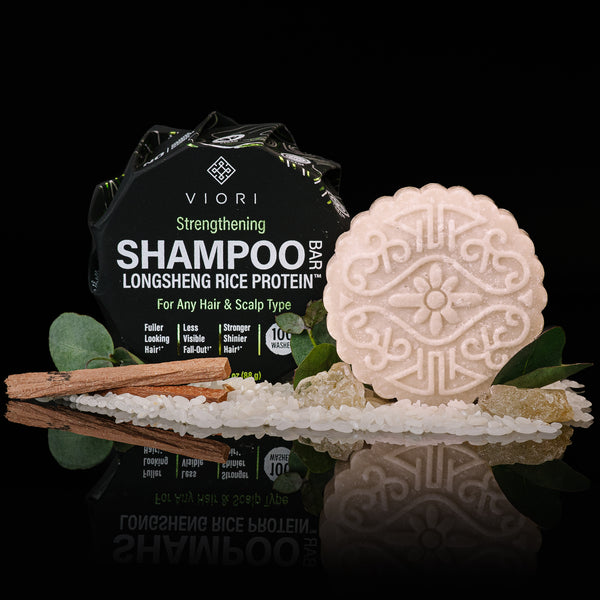
This is one reason I’m picky about bar cleansers: if they aren’t formulated carefully, they can leave hair feeling squeaky and grabby. Viori bars are formulated to be pH balanced, which helps keep the cuticle behaving the way you want it to-smoother, more aligned, and less frizz-prone.
Technique Matters More Than People Think (Especially with Bars)
If you’re using a bar shampoo and your hair is color-treated, fragile, or easily tangled, there’s one habit I recommend almost universally: don’t scrub the bar directly on your hair.
Instead, reduce friction and protect the cuticle by washing like this:
- Wet hair thoroughly.
- Rub the bar between your hands to build a rich lather.
- Apply the lather with your palms and fingertips, focusing on the scalp.
- Let the rinse water cleanse the lengths instead of aggressively rubbing them.
This small change can make a surprising difference in softness and breakage over time, because you’re minimizing mechanical wear on the cuticle.
When “Protein-Free Everything” Can Backfire
Not all breakage is a protein issue-and not all softness is a protein-free win.
WHAT CUSTOMERS ARE SAYING
Real reviews for Rice Water Shampoo Bar – All Hair Types | VIORI
If your hair feels mushy when wet, stretches too far before snapping, or can’t hold shape (especially waves or curls), you may be dealing with a strength imbalance. In that situation, cutting out every strengthening element in your routine can leave hair feeling weaker over time.
One thing I appreciate about Viori’s approach is the emphasis on balance: the products use Longsheng rice water in a way that’s designed to be safe and pH balanced for regular use, because very high concentrations of rice water or protein can be disruptive if overused.
Quick Troubleshooting: Is It Really Protein, or Is It Friction and Buildup?
If you’re not sure what you’re dealing with, here’s a practical way to narrow it down.
- More likely protein-related: stiffness builds over time with repeated strengthening products; hair feels hard even after conditioning; ends snap easily.
- More likely friction/minerals/pH-related: hair feels rough immediately after shampoo; tangles happen during washing; hair feels dull or “draggy” even when clean; results change depending on the water in different locations.
A stylist’s rule of thumb: if your hair feels rough after shampoo but dramatically better after a good conditioning step, you’re often looking at cuticle behavior and friction-not true protein overload.
Where Viori Fits Into a Smarter “Non‑Protein” Conversation
If your goal is the feeling most people are really after-clean, soft, light hair without the stiff aftermath-focus on performance markers, not buzzwords:
- pH-balanced cleansing to keep the cuticle from lifting unnecessarily
- gentle cleansing that removes oil and buildup without stripping
- slip and conditioning support to reduce friction (the hidden driver of tangles and breakage)
- a routine that matches your scalp type, not just your hair length
Non‑protein shampoo can be a useful tool, but it’s rarely the whole answer. When you start thinking in terms of friction control, pH, porosity, and buildup, your routine gets simpler-and your hair gets easier to live with.


