
Rice flour dry shampoo sounds almost too easy: tap a little powder at the roots, watch the grease disappear, and buy yourself another day before wash day. And yes-sometimes it’s that simple.
But when it doesn’t work, it fails in very specific ways: chalky roots, a stiff “helmet” feel, weird clumps at the crown, dull lengths, or that itchy, annoyed scalp that shows up a few hours later. Those aren’t random issues-they’re clues. Rice flour isn’t just soaking up oil. It’s changing how your hair and scalp behave on a microscopic level.
After two decades behind the chair, I’ve learned that dry shampoo is less about “absorption” and more about managing oil, moisture, and friction at the root. Rice flour can do that beautifully-if you understand what’s actually happening.
NOT SURE WHICH PRODUCT IS RIGHT FOR YOU?
TAKE THE QUIZTakes 30 seconds · 134,000+ customers matched
What Rice Flour Is Really Doing on Your Scalp
Let’s clear up the biggest misconception: powders don’t “absorb” scalp oil the way a towel absorbs water. Scalp oil (sebum) is a complex blend of lipids, and when you apply a powder like rice flour, the process looks more like this:
- Oil coats the particles (think of it as a microscopic oil “jacket”).
- Those coated particles form tiny bridges between hairs and each other.
- As oil builds, particles clump together.
- You (hopefully) brush out the oil-loaded powder.
This is why rice flour can make hair look instantly cleaner: it changes how oil sits on the surface and breaks up that reflective “slick” look that reads as greasy.
The Twist Most People Miss: Your Scalp Is Oily and Wet
Here’s the part that rarely gets discussed online: your scalp isn’t dealing with oil alone. It’s also dealing with humidity and sweat-water plus salts-especially around the hairline and crown.
Rice flour is mostly starch, and starch reacts to moisture. In a dry climate, rice flour can stay airy and invisible. In humidity (or after a workout), it can start to behave differently-swelling slightly, clumping faster, and feeling heavier at the root.
If you’ve ever thought, “This looked great at first, and then it got… weird,” you’re not imagining it. That’s often a moisture problem, not an “application mistake.”
A quick (useful) nerd note: damaged starch
Rice flour isn’t identical from bag to bag. Milling can crack starch granules, creating what’s called damaged starch. The more damaged starch present, the faster it binds water and the quicker it can tip into that paste-y, cakey territory on a humid day.
Particle Size: The Difference Between “Fresh Roots” and “Bakery Dust”
Rice flour can be finely milled or more coarse, and that single detail changes everything.
- Finer particles tend to look more natural and control oil with less product.
- Coarser particles are more likely to feel gritty, show white cast, and create visible buildup.
There’s also a tradeoff people don’t expect: ultra-fine powders can grab oil quickly and create dense micro-clumps right at the scalp. That’s when hair looks clean but feels oddly stiff and loses movement.
The Most Important Reframe: Rice Flour Is a Friction Tool
If you take one idea from this post, make it this: rice flour dry shampoo isn’t just managing oil-it’s managing friction.
When powder mixes with sebum, it changes how strands slide against each other. That’s why it can create volume (more grip), but it can also create tangling (too much grip). It’s also why some textures feel amazing with it and others feel instantly rough.
This friction shift explains common complaints almost perfectly:
- “My hair looks clean but feels stiff.” Powder + oil creates bridges that reduce movement at the root.
- “My crown gets tangly.” Increased friction between strands.
- “My curls get frizzy at the roots.” Powder interrupts curl clumping and definition.
- “It makes my scalp itch later.” Powder residue + sweat + friction can irritate sensitive scalps.
Who Rice Flour Dry Shampoo Tends to Work Best For
It’s not about whether rice flour is “good” or “bad.” It’s about match-making: hair type, scalp type, and environment.
Rice flour is often a great fit if you have:
- Fine to medium hair that collapses when it gets oily
- Straight to wavy roots
- A low-humidity climate
- Light styling habits (not a ton of heavy creams or waxes)
You may find it frustrating if you have:
- A humid climate or you sweat frequently
- Very coarse hair that needs slip more than grip
- Curly/coily roots where definition matters
- A scalp that’s sensitive, breakout-prone, or easily itchy
How to Use Rice Flour Dry Shampoo So It Looks Natural (and Doesn’t Get Itchy)
The goal is simple: use a small amount, let it bind to oil, and then remove what you don’t need. Most people do the first part and skip the last part.
WHAT CUSTOMERS ARE SAYING
Real reviews for Rice Water Shampoo Bar – All Hair Types | VIORI
- Start tiny. Add more only if you truly need it.
- Apply at the scalp and the first 1-2 cm of hair. That’s where oil collapses volume.
- Press it in-don’t aggressively rub. Hard rubbing warms sebum and encourages clumping.
- Wait 2-5 minutes. Let the powder do its job before you move it around.
- Brush in sections. You’re not just blending-you’re lifting out oil-loaded powder.
- Check the crown and hairline. Those areas show residue (and irritation) first.
If your scalp tends to itch later in the day, take that seriously. It often means the powder isn’t being removed thoroughly, or it’s mixing with sweat and lingering on the scalp longer than your skin likes.
Wash Day Matters More When You Use Any Dry Shampoo
Dry shampoo is not cleansing-it’s oil management. So your wash day has to reset the scalp gently but thoroughly, especially if you use powders regularly.
One detail that makes a noticeable difference over time is pH balance. Hair and scalp generally do best when products stay in a mildly acidic range (roughly 3.5-6.5). When products lean too alkaline, cuticles can lift, strands feel rougher, and friction increases-exactly what you don’t want if you’re already adding a powder that increases grip at the root.
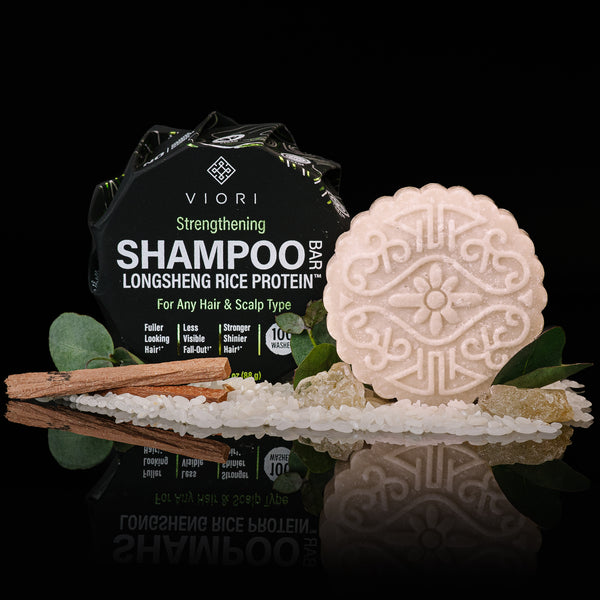
Viori’s shampoo bars are pH balanced and use a gentle cleanser (sodium cocoyl isethionate), which is a big deal if you’re trying to avoid the cycle of “powder buildup” followed by “over-washing.” Following with conditioner also matters: conditioner ingredients carry a positive charge, so they cling to the hair and help restore slip and protection after cleansing.
The Bottom Line
Rice flour dry shampoo can be a fantastic tool when it matches your hair and climate. But it’s not a set-it-and-forget-it product. Its success depends on humidity, particle size, friction, and how well you brush it out.
If you want it to look clean, feel light, and stay comfortable on the scalp, treat rice flour like a technical styling product: use less than you think, give it time to bind oil, remove the excess thoroughly, and keep your wash routine balanced so your scalp doesn’t get stuck in a buildup-and-irritation loop.


