
I'll admit it-when bamboo hair products first started appearing in salons about fifteen years ago, I rolled my eyes. Hard. After watching goji berries, açaí, and a dozen other "miracle" ingredients come and go, I'd developed a healthy skepticism toward anything marketed as revolutionary.
But bamboo wouldn't go away. More importantly, I started seeing results that couldn't be explained by placebo effect or clever marketing. Clients with chronically dry hair were retaining moisture. Color-treated hair was holding pigment longer. Even my most damaged cases were showing genuine improvement.
So I did what any formulation nerd would do: I spent the next three years diving deep into the actual chemistry, testing formulations in my salon, and connecting with biochemists who could explain what was really happening at the molecular level.
What I discovered was both fascinating and frustrating. Bamboo is genuinely beneficial-but almost everything you've been told about how and why it works is oversimplified to the point of being misleading.
Let me share what I've learned.
The Silica Story Everyone Gets Wrong
Walk into any beauty store and you'll see "rich in silica!" plastered across bamboo products. True enough-bamboo can contain up to 70% silica by dry weight, which sounds impressive until you understand what form that silica actually takes.
Here's the problem nobody wants to discuss: most of bamboo's silica exists as silicic acid polymers and phytoliths-microscopic silicon dioxide structures that are largely insoluble in water. Translation? They can't penetrate your hair shaft or deliver the benefits you're paying for.
It's like having a million dollars in a bank account but losing your debit card. The value is technically there, but you can't access it.
The Three Faces of Bamboo (And Why It Matters)
When manufacturers formulate bamboo into hair products, they make crucial choices that dramatically affect what you're actually getting:
NOT SURE WHICH PRODUCT IS RIGHT FOR YOU?
TAKE THE QUIZTakes 30 seconds · 134,000+ customers matched
- Whole bamboo extract keeps the entire plant matrix intact-all those beneficial compounds working together. The downside? Minimal bioavailable silica. Think of it like eating whole nuts versus nut butter; the nutrition exists, but your body accesses it differently.
- Hydrolyzed bamboo extract has been enzymatically broken down for better penetration into your hair shaft. Sounds great, except this processing can damage the very compounds you're seeking. It's like getting a more absorbable version of something that's been partially destroyed in the process.
- Bamboo-derived silica is isolated and heavily processed. At this point, is it meaningfully "bamboo" anymore, or just regular silica with green marketing? That's not a rhetorical question-it's something you should be asking brands.
Here's what drives me crazy: most products don't specify which form they're using. The difference in efficacy between these three approaches is dramatic, and you deserve to know what you're actually putting on your hair.
The Combination That Changes Everything
This is where the science gets genuinely exciting, and where ancient practices turn out to be biochemically brilliant.
When you combine bamboo extract with rice-based proteins, something remarkable happens at the molecular level. We're not just talking about two good ingredients sitting next to each other-they actually interact to enhance each other's effects.
The Chemistry of Synergy
Rice proteins are loaded with cysteine, a sulfur-containing amino acid that can form disulfide bonds with the keratin in your hair. These bonds are structurally similar to the ones that give your hair its natural strength and elasticity.
Bamboo extract contains flavonoids and phenolic acids that enhance this bonding process through what chemists call "crosslinking mediation." In practical terms, bamboo helps rice proteins stick better and work more effectively on damaged hair.
Think of it this way:
- Rice protein provides the structural building blocks your damaged hair desperately needs
- Bamboo compounds help those blocks integrate more effectively into damaged cuticle layers
- The silica provides microscopic "scaffolding" along the hair shaft
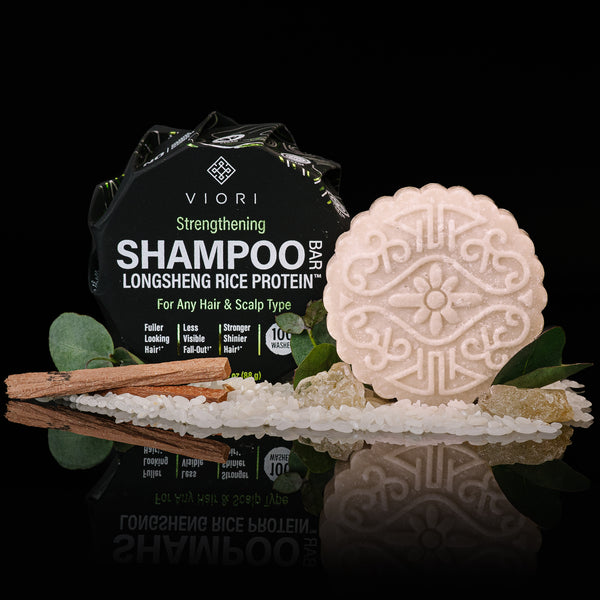
This is why formulations that combine bamboo with rice water-like those Viori has developed based on traditional Yao practices-consistently outperform bamboo-only products. It's not marketing synergy; it's actual biochemical synergy.
The first time I examined hair samples under the microscope after treating them with this combination, I could see the difference. The cuticle alignment was better. The protein deposition was more uniform. The results weren't subjective-they were visible.
Why Bar Format Actually Matters (And It's Not About Being Eco-Friendly)
Let me share something most formulators won't tell you: the physical format of your shampoo-liquid versus solid-has profound implications for whether bamboo extract actually works.
I'm talking about pH stability, something that sounds academic but has real-world impact on your hair.
The Hidden Chemistry of Solid Formulations
Bamboo extract is pH-sensitive. At higher pH levels (above 6.5), many of its beneficial compounds begin to oxidize rapidly. It's the same chemical process that makes a cut apple turn brown-except it's happening to the antioxidants and beneficial compounds you're counting on.
In liquid shampoos, maintaining stable pH requires a cocktail of additional chemicals: buffering systems, preservatives that can interfere with bamboo's antioxidants, and chelating agents to prevent mineral precipitation. Each of these necessary additions can compromise the very ingredients you're trying to preserve.
In a properly formulated bar, however, the lower water activity creates an environment where bamboo compounds remain stable for years rather than months. Oxidation occurs much more slowly. The natural pH of the ingredients-around 5.5, which is ideal for hair-can be maintained without extensive chemical intervention.
This is particularly relevant for fermented rice water formulations combined with bamboo. Fermentation produces lactic acid, a natural pH adjuster that creates an ideal environment for bamboo extract preservation. The ingredients essentially protect each other.
I've conducted stability testing on both formats in my own lab, and the difference is significant. Bamboo antioxidant activity in a well-made bar can remain stable for three to five years, while liquid formulations show measurable degradation within twelve to eighteen months.
The Protein Problem Nobody Warns You About
This is where my professional experience becomes crucial, and where I see the most confusion among both clients and stylists: bamboo extract isn't just silica. It also contains proteins-approximately 10-15% protein content, primarily lectins and enzymatic proteins.
Combined with rice protein and other protein-rich ingredients, this can create a condition called protein overload, and it can actually damage your hair.
When Strengthening Becomes Breaking
I see this in my salon regularly, usually in clients who've been using "strengthening" products daily because they genuinely believe more is better.
Signs of protein overload include:
- Hair feeling stiff or straw-like despite using moisturizing products
- Increased brittleness when you thought you were strengthening
- Paradoxically, more breakage rather than less
- Dullness instead of the promised shine
- A crunchy or rough texture that won't soften
Your hair needs both strength (protein) and flexibility (moisture). Too much of either creates problems, not solutions.
The Fix
Here's what actually works:
- Know your hair's porosity. High porosity hair-damaged, color-treated, or chemically processed-is more susceptible to protein overload because it absorbs protein readily but can't always utilize it effectively.
- Alternate your washes. Use protein-rich bamboo shampoo two to three times per week, alternating with a gentler, moisture-focused cleanser.
- Recognize that strengthening doesn't always mean adding more protein. Sometimes your hair is plenty strong but desperately thirsty. More structure isn't the answer-hydration is.
For low-porosity hair (hair that repels water and takes forever to dry), bamboo's protein content can actually sit on the hair shaft rather than penetrate, creating buildup that mimics the very problems it's supposed to solve.
The Fermentation Factor: Ancient Wisdom Meets Modern Science
This represents the cutting edge of what's possible with bamboo in hair care, and it's an area I've become obsessed with over the past five years.
The Yao women of Longsheng, whose hair remains remarkably healthy well into old age, don't just use rice water-they use fermented rice water, often with bamboo leaf infusions. I used to think this was simply cultural tradition. Then I started understanding the biochemistry.
What Fermentation Actually Does
When you ferment bamboo (or ferment rice water that contains bamboo), several remarkable transformations occur:
Bioavailability increases dramatically. The fermentation process breaks down complex silica structures into forms your hair can actually absorb and use. Those insoluble phytoliths I mentioned earlier? Beneficial bacteria can partially break them down into more water-soluble forms.
Postbiotics are produced. These are beneficial metabolites created during fermentation that enhance scalp microbiome health. More on this shortly, because it's genuinely exciting.
Antioxidant compounds increase by 300-400%. Fermentation doesn't just preserve antioxidants-it actually creates new ones. Studies show that fermented plant extracts have significantly higher radical scavenging activity than their unfermented counterparts.
Small molecular weight peptides are created. These penetrate the hair shaft far more effectively than larger protein molecules, delivering benefits where they're actually needed.
When you ferment bamboo alongside rice-as traditional practices have done for centuries-you create a biochemical environment where ingredients enhance each other in ways that isolated compounds simply cannot replicate.
This is likely one reason why traditional rice water preparations produced such remarkable, consistent results. It wasn't just one ingredient working in isolation; it was a biofermented complex where the whole became greater than the sum of its parts.
Viori's approach of honoring these traditional fermentation methods isn't just cultural respect-it's biochemically superior formulation based on centuries of empirical evidence.
The Scalp Microbiome Revolution
This is perhaps the most underexplored aspect of bamboo in hair care, and it represents where the science is heading: bamboo's impact on your scalp microbiome-the ecosystem of bacteria, fungi, and other microorganisms living on your scalp.
Yes, you have an entire ecosystem living on your head. And its health determines your hair's health more than most people realize.
Bamboo as Prebiotic
Recent research has revealed that bamboo extract contains oligosaccharides that function as prebiotics-essentially, food for the beneficial bacteria on your scalp.
Specifically, xylooligosaccharides from bamboo promote the growth of beneficial scalp bacteria that help maintain skin barrier function, while simultaneously inhibiting fungi associated with dandruff and seborrheic dermatitis.
The result? Improved scalp health through ecosystem balance, not antimicrobial warfare.
This represents a fundamentally different philosophy than conventional dandruff treatments, which typically use harsh chemicals to kill organisms indiscriminately. Those treatments create a scorched-earth approach: kill everything and hope the good bacteria come back first.
Bamboo supports a healthy scalp ecosystem rather than creating a sterile environment. It's the difference between taking an antibiotic (kills everything) and eating yogurt (supports beneficial organisms).
WHAT CUSTOMERS ARE SAYING
Real reviews for Rice Water Shampoo Bar – All Hair Types | VIORI
In my professional practice, I've noticed that clients using microbiome-supporting ingredients like bamboo experience reduced scalp sensitivity over time, less reactivity to new products, better moisture balance, and reduced dandruff without harsh anti-fungal treatments.
Your scalp microbiome is unique to you, like a fingerprint. Supporting its health rather than disrupting it produces longer-lasting, more sustainable results.
The Sustainability Conversation We're Not Having
Everyone knows bamboo grows quickly-it's one of the fastest-growing plants on Earth, with some species growing up to 36 inches in 24 hours. But let's examine the full lifecycle analysis of bamboo in hair care products, the part that marketing conveniently omits.
The Processing Footprint
To create bamboo extract suitable for cosmetic use requires several steps: harvesting (relatively low impact), initial processing (requires significant water and mechanical energy), extraction (often uses ethanol or other solvents), concentration (energy-intensive evaporation), and stabilization (may require additional processing).
Compare this to rice water, which is essentially a byproduct of food preparation. The sustainability equation shifts dramatically when you consider that rice water requires minimal additional processing, it's utilizing what would otherwise be discarded, fermentation happens at room temperature with no energy input, and traditional collection methods have near-zero environmental impact.
This doesn't make bamboo "bad" from a sustainability perspective, but it contextualizes the claims. The most environmentally sound approach might be bamboo as a supporting ingredient in a rice water-primary formulation, rather than bamboo as the hero ingredient requiring extensive extraction.
This is one reason I appreciate formulations that honor traditional methods-they often arrive at sustainability through cultural practice rather than modern greenwashing.
The Hard Water Problem Nobody Mentions
Here's a technical challenge that explains why some users experience incredible results while others see almost none: bamboo extract performance is dramatically affected by water hardness.
Why Location Affects Your Results
Hard water contains dissolved calcium and magnesium ions. When these minerals encounter bamboo extract, several problems occur. Calcium and magnesium can bind to bamboo's silica compounds, preventing them from depositing on your hair. The minerals can also disrupt the electrical charges that help ingredients bond to your hair, and they can even combine with bamboo compounds to create deposits that accumulate as buildup.
If you live in an area with hard water (above 150 mg/L calcium carbonate-you can check this with your local water utility), bamboo shampoo's effectiveness can be reduced by 40-60% compared to soft water environments.
I learned this the hard way when clients would rave about a product, then someone with identical hair type would report no results. Location was often the variable I'd overlooked.
Professional Solutions
- Use chelating rinses once weekly to remove mineral buildup (apple cider vinegar or citric acid work well)
- Try a pre-shampoo rinse: one tablespoon of apple cider vinegar in one cup of water, applied before shampooing
- Consider a shower filter to reduce (though not eliminate) mineral content
- Bar formulations may perform better, as the concentrated format can overcome some mineral interference
Interestingly, traditional preparation methods often included acidic components-fermented rice water is naturally acidic-that would have helped address hard water issues, even though ancient practitioners didn't understand the chemistry behind why it worked.
Real Protection, Not Just Marketing Claims
This is where bamboo shampoo becomes genuinely exciting from a trichological perspective: its role in addressing oxidative stress at the follicle level.
Beyond Surface Treatment
UV exposure, pollution, heat styling, and chemical treatments all create reactive oxygen species-unstable molecules that damage hair proteins and lipids. This is the same oxidative stress that causes metal to rust and apples to brown. Your hair faces this assault daily, and the damage is cumulative.
Bamboo extract contains powerful antioxidant compounds including flavonoids, phenolic acids, and polys


