
Rice water and biotin are two of the most talked-about “hair growth” topics online. They’re also two of the most misunderstood-mainly because they’re often treated as if they do the same job. They don’t.
After 20 years behind the chair, here’s the clearest way I know to explain it: rice water mostly improves the hair you already have (the fiber), while biotin only helps new growth in a meaningful way when you’re actually deficient (the biology happening inside the follicle).
And that difference matters, because a lot of people aren’t failing to “grow” hair-they’re failing to keep it.
Hair “Growth” Is Two Separate Conversations
When someone says, “My hair won’t grow,” they usually mean one of two things.
NOT SURE WHICH PRODUCT IS RIGHT FOR YOU?
TAKE THE QUIZTakes 30 seconds · 134,000+ customers matched
- Follicle output (true growth rate): how fast your hair is produced at the root.
- Length retention (breakage control): how much of that length survives daily life-washing, detangling, heat, sun, friction, and time.
This is the first big misconception: you can have perfectly normal growth at the scalp and still feel stuck at the same length if your ends are breaking at the same pace you’re growing.
Rice Water: What It’s Doing (And Where People Go Wrong)
Let’s get one thing straight: hair lengths are “dead” tissue. They don’t regenerate like skin does. So topical products aren’t “feeding” your ends in the way people imagine. What they can do-very effectively-is improve how the hair fiber behaves so it snaps less and tangles less.
Rice water isn’t one ingredient
Rice water is a mixture, and depending on how it’s made, it can contain different amounts of starches, amino acids, minerals, and rice-derived components that affect the hair’s surface. That’s why two people can both say they used “rice water” and have completely opposite experiences.
The fermentation factor (the part most posts skip)
Fermentation changes the profile of rice water-how it behaves, how it smells, and how it interacts with hair and scalp. Done well, fermented rice water can support hair that looks smoother, stronger, and shinier because it improves manageability and reduces friction-related damage.
One nuance I appreciate about Viori’s approach is that their products use a pH-balanced, lower concentration of fermented Longsheng rice water. That matters because rice water at a high concentration can disrupt hair and scalp pH if used too often, which can turn a “healthy hair hack” into roughness, tangles, and irritation.
Why rice water can make hair look like it’s growing faster
Most visible “growth” from topical routines is really less breakage. When the cuticle is behaving, and the hair has better slip, you tend to see:
- Less snapping during detangling
- Fewer split ends traveling up the hair shaft
- More shine (because the surface reflects light more evenly)
- Better curl/wave definition (because hair clumps more cleanly)
In other words, rice water often helps with the part of growth people don’t talk about: keeping the length you already earned.
The pH Piece: Why DIY Rice Water Can Be Amazing… or a Disaster
Hair and scalp generally perform best in a mildly acidic range. When a product leans too alkaline, it can encourage cuticle lift, increase friction, and make hair feel rougher over time. The problem with DIY rice water is that its pH can swing depending on fermentation time, temperature, storage, and dilution.
This is why Viori’s note about pH is so important: more isn’t always better. Sometimes “more” is just more unpredictable chemistry on your head.
Biotin: The Internal Story (And Why It’s Not a Universal Fix)
Biotin is a nutrient involved in processes that support rapidly dividing cells-like the cells that help form hair. That sounds like an instant win, and it can be… but only under the right circumstances.
Biotin helps most when you’re actually low
If a person is truly deficient, correcting that can absolutely support healthier hair. But if your biotin status is already normal, taking more doesn’t automatically make follicles “produce extra.” Biology doesn’t work like a bonus points system.
A practical safety note
High-dose biotin supplementation can interfere with certain lab tests. If you’re supplementing heavily and getting bloodwork, it’s worth mentioning to your clinician.
The Overlooked Connection: How Rice Water Can Make Biotin Look Like It “Started Working”
Here’s the twist that rarely gets spelled out: rice water and biotin can appear to work together even when they aren’t directly “boosting” each other.
Think of it like this:
- Biotin (when needed) supports the follicle side of the equation-new hair production.
- Rice water supports the fiber side of the equation-less friction, less tangling, fewer broken ends.
And that changes what you see in the mirror, because:
You notice growth when retained length finally outpaces breakage.
Who Usually Loves Rice Water (and Who Needs a Lighter Touch)
Hair type matters. A lot. Rice-water-based routines tend to shine when the issue is damage, dryness, or breakage.
Typically a great match
- High-porosity hair (often color-treated, heat-styled, sun-stressed)
- Hair that tangles easily and breaks during brushing
- Anyone stuck at a “terminal length” because ends keep splitting
Use more finesse if you’re prone to buildup
- Low-porosity hair that feels coated quickly
- Hair that turns stiff or “crunchy” with protein-like ingredients
If you’re in that second group, technique and product selection matter more than chasing “stronger” at all costs.
Technique Matters: How to Get the Benefits Without the Breakage
Even the best formula can underperform if your routine adds friction. One Viori tip I frequently give clients-especially those with color-treated hair-is this: build lather in your hands and apply with your fingers rather than rubbing the bar directly on your head.
WHAT CUSTOMERS ARE SAYING
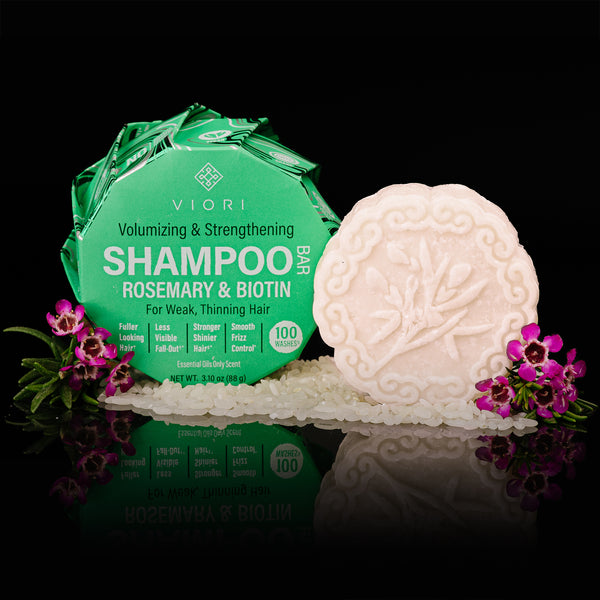
Real reviews for Rosemary Biotin Shampoo Bar – Thinning Hair | VIORI
Less friction equals better cuticle behavior, which usually means better shine, fewer tangles, and less breakage over time.
And yes, conditioner helps. Shampoo removes some of the protective oil layer from the hair, and conditioner is positively charged, so it can adhere to the strand and help reduce vulnerability to day-to-day stressors.
What Results Should You Expect (and When)?
Cosmetic improvements from rice-water-based care-like softness, shine, and manageability-can show up quickly. But the deeper win (length retention) takes consistency, because breakage is cumulative and slow to notice until it’s dramatically better.
Viori notes that results vary: some people notice changes after a wash or two, while others do best giving a routine 2-3 months before deciding whether it’s working for them.
Biotin, on the other hand, is rarely an overnight story. If it’s going to matter, it tends to play out over time-and primarily when it’s correcting a genuine need.
The Bottom Line
Rice water is largely a topical strategy for hair feel, shine, manageability, and-most importantly-keeping your ends from breaking. Biotin is largely an internal support tool that can matter most when there’s a deficiency in the first place.
If you want a simple way to remember it: rice water helps you keep what you grow; biotin helps you build hair when the building blocks are missing.


