
Grey hair has a way of telling the truth. If your routine is even slightly off-too much friction, the wrong cleanse pattern, mineral-heavy water, or a conditioner that isn’t doing enough-silver strands will show it fast. That’s why choosing a solid shampoo for grey hair isn’t just about swapping a bottle for a bar. It’s about understanding what grey hair is actually doing at the fiber level, then using a bar in a way that makes it look brighter, feel smoother, and behave more predictably.
Most online advice stops at “avoid yellowing” or “use something moisturizing.” Helpful, sure-but incomplete. The more useful conversation (and the one I have with clients in real life) is about three under-discussed factors: how grey hair reflects light, how mineral film fakes dullness, and how bar technique can either protect or rough up the cuticle.
Why grey hair can look dull even when it’s clean
When hair loses pigment, it doesn’t just change color-it changes optics. Melanin influences how light moves through the hair shaft. As melanin fades, grey and white hair tends to show every little surface issue more clearly. That’s why hair can be freshly washed and still look slightly flat, cloudy, or “tired.”
NOT SURE WHICH PRODUCT IS RIGHT FOR YOU?
TAKE THE QUIZTakes 30 seconds · 134,000+ customers matched
The difference is usually happening at the surface: a raised cuticle, tiny chips along the cuticle edges, or a bit of film sitting on the strand. On darker hair you might not notice it as quickly. On silver hair, it can steal the sparkle.
So the goal with a solid shampoo isn’t only cleansing. For grey hair, you want a routine that supports cuticle smoothness, because smooth cuticles reflect light more evenly and make greys look brighter and more polished.
The quiet factor that changes everything: pH balance
Here’s where a lot of routines go sideways-without people realizing it. Hair doesn’t love extremes, especially when it comes to pH. When products are too alkaline, hair can swell and the cuticle can lift. Lifted cuticles tend to create:
- More tangling (especially at the crown and nape)
- More frizz, even when you “did everything right”
- A rougher, wirier feel that many people associate with greying
- Less shine, because light scatters instead of reflecting cleanly
That’s one reason I pay attention to bars that are designed to be pH balanced. Viori notes their bars are pH balanced, which is exactly what you want if you’re chasing that smoother, more reflective finish on grey hair.
The “yellowing” culprit people miss: mineral film from hard water
When someone tells me their grey hair is turning yellow, my first question isn’t “What toner are you using?” It’s: “How’s your water?” Hard water can deposit minerals that cling to the hair and dull the surface. On grey hair, that can read as warmth or brass even if the hair itself isn’t truly stained.
Mineral film can also make hair feel strangely inconsistent-clean at the root but heavy through the ends, or soft underneath but rough on top. And it can show up as:
- Dullness (the shine disappears first)
- Drag (hair doesn’t “slip” between your fingers)
- Extra tangles in the mid-lengths
- Stiffness that feels like dryness but doesn’t respond to more conditioner
This is where solid shampoo technique matters. Bars are fantastic-but grey hair and hard water are a combination that rewards precision. You want even distribution, thorough rinsing, and minimal friction so you don’t rough up the cuticle while you’re trying to make it shine.
The #1 bar mistake that makes grey hair feel wiry
If you take nothing else from this post, take this: don’t scrub the bar directly onto your hair lengths. Can you do it? Technically, yes. Do I recommend it for greys? Usually not.
Direct bar-to-hair rubbing increases friction, and friction is one of the fastest ways to make grey hair feel coarse. It can also lead to uneven product concentration-some spots get overloaded while others barely get cleansed-which can create that “roots feel clean but the rest feels off” result.
Viori also recommends building lather in your palm and applying with your hands. That’s smart for color care, and it’s just as smart for grey hair because it reduces mechanical stress and improves distribution.
The pro method: how to wash grey hair with a solid shampoo bar
This is the technique I’d teach any client with silver, white, or salt-and-pepper hair who wants shine without that rough, squeaky aftermath.
- Saturate your hair completely for 30-60 seconds. Fully wet hair reduces friction and helps product spread evenly.
- Build lather in your hands. Rub the Viori shampoo bar between wet palms until you have a creamy lather.
- Cleanse the scalp using fingertips in small circles. Let the foam rinse through the lengths instead of scrubbing them.
- Condition mid-lengths to ends. Take your time here-grey hair benefits from consistent coverage.
- Let conditioner sit for 3-5 minutes before rinsing. This is one of the easiest ways to improve softness and shine.
- Rinse thoroughly. If greys look dull after washing, incomplete rinsing is a surprisingly common reason.
Choosing a Viori bar for grey hair: start with your scalp, not your shade
Grey hair can feel drier, but your scalp might still be oily, normal, or dry. Choosing your bar based on scalp behavior usually gives the most consistent results. Viori’s guidance aligns with what I see day to day:
- Oily scalp: Viori often recommends Citrus Yao, and notes it contains citric-acid-related oil control that can help break down excess oil effectively.
- Normal to dry scalp (or frizz-prone greys): Terrace Garden, Hidden Waterfall, or Native Essence are commonly recommended for more moisture support.
- Sensitive scalp or fragrance sensitivity: Native Essence is Viori’s unscented option and is typically the gentlest choice.
If you’re the classic combo-oily scalp with dry ends-a split routine often works beautifully: cleanse the scalp in the direction of oil control, then focus your conditioning on moisture and slip through the mid-lengths and ends.
Protein and grey hair: the nuance most people skip
Protein gets treated like a villain or a miracle, and grey hair forums are full of both opinions. The truth is more practical: protein is a tool, and your hair’s response depends on balance and technique.
WHAT CUSTOMERS ARE SAYING
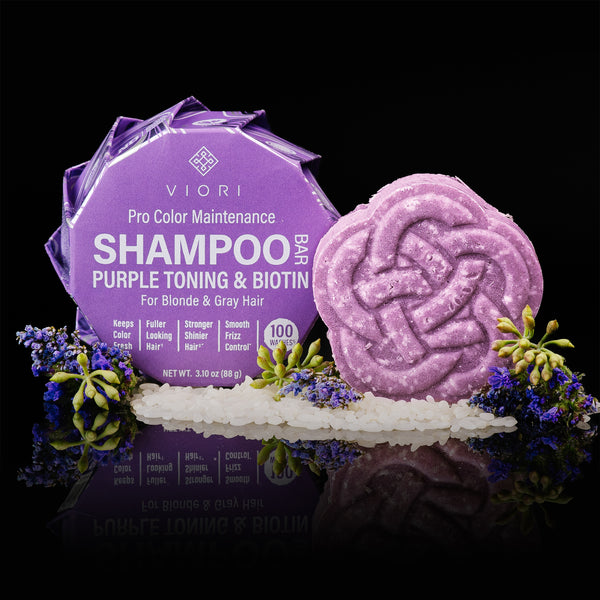
Real reviews for Purple Shampoo Bar with Biotin – Blonde & Gray | VIORI
Viori includes hydrolyzed rice protein and notes it’s used in a low concentration. In hair terms, hydrolyzed proteins can help hair feel stronger and look smoother by supporting the strand’s surface and weak points. But if your hair starts to feel stiff, it’s often not a “protein problem” so much as a routine problem-too much friction, not enough conditioning time, or over-washing the lengths.
What a solid shampoo can (and can’t) do for greys
A well-formulated, pH-conscious solid shampoo routine can absolutely support softer feel, improved shine, and a cleaner, brighter look-especially when you keep friction low and rinsing thorough.
What it can’t do is guarantee that greying will reverse. Viori is clear that they don’t claim to prevent or reverse grey hair. Their bars are designed to support hair and scalp health-things like moisture, strength, shine, and overall manageability-with results varying from person to person.
Why you should give a bar routine time (especially with grey hair)
Grey hair is sensitive to small changes: humidity, mineral exposure, styling habits, and product load. Viori recommends giving their routine 2-3 months before giving up, and that’s realistic. You’re not just switching a cleanser-you’re often retraining your scalp, improving cuticle behavior, and dialing in application technique.
If you want the short version: grey hair loves consistency and hates friction. Use a pH-balanced bar thoughtfully, focus cleansing where it belongs (the scalp), condition with intention, and let the surface of the hair recover. That’s where the brightness comes from.


