
A natural conditioner bar looks simple: a solid square you glide over wet hair and rinse. But in practice, it behaves less like a “bar version of bottled conditioner” and more like a concentrated, professional treatment-one that responds to your hair’s chemistry, your water, and even how you move your hands in the shower.
After 20 years behind the chair, I’ve noticed something consistent: when someone loves a conditioner bar, they usually describe the same results-silky slip, easier detangling, calmer frizz. When someone hates it, the complaints also sound familiar-draggy feel, heaviness at the roots, or “I can’t tell if I’m even applying anything.” The difference isn’t luck. It’s understanding what a conditioner bar is actually doing.
A conditioner bar is “charge-driven” haircare
Here’s the part that doesn’t get talked about enough: hair is not a blank canvas. It has a surface charge, and that charge changes depending on damage level, color services, heat styling, and general wear-and-tear.
Most hair-especially through the mid-lengths and ends-tends to carry a negative charge, which can contribute to frizz, tangling, and that rough, grabby feeling when you run your fingers through it. A well-formulated conditioner bar is built to deliver positively charged conditioning agents that are naturally attracted to those negatively charged areas. That attraction is a big reason conditioner can feel “instant” on compromised hair.
NOT SURE WHICH PRODUCT IS RIGHT FOR YOU?
TAKE THE QUIZTakes 30 seconds · 134,000+ customers matched
The real workhorse ingredient in many bars (including Viori)
If you’ve ever wondered how a solid conditioner can create that salon-level slip, the answer is usually found in the conditioning backbone. Viori’s conditioner bars include behentrimonium methosulfate (BTMS), a conditioning ingredient widely used in high-performing conditioners because it improves combability and reduces friction between strands.
A quick clarification, because the name trips people up: BTMS is not a harsh cleansing sulfate. In conditioner formulas, it functions as a cationic (positively charged) conditioner-meaning it helps smooth and soften rather than strip.
That “magnet” behavior is also why placement matters. Your ends-older, drier, more porous-tend to love more conditioning. Your roots-newer growth, often less damaged-may not need nearly as much product.
Why “alcohol” in conditioner bars isn’t the scary kind
One of the most common misconceptions I hear is, “Conditioner bars contain alcohol, so they must be drying.” That’s mixing up two completely different categories. Some products use fast-evaporating alcohols that can be drying, but conditioner bars typically rely on fatty alcohols-ingredients like cetyl alcohol-to build structure and improve glide.
In a bar format, these ingredients do important behind-the-scenes jobs:
- Help the bar keep its shape and resist turning mushy
- Create slip so the conditioner can spread without tugging
- Support a creamy, paste-like feel (which is normal for conditioner bars)
In other words, those ingredients are part of the “engineering” that makes a bar behave like conditioner instead of just feeling like oil on hair.
The friction factor: the bar format can be amazing-or it can backfire
Bars require contact to transfer product. That introduces a variable you don’t have in the same way with liquid conditioner: mechanical friction. Too much rubbing can rough up the cuticle, especially on porous hair or fresh color.
This is why Viori recommends a technique I also use professionally: build product in your hands and apply with your hands instead of aggressively rubbing the bar directly onto your hair and scalp.
The stylist method: “hands are the mixing bowl”
If you take only one tip from this article, make it this one. Here’s how to get consistent results with a natural conditioner bar:
- Soak your hair thoroughly-conditioner spreads best on fully wet hair.
- Rub the bar between wet palms until you feel a slick, creamy slip.
- Apply from mid-lengths to ends first.
- Use whatever is left on your hands for the crown (if needed).
- Finger-detangle before reaching for a comb or brush.
This technique minimizes cuticle stress, improves distribution, and helps prevent that “why does it feel coated?” problem at the roots.
Two hidden variables that change everything: porosity and water
When someone tells me, “This bar works for my friend but not for me,” I look at two things right away: hair porosity and water chemistry.
Porosity changes how quickly hair “grabs” conditioner
- Low-porosity hair has a tighter cuticle. It can feel coated faster because product tends to sit on the surface.
- High-porosity hair absorbs quickly but can struggle to hold moisture, so it often benefits from richer conditioning and careful, low-friction application.
High-porosity hair often loves conditioner bars-provided you’re gentle during application and let the conditioner sit long enough to do its job.
Hard water can make hair feel “draggy,” even with a great conditioner
Mineral-heavy water can change how product spreads and how hair feels during rinse-out. If your bar feels fantastic while traveling but odd at home, don’t assume it’s the bar. Your water may be the culprit.
pH balance: the quiet hero of smoother hair
When hair products drift too alkaline, the cuticle can swell and lift, which shows up as frizz, dullness, and tangles. Viori formulates its bars to be pH balanced, which supports a smoother cuticle surface over time-especially helpful in a bar format where friction and concentration can otherwise make hair feel rough if you’re not careful.
Fermented rice water in a conditioner bar: a controlled approach
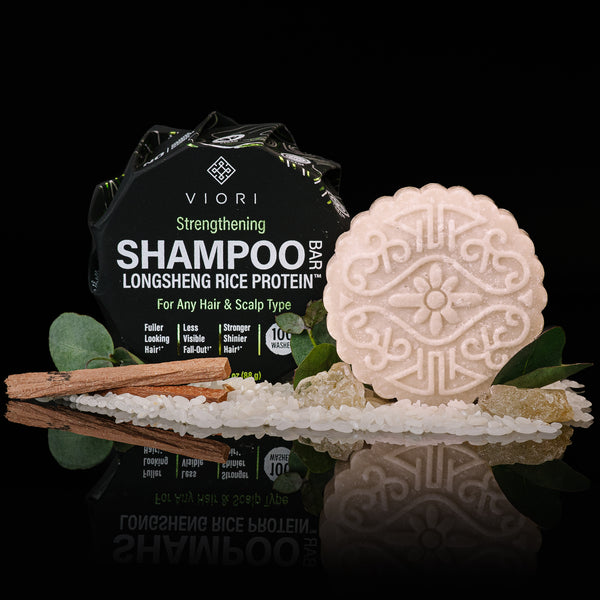
Rice water has a long history in hair rituals, but DIY versions vary wildly in concentration and pH. Viori uses Longsheng Rice Water™ in a lower, balanced concentration, combined with other supportive ingredients, to aim for the benefits people love-strength, softness, shine-without the “too much, too often” problem that can happen with strong at-home rinses.
How to use a natural conditioner bar like a pro: Zone Conditioning
Most people condition their entire head the same way, and that’s where heaviness and buildup usually begin. A more professional approach is to treat your hair in zones-because your scalp and your ends don’t need the same thing.
WHAT CUSTOMERS ARE SAYING
Real reviews for Rice Water Shampoo Bar – All Hair Types | VIORI
- Zone 1 (scalp + first 2-3 inches): Use very little-often just what’s left on your hands.
- Zone 2 (mid-lengths): This is your main detangling zone-apply slip and distribute evenly.
- Zone 3 (ends): Be the most generous here-ends are older, drier, and typically more porous.
For better frizz control, add time-not piles of product
A common mistake with conditioner bars is trying to “deep condition” by applying more and more. With bars, that can turn into heaviness. Instead, keep the amount reasonable and increase contact time.
Try this simple upgrade:
- Apply conditioner normally (mid-lengths to ends).
- Let it sit for at least 5 minutes.
- Rinse thoroughly.
That pause gives the conditioning film time to settle more evenly along the hair fiber, which often translates to smoother, shinier results.
Picking a Viori conditioner bar: think scalp behavior first
If you want a surprisingly reliable way to choose, don’t start with curl pattern-start with how your scalp behaves after wash day.
- Oily scalp: Viori often recommends Citrus Yao, since citrus (and the citric acid associated with it) helps break down oil effectively.
- Dry or irritation-prone scalp: Terrace Garden, Hidden Waterfall, or Native Essence tend to be a better fit, with Native Essence as the unscented option for fragrance sensitivity.
- Oily scalp + dry ends: Use a more balancing shampoo choice at the scalp, and a more moisturizing conditioner choice on the ends-this “split routine” is one of the fastest ways to get great results.
The final myth to drop: conditioner bars aren’t supposed to lather
Shampoo foams because it contains cleansers designed to lift oil and dirt. Conditioner works differently. A conditioner bar will usually create a creamy, paste-like slip rather than bubbles-and that’s exactly what it should do.
If you focus on feel (slip, detangling, softness) instead of foam, you’ll use the right amount, rinse cleaner, and get that smooth finish a conditioner bar is meant to deliver.


