
If you've spent any time exploring alternative hair care methods, you've likely encountered the term "no poo conditioner" or "co-washing." At first glance, it sounds simple enough-skip the shampoo and just use conditioner to cleanse and condition simultaneously. But as someone who's spent twenty years working with hair, I can tell you there's a fascinating biochemical story happening beneath the surface that most people never hear about.
Today, I want to dive deep into a topic that rarely gets the technical attention it deserves: how conditioning agents actually work when you skip traditional shampooing, and why this approach works beautifully for some people while leaving others with frustrating buildup and lackluster results.
The secret? It's all about your hair's porosity and understanding the chemistry at play.
Why Shampoo and Conditioner Were Designed as Partners
To understand why "no poo" conditioning is more complex than it seems, we first need to talk about why traditional shampoo and conditioner work as a two-step system.
The Science of the Shampoo-Conditioner Duo
Think of traditional hair washing as a carefully choreographed dance:
Act One: Shampoo Opens the Door
When you apply shampoo, several things happen at the molecular level:
NOT SURE WHICH PRODUCT IS RIGHT FOR YOU?
TAKE THE QUIZTakes 30 seconds · 134,000+ customers matched
- The anionic (negatively charged) surfactants temporarily raise your hair's pH to around 6-7
- This pH shift causes your hair cuticles-those overlapping scales on each strand-to lift slightly open
- Your hair becomes negatively charged, creating an electrical attraction to positive molecules
- This "opens the door" for the conditioning stage
Act Two: Conditioner Steps Inside
After shampooing, conditioner takes center stage:
- Cationic (positively charged) ingredients in conditioner are magnetically drawn to your now-negative hair
- These beneficial molecules can slip under the lifted cuticles and smooth them back down
- A protective film forms on your hair shaft that remains even after rinsing
- The result: smooth, manageable, conditioned hair
This system works because each step prepares your hair for the next. Shampoo doesn't just cleanse-it creates the electrical and structural conditions that allow conditioner to do its job effectively.
What Happens When You Skip the First Step
When you use a conditioner without shampooing first-true co-washing-you're asking conditioning ingredients to work without that crucial preparation stage. You're depositing positively charged molecules onto hair that hasn't been "primed" with a negative charge or opened cuticles.
This creates three significant challenges:
- Weaker attraction: Without that negative charge, conditioning ingredients have less "magnetic pull" to your hair shaft
- Surface-level results: Closed cuticles mean ingredients sit on top of your hair rather than penetrating where they're needed
- The buildup trap: You might need to use more product to feel any conditioning effect, which ironically leads to faster buildup than traditional washing
So does this mean no poo methods are doomed to fail? Not at all-but success depends on understanding a factor that most advice overlooks: your hair's natural porosity.
The Porosity Puzzle: Why No Poo Works for Some and Not Others
Here's the insight that changed how I approach no poo methods with my clients: your hair's porosity level determines whether co-washing will be your best friend or your biggest frustration.
What Is Hair Porosity?
Hair porosity refers to how easily moisture and products can penetrate your hair cuticle. Think of your hair cuticles like roof shingles:
- High porosity: The shingles are lifted and gaps exist (doors are already open)
- Low porosity: The shingles lie flat and tight (doors are closed)
- Normal porosity: The shingles have a healthy, slightly flexible arrangement
High Porosity Hair: The No Poo Success Story
In traditional hair care education, we're taught that high porosity hair is "damaged" and problematic-it loses moisture quickly and feels dry. But here's the counterintuitive truth: high porosity hair often thrives with no poo methods.
Why? Because the "doors" are already open:
- Cuticles are naturally lifted, so conditioning agents can penetrate without needing shampoo to open them first
- Your hair readily accepts beneficial molecules even without that negative charge preparation
- Natural sebum can actually absorb into the hair shaft rather than sitting on the surface
If you have high porosity hair and switch to co-washing, you might find your hair feels more moisturized and manageable than it ever did with traditional washing. Your hair's structure naturally accommodates this approach.
Low Porosity Hair: The No Poo Challenge
Low porosity hair-with its tightly sealed cuticles-faces the opposite situation. This is where many people run into trouble with co-washing:
- Conditioning ingredients cannot penetrate those closed cuticle doors without pH manipulation
- Products accumulate on the hair surface, creating a waxy or heavy coating
- This coating actually blocks moisture from entering your hair in future treatments
- The result feels "moisturized" or "soft" initially, but you're actually creating a moisture-blocking barrier
This is why you'll find passionate advocates and frustrated critics of no poo methods-they likely have different hair porosity levels. It's not that one person is "doing it wrong." They have fundamentally different hair structures that respond differently to the same approach.
Finding Your Hair's Porosity
Before committing to a co-washing routine, try this simple test:
The Water Drop Test:
- Take a clean, shed hair (one you find on your brush or pillow)
- Place it in a glass of room-temperature water
- Wait a few minutes and observe:
- Sinks immediately: High porosity
- Floats on top: Low porosity
- Hovers in the middle: Normal porosity
This simple test can save you months of frustration by helping you understand what your hair needs.
The Rice Water Exception: Ancient Wisdom Meets Modern Science
Now, let's talk about an exception to these porosity rules-and why traditional rice water-based treatments offer something unique in the world of co-washing.
The Red Yao women of China have used fermented rice water for centuries, maintaining remarkably healthy hair well into old age. As interest in natural hair care has grown, we've started to understand why this traditional approach works from a biochemical perspective-and it's fascinating.
What Makes Fermented Rice Water Different
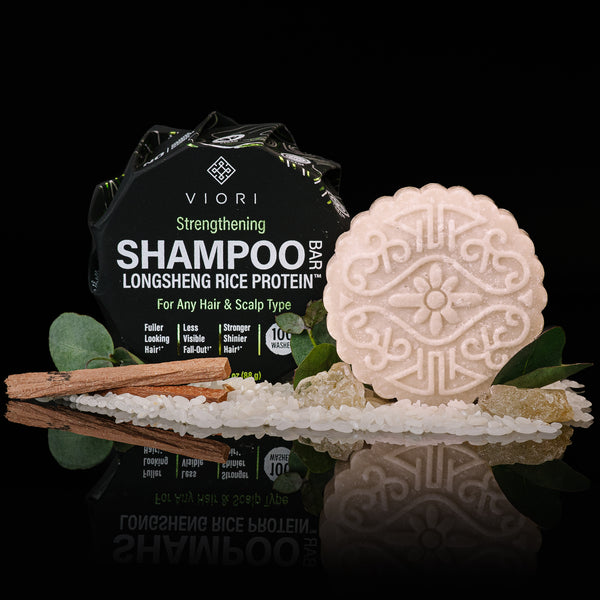
Viori's formulations, inspired by these traditional practices, incorporate fermented rice water-and from a chemistry standpoint, this creates several advantages for co-washing:
pH Balance: Fermented rice water has a naturally acidic pH (around 4-5). This acidity helps smooth hair cuticles without needing the alkaline opening that shampoo provides. It's gentle enough to use regularly but effective enough to work.
Protein Penetration: The hydrolyzed rice protein molecules in fermented rice water are remarkably small. This matters because even low porosity hair with tightly closed cuticles can absorb these tiny proteins without requiring cuticle lifting.
Inositol's Magic: Fermented rice water contains inositol, a vitamin B8 derivative that acts as a humectant. Unlike many conditioning agents that coat the hair surface, inositol actually attracts moisture into the hair shaft.
The critical difference: rice water conditions through penetration rather than just surface deposition.
This is why rice water-based products work across different porosity levels more universally than typical co-wash formulations. You're not just coating your hair-you're delivering beneficial ingredients that can actually enter the hair structure.
Making No Poo Work: A Technical Framework
If you're committed to exploring co-washing, here's how to set yourself up for success based on your hair's unique characteristics.
Strategy for Low Porosity Hair
If you have low porosity hair, you need to help those cuticles open slightly to allow conditioning agents inside:
Product Selection:
- Look for co-wash products with mild natural acids (citric acid from fruit extracts, lactic acid) that gently encourage cuticles to lift
- Choose smaller molecule ingredients: hydrolyzed proteins, amino acids, and glycerin can penetrate more easily
- Consider bar format products (like Viori's shampoo and conditioner bars) that require more scalp contact and friction-more on why this matters in a moment
Application Technique:
- Apply products to soaking wet hair-water helps swell the cuticle and allows better penetration
- Use warm (not hot) water during application to assist cuticle opening
- Spend extra time massaging product into your hair
- Finish with a cool water rinse to encourage cuticles to seal back down
Strategy for High Porosity Hair
If you have high porosity hair, your focus shifts from opening cuticles to sealing and protecting them:
Product Selection:
- Seek formulations with film-forming ingredients like natural butters (shea, cocoa) and cetyl alcohol
- Focus on products that emphasize cuticle-sealing rather than deep penetration
- Rice water-based products work particularly well here
Application Technique:
- You don't need as much product as you might think-a little goes a long way
- Focus on smoothing product down the hair shaft rather than vigorous massage
- Always finish with cool or cold water to encourage cuticle closure
- Consider a diluted apple cider vinegar rinse occasionally to help seal cuticles
The Friction Factor: A Hidden Key to Success
Here's something virtually never discussed in no poo communities, but it's crucial: the mechanical action of applying your co-wash partially compensates for the lack of chemical cuticle opening.
WHAT CUSTOMERS ARE SAYING
Real reviews for Rice Water Shampoo Bar – All Hair Types | VIORI
When you massage a conditioning product into your hair and scalp, you create friction that temporarily lifts cuticle edges, allowing ingredient penetration. This is one reason why:
- Bar format cleansers and conditioners often work better for co-washing than liquids-they require more direct scalp contact and naturally create more friction
- Thorough scalp massage isn't just relaxing or good for circulation-it serves a biochemical purpose by helping products absorb
- The "scrubbing" motion actually facilitates product effectiveness, not just distribution
When I recommend Viori's bars to clients exploring co-washing, this friction factor is part of why they tend to see good results. The format itself supports the technique.
Rethinking Protein and Moisture Balance
If you've spent time in hair care communities, you've heard about "protein-moisture balance." But no poo methods require you to think about this balance in a completely different way.
The Traditional "Reset" Model
With regular shampooing:
- Shampoo strips away everything (creates a deficit)
- Conditioner replaces what was lost (fills the deficit)
- Each wash cycle is essentially a fresh start
The No Poo "Cumulative" Model
Without regular stripping:
- Nothing gets completely removed
- Each conditioning session adds to what's already present
- Balance is achieved through strategic ingredient choices over weeks, not per wash
This requires a different mindset. Instead of thinking "what does my hair need today," think "what has my hair received over the past two weeks?"
A Sample Rotation:
- Weeks 1-2: Focus on moisture-products with humectants like glycerin and light oils
- Weeks 3-4: Introduce protein-rice water treatments or products with wheat or silk protein
- Weeks 5-6: Use lighter conditioning or a clarifying co-wash to prevent buildup
- Repeat the cycle
Many people fail at no poo because they apply traditional wash-day thinking to a cumulative system. They use the same product in the same way every time, and either experience buildup or dryness depending on what that product emphasizes.
The Truth About Sebum: Your Body's Natural Conditioner
Let's talk about something essential but often misunderstood: when you stop using traditional shampoo, your scalp's natural sebum becomes your primary hair conditioning agent, and any products you use should supplement this, not replace it.
Understanding Sebum Composition
Your sebum contains:
- Triglycerides (45%)
- Wax esters (25%)
- Squalene (15%)
- Free fatty acids (15%)
This composition is remarkably similar to many "natural" conditioning ingredients, but with one crucial difference: your sebum is literally molecularly designed to coat human hair at body temperature. No manufactured product, no matter how well-formulated, can claim that same biological compatibility.
The Real Story Behind the "Transition Period"
Almost everyone who talks about starting no poo mentions the dreaded "transition period"-that 6-12 week phase when your hair might feel oily, waxy, or just "off." The common explanation is that your scalp needs to "adjust its oil production."
That's an oversimplification. Here's what's actually happening at a molecular level:
- Sebum distribution visibility: Without detergents constantly stripping oil away, your natural sebum pattern becomes apparent. You're not producing more oil-you're finally seeing your baseline production.
- Old product interference: Previous silicones, polymers, and other ingredients don't just wash away. They're trapped under cuticles and gradually emerge as your hair cuticles normalize and close.
- Scalp microbiome shift: Your scalp's bacterial and fungal ecosystem shifts from detergent-resistant species to oil-metabolizing species. This


