
After twenty years behind the chair, I've seen every hair care trend come and go. Most of them are just marketing hype with a fancy new name. But liaison shampoos? They're different. The problem is, almost nobody explains what they actually do or why they work. Today, I'm pulling back the curtain on the chemistry that makes these formulations fundamentally different from anything sitting in your shower right now.
This isn't about miracle ingredients or overnight transformations. It's about understanding what's really happening to your hair at the molecular level-and why that matters more than any before-and-after photo.
What "Liaison" Really Means (And Why It's Not Just Marketing Speak)
Let's start with the name. "Liaison" comes from French, meaning "connection" or "binding." If you've ever watched a cooking show, you might recognize the term-it's that egg yolk and cream mixture that transforms a thin sauce into something luxurious and cohesive. The ingredients literally bind together.
In hair care, the concept is similar but far more sophisticated. Liaison shampoos don't just clean your hair. They're creating molecular connections between damaged keratin structures while they cleanse. Let that sink in for a moment.
Traditional shampoo strips everything away-the dirt, yes, but also the protective oils and natural sebum your hair needs. Then you scramble to repair that damage with conditioner. It's backwards. It's like tearing down a wall and then trying to patch it with spackling paste.
Liaison technology protects and repairs during the washing process itself. It's a completely different philosophy, and once you understand the science, you'll never look at hair care the same way.
The Chemistry Your Shampoo Bottle Isn't Telling You
Why Traditional Shampoos Leave Your Hair Worse Off
Here's what most people don't realize: conventional shampoos use anionic surfactants-molecules with a negative charge like sodium lauryl sulfate. These molecules are brilliant at removing oil. They have a water-repelling tail that grabs onto sebum and a water-attracting head that lets everything rinse away.
NOT SURE WHICH PRODUCT IS RIGHT FOR YOU?
TAKE THE QUIZTakes 30 seconds · 134,000+ customers matched
The problem? They're completely indiscriminate. They don't distinguish between the dirt you want gone and the protective lipid layer your hair desperately needs. It's like using a sledgehammer to hang a picture frame. Effective? Sure. Appropriate? Not even close.
This is why your hair feels squeaky clean but also stripped, dry, and tangled after shampooing. You've just removed everything that was protecting it.
How Liaison Formulations Change Everything
Liaison shampoos incorporate what chemists call "substantive conditioning agents." These are typically positively charged (cationic) or dual-charged (amphoteric) molecules that can cleanse and create protective bonds with your hair simultaneously.
Here's where it gets fascinating. When hair is damaged-from bleach, heat styling, sun exposure, even aggressive brushing-the cuticle develops an excess negative charge. This happens because you're losing sulfur-containing amino acids and exposing negatively charged carboxyl groups.
Damaged hair is literally electrically charged differently than healthy hair.
Liaison shampoos contain ingredients designed to seek out these negatively charged damage sites like a heat-seeking missile. While cleansing, they're simultaneously finding damage and creating protective bonds exactly where they're needed most. It's elegant chemistry that works with your hair's natural structure rather than against it.
The Ingredients That Make Liaison Technology Possible
Behentrimonium Methosulfate: The Most Misunderstood Ingredient in Natural Hair Care
I need to address this because it's one of the biggest sources of confusion I see. Behentrimonium methosulfate (BTMS) sounds scary. It sounds like sulfates. But it's actually a quaternary ammonium compound derived from rapeseed oil, and it's nothing like sodium lauryl sulfate.
This ingredient is the perfect example of liaison technology in action. Here's what it actually does:
- Penetrates partially opened cuticles: Unlike surface conditioners that just sit on top, BTMS works its way into the slightly swollen cuticle structure that occurs during washing.
- Forms ionic bonds with damage sites: Remember those negatively charged damaged areas? BTMS is positively charged, so it's magnetically attracted to them. It doesn't randomly coat-it targets damage.
- Creates bridges between broken bonds: Disulfide bonds give hair its strength. When they break, hair becomes weak. BTMS creates temporary bridges across these breaks, providing structural support.
- Stays attached through rinsing: This is crucial. BTMS doesn't wash down the drain. It remains bonded to your hair, continuing to work long after you've toweled off.
When formulated in a shampoo rather than just a conditioner, BTMS performs a protective function during the most vulnerable moment-when your cuticles are swollen and susceptible to damage.
Hydrolyzed Proteins: Why Molecular Size Changes Everything
Every beauty store is full of products shouting about protein. But here's what they don't tell you: not all proteins are created equal, and the word "hydrolyzed" is doing a lot of heavy lifting.
Hydrolysis breaks proteins down into specific molecular weights, and this size determines what the protein can actually do for your hair:
- Large molecules (over 10,000 Daltons): Too big to penetrate. They form a protective film on the surface, which is beneficial but limited.
- Medium molecules (1,000-10,000 Daltons): Can penetrate partially into the cuticle for mid-level reinforcement.
- Small molecules (under 1,000 Daltons): These tiny amino acid chains can actually reach the cortex-the inner structure-where they create internal reinforcement.
The most sophisticated liaison shampoos use a spectrum of molecular weights. This technique is called "molecular layering," and it's brilliant. You're getting multi-level structural support-some molecules working on the surface, others penetrating deeper, all reinforcing different layers of your hair's structure.
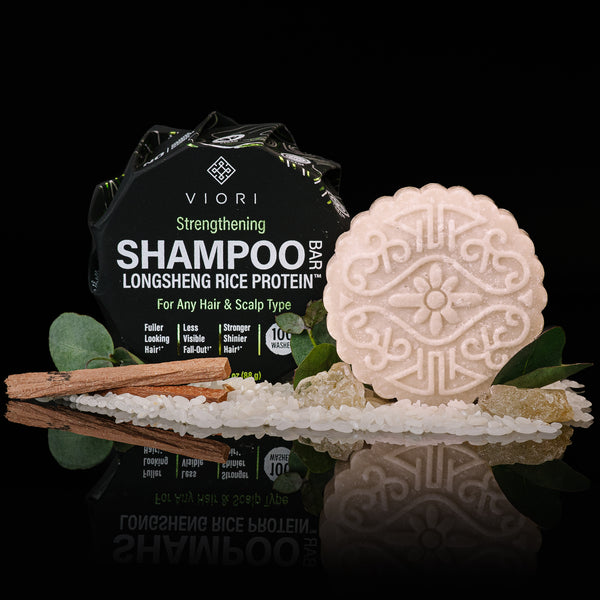
Take rice protein, for example. When properly hydrolyzed, it provides small amino acids that can penetrate damaged areas and create internal reinforcement, while larger molecules offer surface protection. You're essentially scaffolding your hair from the inside out.
At Viori, this principle drives everything we do. The fermented rice water in our formulations contains naturally hydrolyzed proteins with varied molecular weights, providing that crucial multi-layer reinforcement that your hair actually needs.
The pH Factor: The Game-Changer Everyone Ignores
In two decades of consulting with clients, I've found that pH is the most overlooked aspect of hair care. People obsess over ingredient lists but completely ignore the chemical environment those ingredients exist in. It's like having the world's best ingredients for a cake but baking it at the wrong temperature.
Understanding Your Hair's Electrical Nature
Hair has what's called an isoelectric point-the pH where it carries no net electrical charge-around 3.67. At this pH, hair is at its strongest because there's no electrostatic repulsion between keratin chains. Everything is content, stable, and lying flat.
Most traditional shampoos operate at a pH of 5-7, which causes the cuticle to swell moderately. This swelling is necessary for cleaning, but it leaves hair vulnerable. The cuticle scales lift up like shingles on a roof during a windstorm, creating opportunities for damage and moisture loss.
Liaison formulations in the 4.5-5.5 range create optimal conditions for several critical processes:
- Adequate cuticle lifting for thorough cleansing
- Minimal swelling that reduces damage risk
- Perfect conditions for cationic bonding agents to attach to damage sites
- Faster cuticle closure after rinsing, sealing in treatments
Here's something beautiful about natural formulations: certain botanical ingredients naturally create this ideal pH environment. Fermented rice water, for instance, naturally lowers pH through organic acids produced during fermentation. It's not artificially adjusted-the fermentation process itself creates the optimal chemical environment.
This fermentation also increases levels of inositol and panthenol-both clinically shown to strengthen hair's internal structure. Nature and chemistry working in perfect harmony.
Fermentation: Ancient Wisdom Meets Cutting-Edge Chemistry
The fermentation of botanical ingredients represents one of the most sophisticated forms of liaison technology available, though it's rarely explained properly. Let me break down what's actually happening at the molecular level.
The Molecular Transformation
When ingredients like rice are fermented, several critical changes occur that transform them into powerful hair care actives:
- Enzymatic breakdown reduces particle size: Fermentation enzymes break down larger molecules into smaller components, dramatically improving their ability to penetrate the hair shaft. You're essentially pre-digesting the nutrients so your hair can actually use them.
- pH naturally decreases to the optimal range: Fermentation produces organic acids that bring pH into that ideal 4.5-5.5 range for hair bonding without any artificial manipulation.
- Beneficial metabolites are created: The fermentation process creates entirely new compounds that didn't exist in the original ingredient-amino acids, peptides, vitamins, and other bioactive molecules.
- Antioxidant capacity increases: Fermentation creates compounds like ferulic acid, which protect hair from environmental damage and oxidative stress.
The Liaison Mechanism of Fermented Rice Water
Fermented rice water contains a specific type of carbohydrate called inositol, and its molecular behavior is remarkable. At the molecular level, inositol can:
- Insert itself into gaps in the cuticle structure, literally filling damaged spaces
- Form hydrogen bonds with keratin, creating attachments that stabilize structure
- Attract and retain moisture molecules, improving hydration at the molecular level
- Create a scaffolding effect, supporting damaged areas from within
This isn't just moisturizing or conditioning in the traditional sense. It's structural reinforcement at the molecular level. It's the difference between putting a tarp over a damaged roof (surface treatment) and actually repairing the support beams (structural repair).
The Red Yao tribe of China has used fermented rice water for hair care for over 2,000 years, and modern chemistry is now explaining why it works so extraordinarily well. This ancient practice is actually cutting-edge liaison technology.
Substantivity: Why Some Treatments Last and Others Rinse Away
In cosmetic chemistry, "substantivity" refers to a molecule's ability to remain attached to hair through rinsing and subsequent washes. This is the true test of a liaison formulation-the characteristic that separates genuinely effective products from those that just provide temporary coating.
What Determines Whether a Treatment Sticks
Four key factors determine substantivity:
- Molecular charge density: Cationic molecules with higher charge density bind more tightly to damaged (more negatively charged) areas. It's basic electromagnetic attraction, but the strength varies dramatically based on molecular structure.
- Molecular weight: Mid-range molecules (2,000-5,000 Daltons) tend to have optimal substantivity. They're small enough to penetrate but large enough to resist being immediately rinsed away. Not too big, not too small-just right.
- Hydrophobic interactions: Molecules that have both water-loving and water-repelling regions can anchor more effectively. One end grabs onto the hair, the other resists being rinsed away.
- Multiple binding sites: Ingredients that can form several types of bonds-ionic, hydrogen, van der Waals forces-create more durable attachments. It's like securing something with multiple types of fasteners rather than relying on just one.
The Secret Nobody Talks About
Here's something almost never mentioned in consumer content: traditional conditioning agents rely primarily on one type of bond-usually electrostatic attraction. A positive molecule sits on top of negatively charged hair. Simple, but easily disrupted.
True liaison technology employs multiple bonding mechanisms simultaneously, creating a molecular network rather than simple surface coating. These molecules aren't just sitting on top of your hair-they're integrated into its structure through various chemical interactions.
WHAT CUSTOMERS ARE SAYING
Real reviews for Rice Water Shampoo Bar – All Hair Types | VIORI
This is why some treatments rinse away immediately while others provide lasting benefits. Substantivity isn't marketing fluff-it's measurable chemical behavior that you can feel in how your hair performs day after day.
The Progressive Repair Timeline: Why You Need Patience
One of the most misunderstood aspects of liaison shampoos is the time factor. We've been conditioned to expect immediate results-instant shine, immediate slip, that fresh-from-the-salon feeling right away.
But liaison formulations work differently. They operate on a progressive repair model, and understanding this timeline helps set realistic expectations and appreciate the deeper work happening in your hair.
The First Wash
During your first use, several things happen:
- Cleansing occurs while protective agents begin attaching to the most severely damaged sites
- Initial bond formation creates a foundation layer
- Hair may feel different-sometimes not "better" by conventional standards-because there's no heavy silicone coating providing artificial slip
I tell my clients: if your hair feels different after the first wash, that's actually a good sign. It means you're not just coating damage; you're beginning to address it.
Washes 2-5
This is when things get interesting:
- Additional layers of protective molecules attach to moderately damaged sites
- The cumulative bonding creates increasing structural integrity
- Natural shine begins to emerge-not from coating, but because the cuticle is lying flatter due to internal support
- You may notice improved manageability as the hair's structure strengthens
Weeks 2-3
By the third week of consistent use:
- Maximum substantivity is reached as damaged sites become saturated with bonding agents
- Your hair's ability to retain moisture improves dramatically due to better cuticle alignment
- Reduction in breakage becomes measurable as internal structure is reinforced
- Many clients report their hair feels "younger" or like it did before years of damage accumulated
This progressive improvement explains why I always recommend committing to 2-3 months of consistent use before evaluating a liaison shampoo. You're literally rebuilding damaged structures at the molecular level, not just masking them with temporary coatings.
It's the difference between a quick paint job and actual renovation. The renovation takes longer, but the results are incomparably more lasting.
Environmental Chemistry: Why Storage and Usage Methods Matter
Here's an angle I almost never see discussed, but it's crucial for maximizing effectiveness: how you store and use a liaison shampoo directly affects its molecular performance.
The Advantages of Solid Bar Formulations
Solid bar formulations have unique advantages in liaison chemistry:
- Cold storage slows oxidation: Keeping bars in a cool, dry place preserves the bonding capacity of proteins and botanical extracts. Heat degrades active ingredients over time.
- Gradual warming allows controlled release: When


