
After twenty years behind the chair, I've learned that the best hair treatments aren't always the most expensive ones-they're the ones that work with your hair's natural chemistry. Today, I want to pull back the curtain on one of nature's most fascinating conditioning agents: okra.
Yes, that okra. The same vegetable you might find in gumbo has become a popular DIY hair treatment, and there's genuine science behind why it works. But here's what most blog posts won't tell you: understanding the how and why can transform your results from "meh" to amazing.
Let me share what two decades of professional experience and a deep dive into hair science have taught me about this ingredient.
Why Is Okra Slimy? (And Why Your Hair Loves It)
Let's start with the obvious question: what makes okra so slippery, and why does that matter for your hair?
That signature "slime" is actually called mucilage-a complex mixture of natural sugars and plant compounds that form a gel when mixed with water. But it's not just any gel. Okra mucilage contains specific molecules called polysaccharides, including:
- Rhamnogalacturonan (a pectin-like substance)
- Galactan chains
- Galacturonic acid units
- Arabinose residues
Now, before your eyes glaze over, here's why this matters: these specific molecules create what scientists call a "pseudo-plastic fluid." In plain English? The gel stays thick and coating when your hair is at rest, but becomes more liquid and spreadable when you're combing through it. Then it returns to a gel state once you stop.
This is exactly the behavior you want in a detangling treatment. It's not an accident-it's chemistry working in your favor.
How Okra Actually Interacts With Your Hair
Here's where it gets really interesting, and where most beauty blogs stop short of the full explanation.
NOT SURE WHICH PRODUCT IS RIGHT FOR YOU?
TAKE THE QUIZTakes 30 seconds · 134,000+ customers matched
Your hair is made primarily of a protein called keratin. When hair is healthy, the outer layer (the cuticle) lies flat like shingles on a roof. When it's damaged-from heat styling, chemical treatments, or even just vigorous brushing-those cuticle layers lift up and separate.
Okra mucilage does something remarkable: it forms temporary molecular bridges across those lifted cuticle scales.
The galacturonic acid in okra has a negatively charged group that's attracted to positively charged spots on damaged hair. At the same time, the sugar molecules in the mucilage form hydrogen bonds with your hair's protein structure. Think of it like Velcro at a molecular level-okra literally sticks to the gaps in your damaged cuticle and fills them in temporarily.
This creates immediate smoothness, shine, and that coveted "slip" that makes detangling so much easier.
The pH Problem Nobody Talks About
Here's some insider knowledge that can dramatically improve your results if you're making okra treatments at home: pH matters. A lot.
Fresh okra gel typically has a pH between 6.5 and 7.0-pretty neutral. Your hair, however, is happiest at a pH of 4.5 to 5.5 (slightly acidic). At higher pH levels, your cuticle stays partially open, which is why some people experience great softness during an okra treatment, followed by frizz afterward.
Professional tip: If you're making DIY okra gel, add a small amount of apple cider vinegar or lemon juice to bring the pH down to around 4.5-5.0. This encourages your cuticle to close while the okra is still providing its smoothing benefits. It's the difference between salon-quality results and a so-so treatment.
At Viori, pH balance is built into every formula we create. Our bars are carefully calibrated to work with your hair's natural chemistry, not against it-no pH strips or guesswork required.
Surface Conditioning vs. Deep Repair: Understanding the Difference
Let me share something that might surprise you: okra doesn't actually penetrate into your hair shaft.
The mucilage molecules are large-really large on a molecular scale (50,000 to 3,000,000 Daltons, for those who like specifics). That's far too big to slip through your cuticle layer and reach the inner structure of your hair.
What this means for you: Okra is an outstanding surface conditioner. It smooths, detangles, adds slip, and creates shine by working on the outside of your hair. What it can't do is repair internal damage to the protein structure inside your hair shaft.
For that deeper repair, you need smaller molecules that can actually penetrate:
- Hydrolyzed proteins (150-2,000 Daltons)-like the hydrolyzed rice protein in Viori bars
- Panthenol or Vitamin B5 (205 Daltons)
- Individual amino acids (75-200 Daltons)
These microscopic molecules can slip through the cuticle when it's slightly swollen from water and actually reinforce the internal structure of your hair. This is why the most effective conditioning treatments combine both surface conditioning and penetrating ingredients.
Think of it this way: okra is like a protective topcoat for your hair, while smaller proteins are like the structural repair underneath. You need both for truly healthy hair.
Why Fresh Okra Gel Doesn't Keep (And What To Do About It)
If you've ever made fresh okra gel at home, you've probably noticed it doesn't last long. Within 2-3 days, even refrigerated, it starts to smell off or develop mold. There's real science behind this:
- Natural enzymes in the okra keep breaking down the gel's structure
- Microbes love it because it's basically a sugar-rich food source
- Oxidation from air exposure causes browning and degradation
This is actually one of the biggest advantages of professionally formulated products. When you see "okra extract" or "okra-derived ingredients" in products, manufacturers have either freeze-dried the okra powder (which stabilizes it), extracted and purified just the beneficial polysaccharides, or created preserved formulations that remain effective and safe for months.
DIY treatments require immediate use and proper refrigeration, which honestly isn't practical for most people's busy lives.
Matching Okra Treatments to Your Hair Porosity
Not all hair responds to okra the same way, and your hair's porosity is the key variable. Let me break this down:
Low Porosity Hair (cuticles lie very flat)
Your tightly sealed cuticles mean okra's large molecules mostly sit on the surface. This can lead to buildup if you use it too often. If you have low porosity hair, use okra treatments sparingly-maybe every 2-3 weeks-and consider following with a clarifying treatment.
Normal Porosity Hair
You're the ideal candidate for okra treatments. Your cuticles are just slightly raised, creating small gaps where the mucilage can settle in and smooth things out without overwhelming your hair. You can typically use okra weekly with excellent results.
High Porosity Hair (very damaged or chemically treated)
This is where okra really shines. Your raised cuticle scales create gaps that okra mucilage was practically designed to fill. The gel forms a protective film that temporarily seals your cuticle and reduces moisture loss.
However-and this is important-you still need those smaller penetrating molecules I mentioned earlier to address the internal damage. Okra plus protein treatments is your winning combination.
How Okra Stacks Up Against Other Natural Treatments
You might be wondering how okra compares to other popular natural conditioning ingredients. Here's my professional take:
Okra vs. Flaxseed Gel
Both create mucilage, but with slightly different sugar compositions. Flaxseed gel tends to be more "stringy" and provides stronger hold, making it better for styling. Okra is more purely about conditioning and detangling, with superior slip.
Okra vs. Aloe Vera
Aloe's molecules are somewhat smaller than okra's, so it can penetrate slightly better. Aloe also contains vitamins, minerals, and enzymes that okra doesn't have. But okra wins hands-down for detangling and slip because of its higher viscosity and unique texture.
Okra vs. Marshmallow Root
Marshmallow root creates a similar mucilage to okra but with slightly different proportions of sugars. It's a bit less effective at binding to damaged hair, but it has better emollient (softening) properties.
The bottom line? Each has its strengths. The best approach often involves rotation or combination of beneficial ingredients.
The Missing Pieces: What Okra Can't Do
To give you truly comprehensive advice, I need to be honest about okra's limitations.
It's all moisture, no protein: Okra provides hydration and smoothing, but zero protein. Hair health requires a balance between moisture (flexibility, hydration) and protein (strength, structure). Using okra constantly without protein treatments can lead to over-moisturized hair that becomes mushy, limp, and prone to breakage.
It has no lipids: Your hair's natural protective coating includes a lipid (oil) layer that provides waterproofing and shine. Okra is entirely water-based and can't restore this protective layer. For complete conditioning, you need complementary oils or lipids-like the fatty alcohols and rice bran oil in Viori conditioner bars-to work alongside the water-soluble mucilage.
It's humidity-sensitive: Here's something almost nobody discusses: okra mucilage attracts moisture from the air. In high humidity, your okra-treated hair might absorb too much atmospheric moisture and become frizzy or limp. In very dry conditions, it might actually pull moisture from your hair into the environment, leaving you unexpectedly dry.
This environmental sensitivity is one reason why controlled, well-formulated products often outperform DIY treatments-they include ingredients that buffer against weather variables.
A Professional-Level Okra Treatment Protocol
Want to maximize your results? Here's an advanced technique I've developed that addresses okra's limitations:
Step 1 - Penetrating Pre-Treatment (15-20 minutes)
Start with a treatment containing small molecules-amino acids, panthenol, or hydrolyzed proteins. Apply this to damp hair first. While your cuticle is swollen from water, these tiny molecules slip inside and reinforce your hair's internal structure.
WHAT CUSTOMERS ARE SAYING
Real reviews for Rice Water Shampoo Bar – All Hair Types | VIORI
Viori's conditioner bars are ideal for this phase, with hydrolyzed rice protein and vitamins B5 and B8 that actually penetrate the hair shaft.
Step 2 - Okra Sealing Treatment (20-30 minutes)
After the penetrating treatment has had time to work, apply your pH-adjusted okra gel over it. This seals your cuticle with all those beneficial smaller molecules trapped inside, giving you both internal and external conditioning.
Step 3 - Cool Water Rinse
Finish with cool (not cold) water. This encourages final cuticle closure. The okra film will remain partially attached, continuing to condition and protect your hair between washes.
The Bigger Picture: Tradition Meets Science
The ancient wisdom of using natural ingredients like okra for hair care has stood the test of time for good reason-the chemistry genuinely works. But understanding how it works at a molecular level allows us to use it more effectively.
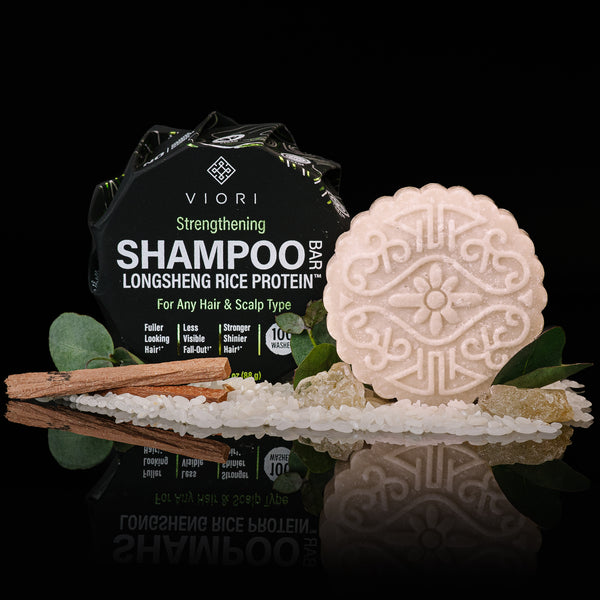
At Viori, we're inspired by the Yao women of Longsheng, China, who have maintained remarkably healthy hair for centuries using fermented rice water. Their traditional wisdom taught us that the best hair care honors natural ingredients while applying modern scientific understanding to optimize results.
While okra offers specific and valuable benefits, Longsheng rice water provides a more complete solution: penetrating proteins from rice, moisture-binding vitamins, cuticle-smoothing conditioners, and protective lipids-all in a pH-balanced, stable formula designed to work across all hair types and climates.
Whether you experiment with DIY okra treatments or prefer the convenience and consistency of professionally formulated products like Viori bars, what matters is understanding what your hair actually needs. True hair health isn't about following trends-it's about addressing multiple levels of your hair structure, from the internal cortex to the cuticle surface to the protective outer layer.
Making Informed Choices for Your Hair
The science of okra conditioning reveals something important: there's rarely a single "miracle" ingredient. Healthy hair comes from a thoughtful, balanced approach that includes:
- Surface conditioning (what okra does beautifully)
- Internal protein repair (from hydrolyzed proteins and amino acids)
- Moisture balance (from humectants and hydrating ingredients)
- Lipid protection (from natural oils and fatty compounds)
- pH optimization (to encourage cuticle closure)
Understanding these principles empowers you to look beyond marketing buzzwords and make genuinely informed decisions about your hair care routine.
Your hair is unique-its porosity, protein-moisture balance, and environmental conditions all affect how it responds to treatments. The more you understand about the actual science, the better equipped you are to give your hair exactly what it needs.
I'd love to hear from you: Have you tried okra treatments? What has your experience been with natural conditioning ingredients? Have you noticed how humidity or your environment affects your hair's response to treatments? Drop your thoughts in the comments-let's learn from each other's real-world experiences.
And if you're curious about how traditional botanical wisdom and modern hair science come together in our Viori formulations, explore our collection of rice water-based bars that provide comprehensive conditioning without the trial and error of DIY treatments.
Your hair deserves the best of both worlds: the gentle effectiveness of natural ingredients and the optimized performance of scientific formulation. That's not just good marketing-it's good chemistry.


