
Look, I've been doing hair for twenty years, and I've seen every trend imaginable walk through my salon door. Crystal-infused conditioners. Placenta treatments. You name it, I've heard the pitch. So when clients started telling me their gray hair looked different-darker, less noticeable-after switching to shampoo bars, I'll admit I rolled my eyes a little.
But then it kept happening. Different clients, different hair types, similar stories. And these weren't people trying to sell me something. They were genuinely surprised. One client actually apologized for "wasting money" on the root touch-up appointment she'd booked because her grays had faded enough that she didn't need it yet.
That got my attention.
I started digging into the actual science-not the marketing fluff, but the real chemistry and biology. And honestly? What I found surprised me. This isn't about some miracle ingredient. It's about understanding how the bar format itself changes everything about how ingredients reach your scalp and follicles.
Let me walk you through what's actually happening here.
First Things First: Why Does Hair Turn Gray Anyway?
Before we can talk about whether shampoo bars make a difference, you need to understand what's actually going on when those silver strands appear.
Your hair follicles contain melanocytes-basically little pigment factories. These cells produce the melanin that gives your hair its color. When hair turns gray, it's usually happening through one of two pathways:
- Melanocyte stem cell depletion: Your pigment factories gradually shut down and stop producing melanin altogether
- Oxidative stress: Hydrogen peroxide builds up in your follicles and literally bleaches your hair color from the inside out (yes, your body produces its own hair bleach-wild, right?)
Here's the part most people miss: your scalp environment directly affects how quickly this happens. The pH level, inflammation, hydration status, even the bacterial balance on your scalp-all of these influence whether your melanocytes thrive or decline.
And this is where shampoo bars enter the conversation in a way that actually makes scientific sense.
NOT SURE WHICH PRODUCT IS RIGHT FOR YOU?
TAKE THE QUIZTakes 30 seconds · 134,000+ customers matched
The Bar Format Itself Is the Game-Changer
Everyone talks about shampoo bars being eco-friendly or convenient for travel. Sure, fine. But from a formulation chemistry standpoint? The solid format does things that liquids simply cannot do.
pH Stability: The Detail Nobody Mentions
Your melanocytes work best at a pH between 5.5 and 6.5. That's their sweet spot. Stay in that range, and you're giving them the best environment to keep producing pigment.
Here's the problem with liquid shampoos: the second you open that bottle, the pH starts drifting. Water gets in from your wet hands. Steam from the shower. Maybe you dilute it a bit to make it last longer. By the time you're halfway through the bottle, you're using a chemically different product than when you started.
Shampoo bars don't have this problem. With minimal water content, the pH stays remarkably stable. What you use on day one is essentially identical to what you're using three months later. Your melanocytes get that consistent, optimal environment wash after wash.
Viori's bars specifically use natural pH buffers like sodium lactate to maintain that 5.5-6.5 range. It sounds like a small thing, but over the months-long hair growth cycle? Consistency matters enormously.
Concentration Without Dilution
Think about how you use liquid shampoo. You pump it into your palm, where it immediately starts mixing with water and running through your fingers. By the time it reaches your scalp, those active ingredients are already diluted.
Bar shampoos work completely differently. The concentrated formula makes direct contact with your scalp first. As you massage and work up lather, you're creating what pharmaceutical chemists call "concentration gradients"-high initial concentration, followed by gradual release as you work the product through.
This mimics how time-release medications work. And it potentially allows melanocyte-supporting ingredients to reach therapeutic thresholds that diluted formulations never achieve.
I know that sounds technical, but here's the simple version: bars get more of the good stuff directly where it needs to go.
The Fermented Rice Water Connection
You've probably heard about the Yao women of China and their famously dark hair that stays pigmented well into old age. The story usually stops there-ancient tradition, mystical rice water, the end.
But the chemistry goes deeper, and it's actually fascinating.
Inositol: The B-Vitamin You've Never Heard Of
Fermented rice water contains high concentrations of inositol, also called Vitamin B8. But here's what the pretty marketing photos don't tell you: inositol directly influences tyrosinase activity-the enzyme responsible for making melanin in your hair.
The fermentation process concentrates inositol levels three to four times higher than regular rice water. We're talking about moving from "nice to have" concentrations into potentially therapeutic ranges. Additionally, inositol supports mitochondrial function in melanocytes, helping them fight off the oxidative stress that causes premature graying.
And because bars aren't pre-diluted with water, they deliver this inositol in higher concentrations per wash than liquid equivalents.
Panthenol: More Than Just Moisture
Yes, panthenol (Vitamin B5) is a great moisturizer. Every hair product talks about it. But its role in pigmentation preservation rarely gets discussed:
- It acts as an antioxidant that reduces hydrogen peroxide accumulation in follicles
- It enhances cellular metabolism in the rapidly dividing cells where melanin is produced
- It improves melanin transfer from melanocytes into your actual hair strands
Again, the bar format delivers this in higher concentrations than you'd get from a diluted liquid.
The Physical Application Factor That Everyone Misses
This might actually be the most important piece, and almost nobody talks about it.
When you use a bar shampoo, you're not just washing your hair differently-you're physically engaging with your scalp in a fundamentally different way.
Mechanical Stimulation Matters More Than You Think
The gentle friction of massaging a bar directly on your scalp creates several beneficial effects:
- Increased blood flow to hair follicles, delivering more nutrients and oxygen
- Enhanced ingredient penetration through temporary, friction-induced increase in permeability
- Nerve stimulation that triggers local release of growth factors
Research shows that just five minutes of daily scalp massage can increase hair thickness. Bar users naturally engage in more scalp contact time and apply more direct pressure than people using liquid shampoos. This potentially activates the dermal papilla cells that regulate melanocyte activity.
You literally can't replicate this effect by pouring liquid on your head and quickly rinsing.
The Protein Penetration Theory
Viori's bars contain hydrolyzed rice protein with a molecular weight between 150-1000 Daltons-small enough to actually penetrate into your hair cortex, the inner layer where melanin granules live.
When you combine this with the friction of bar application, something interesting happens:
- Cuticle scales temporarily lift from the physical manipulation
- Proteins deliver directly to the cortex
- Existing melanin gets protective benefits against oxidative degradation
This mechanical-chemical synergy simply doesn't occur with liquid application.
What Traditional Shampoos Might Be Doing to Your Color
Let's talk about what you're washing with currently-because it might be part of the problem.
Sulfate-based cleansers (listed as SLS or SLES on labels) are aggressive enough to:
- Strip the lipid layer that naturally protects melanin granules
- Cause oxidative stress through excessive cleansing
- Disrupt your scalp microbiome, increasing inflammation that affects melanocytes
Despite the similar-sounding name, behentrimonium methosulfate-used in Viori formulations-is completely different. It's actually a gentle conditioning agent, not a harsh detergent.
The cumulative effect over months? Less pigment degradation means your existing pigmented hairs stay vibrant longer. What looks like gray "reversal" might actually be preservation-but the end result is the same: less visible gray.
The Bamboo Extract and Microbiome Angle
Bamboo: Not Just Marketing Fluff
When I first saw bamboo extract on ingredient lists, I assumed it was just there to sound exotic. But it actually has specific relevance to pigmentation:
- High silica content-silica is a required cofactor for tyrosinase enzyme stability (the enzyme that makes melanin)
- Supports collagen structure in follicles where melanocytes attach
- Provides antioxidant protection for melanocytes
With the prolonged contact time of bar application, these compounds may actually reach therapeutic levels directly at the follicle.
Your Scalp Microbiome Affects Hair Color
Here's something emerging in research that almost nobody's talking about yet: your scalp's bacterial balance appears to influence hair pigmentation through inflammatory mediators that affect melanocyte survival.
Bar shampoos' stable pH creates consistent conditions for beneficial bacteria. Liquid shampoos' pH drift can favor inflammatory bacterial species instead.
This microbiome stability may indirectly support melanocyte health through reduced chronic inflammation-a mechanism virtually no one in the gray coverage discussion currently addresses.
The Conditioner Bar Completes the System
Most gray coverage discussions focus only on shampoo, but the conditioning step has distinct relevance that's technically fascinating.
Think of it as a two-phase delivery system:
Phase 1 (Shampoo Bar): Active ingredient delivery to scalp and follicles, pH optimization, antioxidant support
WHAT CUSTOMERS ARE SAYING
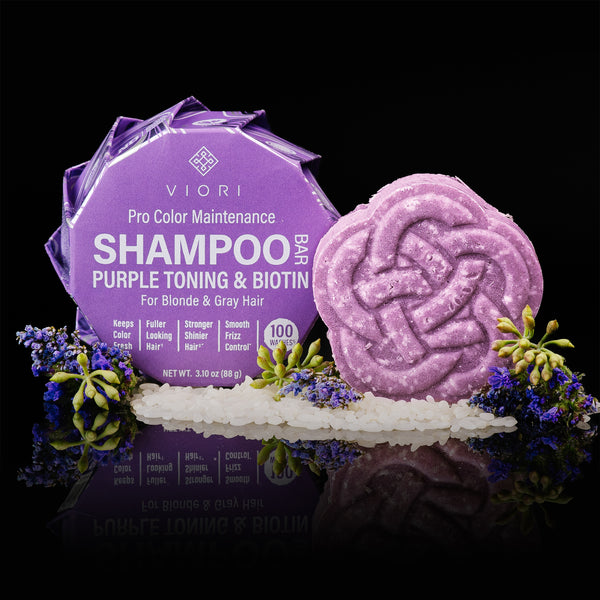
Real reviews for Purple Shampoo Bar with Biotin – Blonde & Gray | VIORI
Phase 2 (Conditioner Bar): Cuticle sealing to protect melanin granules from environmental oxidation, occlusive barriers that maintain follicle hydration, protective film formation
Viori's conditioner bars contain ingredients like honeyquat with humectant and antioxidant properties. Melanocytes are extremely sensitive to hydration status-dehydrated follicles show reduced melanin production.
This isn't just conditioning your hair. You're creating an optimized environment for melanocyte function.
Results appearing after 2-3 months make perfect sense when you understand this is the timeframe for new hair growth cycles.
The Unexpected Behavioral Shift
Here's something I've noticed with clients who switch to bars: they naturally wash less frequently.
Why? Because bars don't strip natural oils as aggressively. Hair stays cleaner longer. The natural sebum balance restores itself.
The pigmentation connection:
- Reduced washing frequency equals fewer oxidative stress cycles
- Less mechanical damage equals better melanin retention
- Restored sebum composition provides natural antioxidant protection
This behavioral shift, driven by the product formulation itself, creates a compounding protective effect that accumulates over months.
Let's Set Realistic Expectations
As a professional, I believe in honest guidance above all else. So let me be absolutely clear about what the science supports-and what it doesn't.
What the Science Actually Supports:
- Melanocyte protection through concentrated antioxidants
- Optimized follicular environment (pH, hydration, microbiome balance)
- Reduced degradation of existing melanin
- Potential support for tyrosinase activity through ingredient cofactors
- Enhanced ingredient delivery through mechanical and concentration advantages
What the Science Does NOT Support:
- Reversal of complete melanocyte stem cell depletion
- Overnight color changes
- Universal results regardless of the cause of graying
- Results comparable to permanent hair color
The Realistic Timeline
Hair grows approximately half an inch per month. If shampoo bars support new pigmented growth at the follicle level, visible results require 2-6 months depending on your gray location and percentage.
This aligns perfectly with the timeframe users report-further supporting the plausibility of the mechanisms we've discussed.
Who's Most Likely to See Results?
Based on my professional experience and understanding of the science, shampoo bars show the most promise for:
Ideal Candidates:
- Early-stage graying (less than 30% gray)
- Stress-related premature graying
- Nutritional deficiency-related graying
- Those wanting to maintain and protect existing color
- Anyone seeking to optimize their follicle environment
Less Likely to See Dramatic Results:
- Advanced graying (70%+ gray)
- Purely genetic graying with strong family history
- Complete melanocyte depletion
- Those expecting complete color reversal in weeks
Support Your Results from the Inside Out
The bar format creates optimal external conditions, but melanocyte health depends on multiple factors. Support your results with:
- Adequate B-vitamin intake (B12, B6, folate, biotin)
- Antioxidant-rich diet (berries, leafy greens, nuts)
- Stress management practices
- Regular scalp massage
- UV and pollution protection
- Adequate sleep and hydration
Think of shampoo bars as creating the best possible external environment while you support internal health. They work together.
Why I Recommend Viori to My Clients
I've become increasingly selective about the products I recommend in my practice. Viori's approach aligns with what the science tells us actually matters:
Formulation Integrity:
- Authentic fermented rice water (not just "rice water extract" added to a standard formula)
- Stable pH buffering systems
- Concentrated active ingredients
- Gentle, sulfate-free cleansing
- Melanocyte-supporting compounds (inositol, panthenol, rice protein, bamboo extract)
Format Advantages:
- Consistent delivery across the product's lifetime
- No water dilution compromising effectiveness
- Enhanced scalp contact for mechanical benefits
- Minimal preservatives needed
Realistic Communication:
- Appropriate timeline expectations (3-6 months)
- Acknowledgment that results vary


