
You've probably seen the blog posts and social media threads claiming you should ditch your shampoo, go back to "natural" soap, and your hair will thank you after a "transition period." But as someone who's spent two decades studying hair and scalp health, I need to share something that might surprise you: the soap versus shampoo debate isn't really about natural versus synthetic-it's about chemistry that works with your hair versus chemistry that literally damages it at a molecular level.
Let me take you on a journey into what actually happens when soap meets hair. Fair warning: we're going to get delightfully nerdy about protein structures, pH levels, and why your great-grandmother's hair washing routine worked for reasons nobody understood at the time.
The Hard Water Problem Nobody Talks About
Here's what most "natural hair care" articles won't tell you: The historical shift from soap to modern cleansers wasn't a marketing conspiracy-it was solving a genuine chemical problem that made millions of people's hair look and feel terrible.
When your great-grandmother washed her hair with lye soap and rainwater, it actually worked reasonably well. The key word there? Rainwater. Rainwater is naturally soft, meaning it's low in minerals.
But here's what happens when that same bar of true soap meets the tap water most of us have today:
True soap is made of sodium or potassium salts of fatty acids. When these compounds encounter calcium and magnesium ions in hard water (and most municipal water is moderately to very hard), they undergo a chemical reaction that creates insoluble calcium soap. You know this substance well-it's that grimy ring around your bathtub. That's soap scum.
Now imagine that same scum coating every strand of your hair.
This calcium soap buildup:
- Forms a waxy, dull coating on each hair shaft
- Increases your hair's negative charge, causing the protective outer cuticles to lift up like shingles in a windstorm
- Shoots your hair's pH up to 9-10 (when your hair is happiest around 4.5-5.5)
- Makes hair feel straw-like, brittle, and impossibly tangled
Here's the kicker: That "transition period" people talk about when switching to soap? It's not your hair "detoxing" from commercial products. There's no such thing as hair detoxing-your hair is dead protein, not a liver. What you're experiencing is the progressive accumulation of calcium soap deposits. It's not adaptation; it's damage accumulation.
What's Actually Happening to Your Hair Cuticles (And Why It Matters)
Let me get technical for a moment, because this is where soap fundamentally fails hair in ways it doesn't fail skin.
NOT SURE WHICH PRODUCT IS RIGHT FOR YOU?
TAKE THE QUIZTakes 30 seconds · 134,000+ customers matched
Picture your hair cuticles like overlapping roof shingles. When your hair is at its natural, slightly acidic pH, these shingles lie flat and smooth, protecting the inner cortex of your hair shaft. When exposed to alkaline conditions (like soap's pH of 9-11), these shingles lift and separate.
Here's the cascade of damage that occurs:
First, the hydrogen bonds break. Your hair's keratin proteins are held together by hydrogen bonds that are incredibly pH-sensitive. Alkaline conditions disrupt these bonds like breaking the moorings on a boat.
Second, the cuticle swells. The inner cortex of your hair shaft absorbs water and can expand by up to 20% in diameter. Those lifted cuticle scales separate even further.
Third, mechanical damage becomes almost inevitable. Wet, swollen, cuticle-lifted hair is exponentially more vulnerable to breakage from combing, towel-drying, and even just touching it.
Fourth, the damage compounds with every wash. Each washing cycle leaves the cuticle slightly more damaged than before. It's a ratchet effect-your hair condition can only go in one direction: downward.
And here's what I really need you to understand: This isn't about "getting used to it" or "letting your hair adjust." You're literally causing cumulative structural damage to the protein matrix of your hair with every single wash.
Your hair cannot heal itself. It's not living tissue. Every bit of damage you do is permanent until you cut it off.
The Ancient Exception That Proves the Rule
Now, before you think I'm completely anti-traditional methods, let me share something fascinating: some ancient hair care practices actually worked brilliantly-but not for the reasons people think.
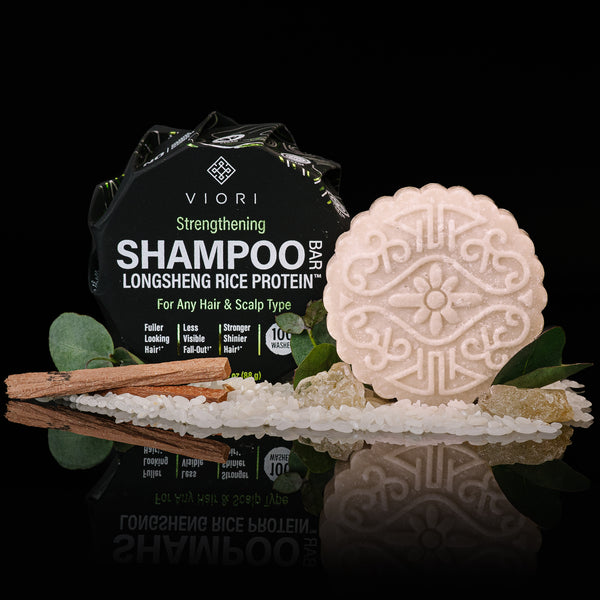
The Red Yao women of Longsheng, China, have famously lustrous hair that often grows past their waists. For centuries, their secret has been fermented rice water, and many women in this community don't get their first gray hair until their 80s.
Here's what makes this different from washing with regular soap: The fermentation process accidentally creates the ideal chemical profile for hair care.
When rice water ferments, several remarkable things happen:
Inositol forms-a carbocyclic sugar that can actually penetrate the hair shaft and repair damage from the inside by strengthening the internal keratin bonds.
Pitera develops-a mixture of amino acids and organic acids that naturally lowers the pH of the washing solution, keeping it in the acidic range that protects your cuticle integrity.
Natural saponins from the rice emerge-these are gentle surfactants that can clean without the high pH problem of true soap.
The concentration matters critically-pure rice water in very high concentrations can actually disrupt your pH balance, which is why modern formulations like those from Viori use controlled concentrations combined with pH-balancing ingredients.
Here's the insight that nobody discusses: Traditional rice water worked not because it avoided chemistry, but because fermentation accidentally created perfect chemistry. The Red Yao women stumbled onto an ideal combination of mild surfactants, protein repair compounds, and acidic pH through generations of trial and error.
They got the chemistry right without knowing they were doing chemistry at all.
The "No-Poo" Movement's Dangerous Misunderstanding
Let's talk about the baking soda and vinegar method that's become popular in natural hair care circles, because it perfectly illustrates how misunderstanding chemistry can lead you astray.
Baking soda has a pH of 9-that's highly alkaline, actually worse than many soaps. It causes the same cuticle-lifting damage we just discussed.
The idea is that you then use a vinegar rinse to re-acidify and "close" the cuticle. But here's the problem: the damage happens the moment that alkaline substance hits your hair. You can't undo it by acidifying afterward.
It's like burning yourself and then immediately putting ice on the burn. The ice might help with inflammation, but the tissue damage already occurred.
You're essentially giving your hair a chemical treatment and then trying to neutralize it, swinging your hair's pH wildly in both directions with every single wash. This is actually worse than using properly formulated products that maintain a stable, appropriate pH throughout the cleansing process.
The Sebum Regulation Myth
There's a persistent belief that conventional shampoos cause your scalp to "overproduce" oil, and if you stop washing with them (or switch to soap), your scalp will eventually "regulate itself" and produce less oil.
Let me share what dermatological science actually tells us:
- Sebum production is primarily regulated by hormones, specifically androgens
- Yes, sebaceous glands respond to being stripped of oil by increasing production
- But here's the paradox: soap actually strips scalp oils MORE aggressively than modern sulfate-free cleansers due to its high pH and mechanism of action
People think soap is "gentler," but chemically speaking, it's more stripping. So why do some people feel they can go longer between washes when using soap?
It's not because their scalp has "regulated." It's because the calcium soap buildup creates a waxy coating that masks oiliness-while simultaneously making hair look dull and lifeless. You're trading the appearance of oil for the appearance of damage.
What Your Hair Actually Needs (The Protein Perspective)
Hair is 95% protein-specifically, keratin. When we talk about "hair health," we're really talking about maintaining the structural integrity of these protein formations.
What damages hair protein:
- pH extremes (below 3.5 or above 8)
- Mechanical stress when the cuticle is lifted
- Oxidative damage from environmental factors
- Heat styling
- Dehydration of the inner cortex
What protects and repairs hair protein:
- Maintaining pH between 4 and 6
- Protein supplements small enough to penetrate or adhere to the hair shaft (hydrolyzed rice protein, wheat protein, silk protein)
- Moisturizers that prevent dehydration
- Antioxidants that fight environmental damage
- Cuticle-sealing ingredients that smooth the outer layer
Look at these lists. True soap does none of the protective actions and causes several of the damaging ones.
This isn't my opinion as a stylist. This is protein chemistry.
The Historical Reality Nobody Wants to Admit
Here's something that might burst the romanticized bubble around "traditional" hair care: People in the past who used soap on their hair had universally worse hair quality than we have access to today.
If you look at historical accounts, diaries, and even portraits from the soap-washing era:
- Hair was typically dull and coarse in texture
- Women covered their hair for practical reasons, partly because maintaining it in an attractive state was genuinely difficult
- People washed their hair very infrequently-often only once a month-partly because washing caused such visible damage
- The ideal of shiny, flowing, healthy-looking hair was genuinely rare because it was so hard to achieve
The romanticization of historical hair care methods conveniently ignores that people living in those times would have been thrilled to have access to modern formulations that actually work with hair structure rather than against it.
The Water Quality Factor Everyone Ignores
Here's an angle that's almost never discussed but makes a massive difference: Your water quality determines whether soap will "work" for your hair more than almost any other factor.
If you have soft water (low mineral content): Soap will perform better and won't create as much calcium buildup. However, you'll struggle to rinse it out completely because there aren't enough minerals for it to react with. Your hair may feel limp, slippery, and over-conditioned.
If you have hard water (high calcium and magnesium): Soap will create heavy buildup, dullness, tangles, and that characteristic straw-like texture that makes people abandon the experiment.
If you have well water: Depending on your specific mineral profile, you might also be dealing with iron deposits that oxidize and make everything dramatically worse.
Modern cleansing surfactants were specifically engineered to work effectively across all water types-and this is actually a significant innovation that solved a real problem affecting millions of people.
Why Modern Formulations Aren't the Enemy
Here's where I'll offer a perspective you won't find in most natural living blogs: The development of synthetic surfactants was actually a response to a genuine chemical problem, not a manufactured need created by corporations.
WHAT CUSTOMERS ARE SAYING
Real reviews for Rice Water Shampoo Bar – All Hair Types | VIORI
Modern cleansing agents like Sodium Cocoyl Isethionate (the primary cleanser in Viori shampoo bars, for instance) represent genuine advances in hair chemistry because they:
- Function effectively in both hard and soft water without forming insoluble salts
- Maintain a pH much closer to hair's natural range (between 5.5 and 7)
- Rinse cleanly without leaving alkaline residue on the hair shaft
- Can be formulated with conditioning agents that deposit exactly where hair needs them
Here's my contrarian take: Calling these ingredients "chemicals" while calling soap "natural" is chemically meaningless-both are synthesized molecules. Soap doesn't grow on trees. It's the product of a chemical reaction (saponification) between fat and lye.
The real question isn't natural versus synthetic. The question is whether the molecular structure of your cleanser is compatible with hair protein chemistry. Your hair doesn't respond to marketing buzzwords-it responds to molecular interactions.
The Realistic Path Forward
If you're genuinely committed to moving away from conventional shampoos (and I understand that impulse), the solution isn't soap-it's understanding surfactant chemistry and choosing products formulated with:
Mild syndets (synthetic detergents) like Sodium Cocoyl Isethionate that are pH-balanced for hair
Conditioning agents that selectively deposit on damaged areas without creating buildup
Protein supplementation from hydrolyzed rice protein, wheat protein, or silk protein that can penetrate the hair shaft
pH buffers to consistently maintain the 4.5-5.5 range where hair is most stable
Natural oils and butters in formulations that allow them to condition without causing greasiness or weighing hair down
This is exactly what Viori's formulation represents. It's not about avoiding chemistry-it's about using chemistry that works with your hair structure rather than against it. The formulation honors the traditional wisdom of the Red Yao women's fermented rice water while incorporating modern understanding of what hair actually needs at a molecular level.
The Bottom Line: Your Hair Deserves Better Than Guesswork
After 20 years in this industry, here's what I want you to take away from this deep dive:
The soap versus shampoo debate is actually a case study in how misunderstanding chemistry leads people to make choices that harm the very thing they're trying to protect.
True soap fails hair because:
- Hair protein chemistry requires specific pH conditions that soap cannot provide
- Hair is not skin-it's non-living tissue that cannot repair or regenerate itself
- Hard water creates insoluble compounds with soap that actively damage hair structure
- Soap's cleansing mechanism is fundamentally incompatible with maintaining cuticle integrity
The lesson here isn't "natural bad, synthetic good" or vice versa. It's that effective hair care requires understanding what hair actually is-keratin protein structures with specific chemical needs-and choosing products formulated to meet those needs.
The Red Yao women's rice water tradition endured for centuries because it accidentally got the chemistry right through empirical observation over generations. Modern formulations work because they intentionally got the chemistry right while incorporating and honoring those traditional insights.
The choice isn't between soap and shampoo. It's between understanding your hair's chemistry and flying blind based on marketing buzzwords-whether those buzzwords are "all-natural" or "scientifically advanced."


