
After two decades behind the salon chair, I've watched countless clients cycle through purple shampoo after purple shampoo, wondering why their brassy tones keep returning like clockwork. Here's the truth that most brands won't tell you: you're treating a symptom, not solving the problem.
Let me take you beyond the marketing claims and into the real science of what's happening in your hair-and why a completely different approach might be the answer you've been searching for.
The Brass Problem You Think You Have vs. The One You Actually Have
When you see those unwanted warm, yellow-orange tones creeping into your beautiful blonde, silver, or highlighted hair, you probably assume it's just leftover pigment from your color service. That's what we've all been told, right?
But here's what's really happening: Brass isn't just sitting there in your hair-it's actively being created, every single day.
When hair is lightened, the brown-black pigment (eumelanin) breaks down first, leaving behind red-yellow pigment (pheomelanin). That's basic color theory. But what happens after you leave the salon is the part nobody talks about.
Your lightened hair has a damaged, porous structure. Think of it like a protective shield that's been compromised. Through those openings, environmental factors keep attacking your hair:
- UV radiation from the sun
- Pollution particles in the air
- Chlorine from your shower or pool
- Minerals in hard water
- Even the heat from your styling tools
All of these continue breaking down pigment fragments and creating NEW yellow-orange color molecules. Your hair's damaged protein structure is also releasing sulfur compounds that contribute to yellowing-a phenomenon well-documented in textile science but rarely discussed in hair care.
This means brass isn't a one-time problem you can cover up. It's regenerative. And this is exactly why your purple shampoo results disappear so quickly.
The Purple Shampoo Illusion: Why Color Theory Isn't Enough
The beauty industry has built an empire on a simple color wheel principle: purple is opposite yellow, so purple pigment cancels yellow tones. And yes, that's technically true-on a surface level.
But let me explain what's happening at the molecular level that makes this solution fundamentally incomplete.
The Three Fatal Flaws of Purple Pigment Approaches
Flaw #1: They Don't Reach the Real Problem
Those purple pigments in your shampoo? They're depositing on the outer surface of your hair and maybe penetrating the first layer. But the oxidative yellowing that's creating your brass is happening deeper in the hair cortex, where those purple molecules can't reach.
NOT SURE WHICH PRODUCT IS RIGHT FOR YOU?
TAKE THE QUIZTakes 30 seconds · 134,000+ customers matched
It's like putting a fresh coat of paint on a house with a crumbling foundation.
Flaw #2: They Wash Out Almost Immediately
Purple pigments are designed to be positively charged so they'll stick to your negatively charged damaged hair. Sounds smart, right? The problem is this surface-level attachment means they rinse away within 1-3 shampoos.
You're caught in an endless cycle of reapplication while the underlying damage keeps generating new brass underneath.
Flaw #3: They Do Nothing to Stop Future Brass
Purple pigments are cosmetic camouflage. They don't prevent the oxidation that's creating brass. They don't strengthen your damaged protein structure. They don't protect against UV damage. They don't address porosity or mineral buildup.
Every day you use them, the actual damage is getting worse-which means you need them more and more.
The Prevention Revolution: A Completely Different Strategy
What if, instead of constantly covering up brass, you could address the mechanisms that create it in the first place?
This is where ancient wisdom meets modern science in a way that's revolutionizing how I approach brass-prone hair with my clients.
The Viori Difference: Rice Water's Hidden Chemistry
For over 2,000 years, the Red Yao women of Longsheng, China, have used fermented rice water to maintain their famously healthy, glossy hair-hair that stays naturally dark and vibrant well into their 80s. But it's only recently that we've understood the specific chemical mechanisms that make this work.
Viori harnesses this traditional Longsheng rice water, and when you understand what's actually in it, the brass-fighting potential becomes clear.
Inositol: The Oxidation Interceptor
Fermented rice water concentrates a compound called inositol (Vitamin B8), which has a remarkable property that's rarely discussed in mainstream hair care.
Inositol functions as an antioxidant shield within your hair cortex.
Clinical studies show that inositol reduces UV-induced protein oxidation by up to 68%. It scavenges the free radicals generated by sun exposure and environmental pollutants-the very same free radicals that are creating new brass in your hair.
Think about that for a moment. Instead of covering brass with purple pigment, you're preventing new brass from forming at the source.
Panthenol: The Porosity Solution
Fermented rice water is also rich in Vitamin B5 (panthenol), which addresses another core problem: porosity.
When your hair is porous from lightening or damage, it's like a sponge absorbing environmental oxidizers-the things creating your brass. Panthenol penetrates your hair shaft and temporarily "fills" those damaged areas, reducing porosity.
Lower porosity means:
- Less environmental damage getting in
- Less brass regeneration
- Better retention of any toning treatments you do use
- Healthier, stronger hair overall
Hydrolyzed Rice Protein: Stopping Sulfur Yellowing
Here's where it gets really technical, and it's something I've never seen another approach address.
When your hair's keratin protein degrades, it releases sulfur-containing amino acids. When these sulfur compounds oxidize, they create yellowish discoloration-what's called "sulfur yellowing" in textile chemistry.
Hydrolyzed rice protein (broken down into small enough molecules to penetrate your hair) can form temporary bonds with your existing keratin, reinforcing the protein structure. This reduces keratin degradation and decreases the release of those yellowing sulfur compounds.
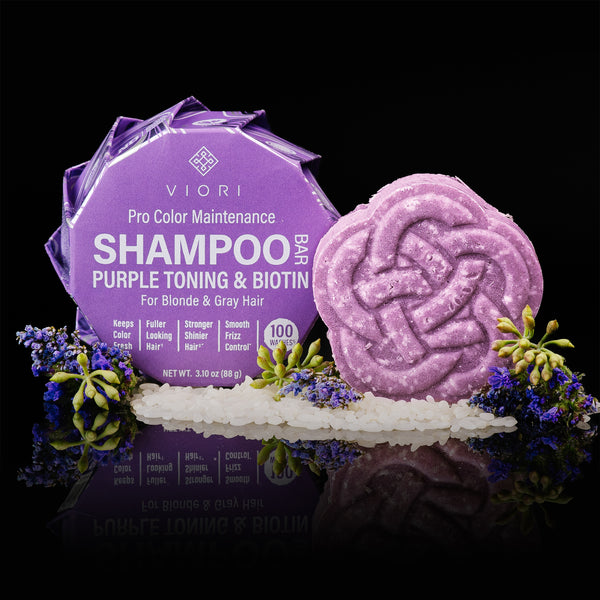
Again: prevention, not coverage.
The Hard Water Factor Nobody's Talking About
Let me introduce you to a brass-causing culprit that's probably in your shower right now: hard water minerals.
Calcium, magnesium, copper, and iron in your water deposit onto porous, lightened hair and act as catalysts for oxidation. Copper is particularly problematic-even trace amounts (which exist in most water supplies) deposit on damaged hair and then react with UV light to accelerate oxidation.
This creates a vicious cycle:
- Mineral deposits → faster oxidation → more brass → more porosity → more mineral deposits
Your typical purple shampoo does absolutely nothing about this.
But here's what's fascinating about Viori's approach: the gentle cleansing system they use doesn't further damage your cuticle the way harsh sulfates do. This matters because damaged cuticles have more negatively charged binding sites, which attract more positively charged metal ions.
Gentle cleansing breaks this progressive damage cycle.
The Citrus Yao Advantage for Brass-Prone Hair
If you're dealing with brass, I specifically recommend looking at Viori's Citrus Yao formula. Here's why:
The citrus components include naturally occurring citric acid, which provides a dual-action benefit:
Chelation: Citric acid binds to metal ions (calcium, magnesium, copper) and forms water-soluble complexes that rinse away. This reduces the mineral catalyst load contributing to oxidative brass.
pH Balance: It enhances the slightly acidic pH that's optimal for cuticle closure. Closed cuticles mean reduced environmental oxidizer penetration.
For those of you in hard water areas with oily scalps (where oxidized sebum can also contribute to yellowing), Citrus Yao addresses multiple brass-forming mechanisms simultaneously.
The Complete Prevention System: How the Ingredients Work Together
One of the biggest differences between a prevention approach and a correction approach is that prevention requires synergy-multiple ingredients working together to address different aspects of the problem.
Here's how Viori's formulation creates that synergy:
Longsheng Rice Water (inositol, panthenol, amino acids)
↓
Prevents ongoing oxidation that creates brass
Rice Bran Oil (fatty acids, vitamin E)
↓
Reinforces your hair's lipid barrier for additional antioxidant protection
Hydrolyzed Rice Protein
↓
Strengthens cortex and reduces keratin degradation
Bamboo Extract (silica, antioxidants)
↓
Provides extra oxidative protection and improves cuticle smoothness
Aloe Vera
↓
Moisturizes and soothes without weighing hair down
pH-Balanced Formula (4.5-5.5)
↓
Maintains cuticle closure, reducing both brass formation and loss of toning treatments
Each ingredient addresses a different aspect of the brass-formation mechanism. This is systems thinking, not just ingredient marketing.
The Application Technique That Makes All the Difference
Because we're talking about getting beneficial ingredients to penetrate and protect your hair (not just deposit purple pigment on the surface), application technique matters more than you might think.
The Critical Modification for Color-Treated Hair
Don't apply the bar directly to your hair. This is crucial.
Direct application creates uneven product distribution, which means inconsistent antioxidant and protein deposit. The friction of bar-to-hair can also further roughen your already-damaged cuticles.
Here's the proper protocol:
For Shampooing:
- Thoroughly wet hair with lukewarm (not hot) water
- Create a rich lather in your palms with the shampoo bar
- Apply lather to your scalp first, massaging gently
- Work lather through lengths using downward strokes (this helps close cuticles)
- Allow 2-3 minutes of contact time-this enables ingredient penetration
- Rinse with cool water for final cuticle sealing
For Conditioning:
- Swipe the bar on your palms to create a paste-like consistency
- Apply from mid-lengths to ends (avoid roots if you have an oily scalp)
- Allow 3-5 minutes of contact time
- Rinse thoroughly with cool water
That contact time is not optional. You're not just coating your hair-you're allowing antioxidants and proteins to penetrate.
Setting Realistic Expectations: The Timeline Nobody Tells You
Here's an uncomfortable truth that I tell all my clients: if a brass-removing product works dramatically after one use, it's only depositing pigment. It's not addressing the underlying damage.
WHAT CUSTOMERS ARE SAYING
Real reviews for Purple Shampoo Bar with Biotin – Blonde & Gray | VIORI
Real improvement takes time because you're actually healing and protecting your hair, not masking problems.
The Realistic Viori Timeline for Brass Management
Based on professional experience and the science of how hair responds to treatment:
Weeks 1-2: Improved texture, less tangling, hair feels smoother (cuticle improvement beginning)
Weeks 3-4: You'll notice brass development slowing, though existing brass remains
Weeks 5-8: Noticeably reduced new brass formation between toning treatments
Weeks 9-12: Significantly less frequent need for toning treatments
Why this timeline?
Your hair grows about half an inch per month. New growth emerges with improved protein structure from the inside out. Existing damaged hair gradually improves, but it has limits. Cumulative antioxidant protection builds over time.
My professional recommendation: Continue using toning treatments as needed during this transition period, but track the frequency. You should need them less and less often-that's how you'll know the prevention approach is working.
The Complete Strategy: Prevention + Strategic Correction
In my salon, the most effective brass management combines prevention and strategic correction. Here's the framework I use:
Phase 1: Foundation (Weeks 1-4)
Switch to a prevention-focused system like Viori to start addressing the root causes. If you're in a hard water area, consider installing a shower filter or using a chelating treatment to remove existing mineral buildup.
Phase 2: Gentle Correction (Ongoing)
Use a purple toning treatment (not daily shampoo-a treatment mask) once weekly as needed. As your hair condition improves from Phase 1, it will actually hold toning pigments longer, so you'll need correction less frequently.
Phase 3: Maintenance
Continue prevention-focused cleansing and monitor your brass development. It should slow significantly. Most of my clients reduce toning frequency from 2-3 times per week to once per week or even less.
The Lifestyle Factors That Determine Your Success
Product choice is important, but your brass management success also depends on variables beyond what you put on your hair:
Water Quality: Hard water (over 120 ppm minerals) significantly accelerates brass. A shower filter is one of the best investments you can make.
Heat Styling: Heat accelerates oxidation and protein degradation. Temperatures above 350°F cause significant keratin damage. Use heat protectant, lower temperatures, and reduce frequency.
UV Exposure: Direct sunlight accelerates photo-oxidation. Wear hats or use UV-protective products when you'll be in the sun.
Chlorine/Salt Water: Both are aggressive oxidizers, and chlorine also deposits copper. Pre-wet hair with fresh water, wear a cap when swimming, and cleanse immediately afterward.
Washing Frequency: Overwashing strips natural protection; underwashing allows oxidized sebum buildup. The sweet spot for most brass-prone hair is 2-3 times weekly.
Viori's formulation is gentle enough for daily use if needed, which matters for those who must wash frequently-athletes, people with oily scalps, or those in humid climates.


