
After twenty years behind the chair, I've seen countless hair care trends come and go. But the shampoo bar revolution? This one's different. And not for the reasons you might think.
Most articles about shampoo bars focus on sustainability (yes, eliminating plastic bottles matters) or natural ingredients (important, but not the whole story). What rarely gets discussed is the fascinating physics and chemistry that make bars fundamentally different from liquid shampoos-differences that can dramatically impact your hair's health.
Let me take you behind the science to understand what's really happening when you switch from bottle to bar.
It's Not Just What's Inside-It's How It Gets There
Here's something that surprised me early in my career: two products with nearly identical ingredient lists can produce completely different results. The secret? How those ingredients interact with your hair's physical structure.
Your hair cuticles aren't smooth tubes-they're more like tiny pinecones, with overlapping scales pointing from root to tip. This matters enormously when we talk about shampoo bars versus liquids.
The Directional Advantage You Never Knew Existed
When you pour liquid shampoo on your head, the dissolved surfactants spread in every direction simultaneously. It's democratic but indiscriminate.
With a shampoo bar, something completely different happens: you're creating directional friction as you apply it. When used correctly-gliding from root to tip, following your cuticle's natural pattern-the bar actually encourages cuticle alignment while it cleanses.
Think of it like petting a cat. Stroke with the fur, and everything lies smooth. Stroke against it, and... well, you know what happens.
The catch? Most people don't realize there's a proper technique. They create circular scrubbing motions or work against the cuticle direction, then wonder why their hair feels rough and tangles easily. This isn't a formulation flaw-it's a user education gap that's given bars an undeserved bad reputation.
NOT SURE WHICH PRODUCT IS RIGHT FOR YOU?
TAKE THE QUIZTakes 30 seconds · 134,000+ customers matched
Pro tip: Apply your bar in smooth, downward strokes from roots to ends. No circular motions. No scrubbing upward. Just gentle, directional glides that follow your hair's natural architecture.
The Concentration Factor: A Game-Changer for Damaged Hair
This is where the chemistry gets really interesting.
Liquid shampoos deliver a pre-mixed, uniform concentration of cleansing agents across your entire head at once. Shampoo bars create what chemists call a concentration gradient-intense cleansing right where you apply the bar, gradually decreasing as you work it through your hair.
Why does this matter? Because hair damage during washing primarily occurs through three mechanisms:
- Osmotic swelling-water penetrating the cuticle and swelling the inner cortex
- Protein solubilization-surfactants literally extracting proteins from your hair shaft
- Lipid depletion-stripping away the protective fatty acid layer on your cuticles
With liquid shampoo, every strand experiences maximum surfactant concentration for the entire wash duration. With bars, you're experiencing:
- Peak concentration only at application points, and only briefly
- Rapid dilution as you work the lather through
- Lower overall exposure time to maximum surfactant levels
The bottom line: If your hair is color-treated, heat-damaged, or high porosity, this concentration gradient can mean significantly less protein loss per wash. You're still getting clean-just with less collateral damage.
I've seen this play out hundreds of times. Clients with compromised hair who struggled with breakage often notice stronger, more resilient hair within weeks of switching to bars. Same cleansing result, different chemical pathway.
The Water Activity Secret
Here's where formulation chemistry gets fascinating.
Liquid shampoos are 70-80% water. That water isn't just filler-it's the medium that keeps everything dissolved and allows surfactant micelles to form. But it also means:
- Preservatives are mandatory (bacteria thrive in water)
- Surfactants are constantly active and can degrade over time
- The pH is locked at manufacturing and can shift during storage
- Ingredients interact continuously in the bottle
Shampoo bars exist in what chemists call a low water activity state until you use them. This creates several advantages:
Real-Time pH Adjustment
When Viori's bars (formulated in the ideal 3.5-6.5 pH range) meet your hair, the final pH isn't predetermined-it's influenced by your hair's existing pH, your water's mineral content, and the dilution ratio you create.
If you have hard water rich in minerals, a liquid shampoo's pH might shift alkaline during use, raising your cuticles and causing frizz. A bar formulation buffers these changes better because you're controlling the dilution in real-time.
Superior Ingredient Stability
Consider Viori's key ingredients: hydrolyzed rice protein, bamboo extract, vitamin B8, and vitamin B5. In liquid formulas, these proteins remain hydrated and can slowly break down through hydrolysis over months of storage.
In a solid bar with minimal water? These proteins stay remarkably stable until the moment you activate them with water during washing.
Translation: The rice protein you're applying from a fresh bar is potentially more intact and functionally effective than the same protein that's been sitting in a liquid bottle for six months.
Your Scalp Isn't Uniform-Why Should Your Shampoo Be?
Your scalp produces oil (sebum) at different rates across different areas. The crown and vertex typically run oilier than the sides and nape. It's basic biology.
Yet liquid shampoos treat your entire head identically-same cleansing intensity everywhere, whether that area needs it or not. This often means over-cleansing drier sections to adequately cleanse oilier zones.
Bars change this equation entirely.
With a bar, you're creating a graduated cleansing process:
- Apply more pressure and product where oil concentrates
- Use a lighter touch on drier areas
- Mechanically distribute cleansing agents where they're needed most
It's the difference between using a paint roller on your entire head versus having a brush that lets you customize application. Most people never realize this level of control is even possible.
After two decades of working with every hair type imaginable, I can tell you: this customization capability is genuinely transformative for people with combination scalp types.
The Rice Water Revolution: Why Fermentation Chemistry Matters
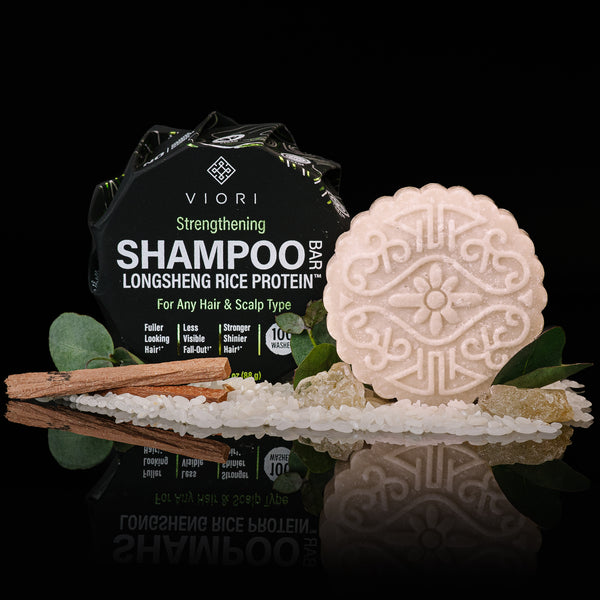
Since we're talking about Viori specifically, let's examine what makes their Longsheng rice water formulation special from a chemistry standpoint.
Fermented rice water contains powerful bioactive compounds:
- Inositol (vitamin B8)-strengthens hair shafts at the cellular level
- Pitera-a fermentation byproduct loaded with amino acids and minerals
- Allantoin-promotes cell regeneration
- Ferulic acid-provides antioxidant protection
The stability question becomes critical: how well do these delicate compounds survive in different formulation formats?
In liquid systems:
- Amino acids can undergo Maillard reactions over time (that "off" smell some products develop)
- Ferulic acid is vulnerable to oxidation from dissolved oxygen
- Bioactives can degrade if preservative systems fail
In solid bar systems:
- Compounds remain in a stable, minimally reactive state
- Oxidation proceeds much slower due to limited water
- Microbial degradation is essentially impossible
What this means for your hair: The rice water bioactives in Viori's bars likely deliver more potency when you use them compared to the same ingredients formulated into liquid systems months earlier.
I've recommended Viori to countless clients specifically because this formulation approach preserves the integrity of those traditional Longsheng rice water benefits that have kept Yao women's hair healthy for centuries.
The Exfoliation Effect Nobody Talks About
Here's a clinical observation that surprised me: shampoo bars provide gentle mechanical exfoliation that liquid shampoos simply cannot replicate.
When you apply a bar directly to your scalp, the physical friction:
- Loosens dead skin cells (reducing flaking and dandruff)
- Stimulates superficial blood flow to follicles
- Disrupts bacterial biofilms that can contribute to scalp issues
It's similar to the difference between liquid body wash and bar soap-the bar delivers dual action (chemical cleansing plus mechanical benefits) that liquids miss entirely.
I've seen this clinically with clients suffering from seborrheic dermatitis and folliculitis. Many experience noticeable improvement when switching to bars, even when the active ingredients mirror their previous liquid products. The mechanical disruption of scalp biofilms appears to make the difference.
The Hard Water Surprise
This contradicts conventional wisdom, but experience has taught me: in hard water conditions, quality bar formulations often outperform liquid shampoos.
Hard water contains calcium and magnesium ions that bind with surfactants, creating that dreaded "soap scum" and reducing cleaning power.
Liquid shampoos encounter these minerals at a fixed dilution ratio-the precipitation occurs throughout your entire application.
With bars, you're creating a concentrated surfactant solution right at application before dilution occurs. This concentrated delivery can:
- Saturate available mineral binding sites rapidly
- Create a protective effect where initial precipitation "uses up" available minerals
- Leave excess surfactants free to remain active
Real-world result: If you have hard water and found liquid shampoos leave buildup, a well-formulated bar might actually work better, not worse.
Does Your Hair Porosity Matter?
Absolutely. And understanding how bars perform across different porosity levels prevents most user disappointment.
Low Porosity Hair (Tightly Sealed Cuticles)
Bar performance: Excellent. The mechanical application helps products penetrate better than liquids that tend to sit on the surface. The concentration gradient prevents buildup.
WHAT CUSTOMERS ARE SAYING
Real reviews for Hidden Waterfall Barra de Champú
Medium Porosity Hair (Slightly Raised Cuticles)
Bar performance: Optimal. This is the sweet spot. These hair types benefit from everything bars offer-controlled application, mechanical smoothing, graduated cleansing intensity.
High Porosity Hair (Significantly Damaged Cuticles)
Bar performance: This requires technique adjustment. High porosity hair needs:
- Gentle application (lather in hands first rather than direct application)
- Acidic pH for cuticle smoothing (Viori's pH balance addresses this)
- Protein supplementation (rice protein in Viori's formula provides this)
That common complaint "bars make my hair tangly" almost always comes from high porosity hair users applying the bar with too much friction directly on damaged cuticles. It's not the bar format-it's mechanical stress on already-compromised structure.
High porosity hair tip: Create lather between your palms first, then apply the foam to your hair with minimal friction. This gives you all the benefits without the mechanical stress.
The Protein-Moisture Balance
Hair health requires a delicate balance: adequate protein for strength, sufficient moisture for flexibility. Too much protein creates brittle, straw-like hair. Too much moisture without protein yields limp, weak strands.
Liquid shampoos typically separate protein treatments from cleansing because proteins can destabilize liquid surfactant systems and raise shelf-life concerns.
Bars can incorporate higher functional concentrations of proteins because the solid format is inherently more stable and proteins release gradually rather than all at once.
Looking at Viori's formula: hydrolyzed rice protein, cocoa butter, shea butter, rice bran oil-this combination delivers both protein and moisture in a single step.
I've watched clients with fine, protein-sensitive hair tolerate Viori's protein content beautifully, even when they'd experienced protein overload from liquid protein treatments. The gradual, controlled delivery makes the difference.
So... Are Shampoo Bars Actually Better?
After all this technical analysis, here's my honest professional assessment: Shampoo bars aren't inherently better or worse-they're mechanically and chemically different in ways that create specific advantages for specific situations.
Bars Excel When:
- You have hard water (concentrated surfactants overcome mineral interference)
- You have high porosity hair and use proper technique (protein delivery plus pH control)
- You have an oily scalp but dry ends (differential application intensity)
- You want maximum ingredient stability (low water activity preservation)
- You have scalp conditions benefiting from gentle exfoliation
Bars May Challenge You When:
- You have very tangled, delicate hair and struggle to apply gently
- You cannot dedicate a few extra minutes to proper technique initially
- You're unwilling to learn a new application method
The Viori Advantage
Their formulation addresses the most common bar shampoo complaints I hear from clients:
- pH balanced (prevents excessive cuticle swelling and frizz)
- Contains both protein and emollients (addresses strength and moisture simultaneously)
- Rice water bioactives suit solid formulation (stability advantage over liquid versions)
- Multiple formulas (Citrus Yao for oily scalps, other varieties for dry/normal types)
The Bottom Line
The question "are bars better?" is like asking "are manual transmissions better than automatic?"
Better at what? For whom? Under what conditions?
From a pure hair structure and chemistry perspective, quality bars offer:
- Superior protein preservation and delivery
- Customizable application intensity
- Concentration gradient delivery reducing cumulative protein loss
- Mechanical benefits for scalp health
- More stable bioactive ingredients
But they require:
- Proper technique
- Understanding your hair's specific needs
- A brief adaptation period (2-4 weeks typically)


