
As a beauty professional with two decades of experience, I've seen every hair care trend imaginable. But one question keeps resurfacing, especially among those seeking more natural routines: Can I just use regular soap on my hair?
It seems simple enough. Soap cleans your body-why not your hair? But this seemingly straightforward question opens up a fascinating world of chemistry, scalp biology, and hair structure that most articles barely scratch the surface of.
Today, I'm not giving you a simple yes or no. Instead, we're diving deep into what actually happens when soap meets hair, exploring the molecular science behind it, and examining what this means for your specific hair type.
The Chemistry Lesson You Didn't Know You Needed
To understand whether soap can replace shampoo, we need to talk about what makes them fundamentally different at the molecular level.
The pH Factor: More Than Just Numbers
Here's where most discussions oversimplify things. Yes, traditional soap is alkaline (pH 8-10), while healthy hair thrives at slightly acidic pH (4.5-5.5). But the why behind these numbers matters far more than the numbers themselves.
Your hair cuticle-the outermost protective layer-consists of overlapping scales, like shingles on a roof. In an acidic environment, these scales lie flat and smooth, creating shine and protecting the inner cortex. When exposed to alkaline substances, these scales lift and separate.
Here's what rarely gets discussed: This lifting isn't inherently damaging if it's temporary and controlled. Shampoo actually needs to raise the cuticle slightly to remove oil and dirt effectively. The critical difference is that quality shampoos are formulated to be pH balanced-they don't swing the pH too far and include ingredients to help the cuticle return to its natural state.
Traditional soap, however, creates a more dramatic and prolonged alkaline environment. Without proper rinsing and follow-up treatments, your cuticle remains elevated, leading to:
NOT SURE WHICH PRODUCT IS RIGHT FOR YOU?
TAKE THE QUIZTakes 30 seconds · 134,000+ customers matched
- Increased porosity - your hair absorbs and loses moisture too quickly
- Mechanical damage from tangling
- Color fading for treated hair
- Protein loss from the inner cortex
The Surfactant Story: Not All Cleansers Are Created Equal
Both soap and shampoo contain surfactants-molecules with a water-loving head and an oil-loving tail. This dual nature allows them to grab onto oils and rinse them away with water.
Traditional soap uses surfactants created through saponification-the chemical reaction between fats/oils and lye. This creates molecules like sodium tallowate or sodium cocoate.
Modern shampoos use different surfactants specifically chosen for hair. Quality formulations like Viori's shampoo bars use Sodium Cocoyl Isethionate (SCI)-a coconut-derived cleanser often called "baby foam" because it's exceptionally mild yet effective.
The rarely discussed distinction: Soap surfactants have a single hydrophilic group, while many shampoo surfactants have multiple polar groups or different molecular architectures. This affects how they interact with both water and the proteins in your hair.
In hard water (water high in calcium and magnesium), soap surfactants form insoluble precipitates called "soap scum." On your hair, this manifests as a dull, waxy buildup that's incredibly difficult to remove. Shampoo surfactants are specifically designed to remain soluble even in hard water.
Your Scalp's Oil Production: The Rebound Effect No One Talks About
Here's an angle rarely explored in depth: the relationship between your cleansing method and your scalp's natural oil production cycle.
Your sebaceous glands produce sebum-a complex mixture of triglycerides, wax esters, squalene, and cholesterol esters-to protect both your scalp and hair. This isn't just "oil" that needs to be stripped away; it's a sophisticated biological moisturizer and protectant.
Why Soap Might Actually Make Your Hair Greasier
Traditional soap is exceptionally effective at removing oils. Too effective, in many cases.
When you strip away too much sebum too aggressively, your scalp responds by increasing oil production-a phenomenon called "rebound oiliness." This creates a frustrating cycle:
- You wash with soap, removing nearly all surface oils
- Your scalp's moisture sensors detect this dryness
- Sebaceous glands kick into overdrive
- Within 24-48 hours, your hair feels greasier than before
- You wash more frequently, perpetuating the cycle
The professional insight: The goal isn't to eliminate sebum but to regulate it. Quality shampoos like Viori's bars are formulated to cleanse without over-stripping. They contain ingredients like rice bran oil and shea butter that clean effectively while signaling to your scalp that it doesn't need to overproduce oil.
For oily scalps specifically, Viori's Citrus Yao contains natural citric acid that helps break down excess oil without the harsh stripping action of traditional soap.
What Soap Does to Your Hair's Protein Structure
This is perhaps the most overlooked aspect of the soap versus shampoo debate: the effect on hair's protein structure.
Hair is approximately 95% protein, primarily keratin. This keratin exists in a complex structure held together by:
- Hydrogen bonds (broken by water, reformed during drying)
- Disulfide bonds (permanent bonds that give hair its shape)
- Salt bonds (ionic bonds sensitive to pH changes)
- Van der Waals forces (weak attractions between molecules)
The Alkaline Assault
When soap's alkaline pH interacts with hair, it disrupts salt bonds and can even begin to affect disulfide bonds at higher pH levels or with prolonged exposure. This doesn't just affect how your hair looks-it fundamentally weakens its structure.
What I've observed over 20 years: Clients who attempt to use traditional soap long-term almost universally experience:
- Increased breakage, particularly at the mid-shaft
- Split ends that travel further up the hair shaft
- Loss of elasticity (hair snaps rather than stretches)
- Difficulty retaining length
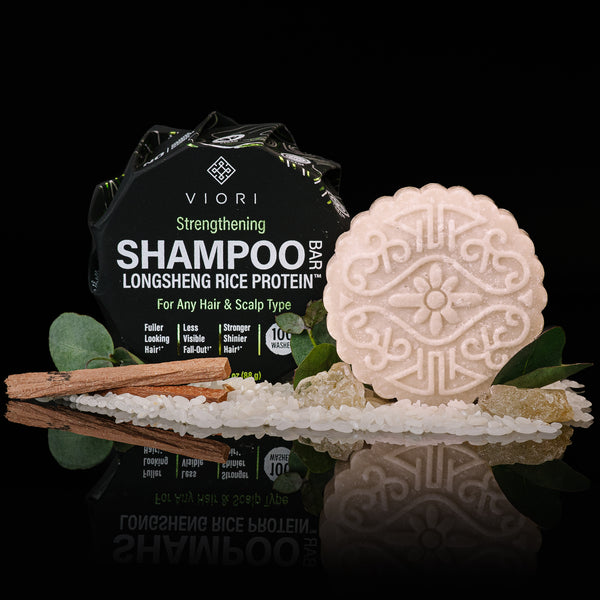
Quality hair products incorporate protein-protecting ingredients. Viori's formulation, for example, includes hydrolyzed rice protein-small enough to penetrate the hair shaft and temporarily fill in structural gaps, actually strengthening hair with each wash.
The Water Quality Wild Card
Here's a critical factor that almost never receives adequate attention: your water quality dramatically affects whether soap could ever work for your hair.
Hard Water: The Soap Killer
If you live in an area with hard water (approximately 85% of the United States), using traditional soap becomes exponentially more problematic.
The calcium and magnesium ions in hard water react with soap to form insoluble salts-that infamous soap scum. On hair, this creates a coating that:
- Prevents moisture penetration
- Makes hair feel stiff, straw-like, or waxy
- Attracts dirt and environmental pollutants
- Is extremely difficult to remove without acidic rinses
Even if you're diligent about following up with vinegar rinses, you're fighting an uphill battle against basic chemistry.
Soft Water: A Different Story
In soft water environments, traditional soap can rinse cleaner from hair. This is why some people in soft water areas report success with soap-based hair washing while others find it disastrous.
The professional recommendation: If you're going to experiment with soap, first test your water hardness. You can purchase inexpensive test strips online. If your water measures above 120 mg/L (7 grains per gallon), soap will almost certainly cause buildup issues.
Your Scalp Microbiome: The Cutting-Edge Consideration
This is genuinely frontier territory that most hair care discussions haven't yet incorporated: the effect of cleansing method on your scalp's microbiome.
Recent research has revealed that your scalp hosts a complex ecosystem of bacteria and fungi. This microbiome plays crucial roles in:
- Sebum regulation
- Scalp pH maintenance
- Protection against pathogenic organisms
- Inflammation control
How Your Cleanser Affects Scalp Ecology
Traditional soap's high pH doesn't just affect your hair-it temporarily disrupts your scalp's pH, potentially altering the microbiome balance. Some research suggests that dramatic pH shifts can favor certain fungal species associated with dandruff and scalp irritation.
Gentler, pH-balanced cleansers help maintain a stable environment for beneficial scalp flora. Viori's formulations are specifically pH balanced to work with your scalp's natural chemistry rather than against it.
The forward-thinking approach: As we learn more about the scalp microbiome, we're discovering that harsh cleansing might contribute to long-term scalp issues by disrupting this delicate balance. This represents a paradigm shift from viewing cleansing purely as removing dirt and oil to understanding it as maintaining a healthy ecosystem.
If You Use Soap, You Can't Skip This Step
If you're determined to use soap on your hair, you absolutely cannot skip the conditioning step-but not for the reasons you might think.
The Acidic Rinse: Chemistry Correction
After washing with soap, your hair sits at an alkaline pH with lifted cuticles. An acidic rinse (typically diluted apple cider vinegar or lemon juice) serves multiple functions:
- Neutralizes alkalinity - brings hair back toward its natural pH
- Closes cuticles - helps scales lie flat again
- Removes mineral deposits - particularly in hard water situations
- Adds shine - smooth cuticles reflect light better
The critical detail: The concentration and contact time matter enormously. Too much acid or leaving it on too long can over-correct, making hair brittle. Generally, a rinse of 1-2 tablespoons of apple cider vinegar in 1-2 cups of water, left for 30-60 seconds, is appropriate.
Why You Still Need Real Conditioner
Even with perfect acidic rinsing, soap-washed hair benefits tremendously from actual conditioner. Here's why:
Conditioner isn't just about slip and softness-it's about repairing what cleansing disrupts. Quality conditioners like Viori's bars contain:
- Cationic surfactants - positively-charged molecules attracted to negatively-charged damaged sites on hair
- Emollients (like shea butter and cocoa butter) - fill gaps in the cuticle layer
- Humectants - draw moisture into the hair shaft
- Proteins - temporarily reinforce damaged areas
The conditioning step isn't optional-it's compensating for what soap's alkalinity disrupted.
Hair Type Matters More Than You Think
In my two decades working with clients, I've learned that hair type dramatically affects whether soap could ever be viable.
WHAT CUSTOMERS ARE SAYING
Real reviews for Hidden Waterfall Barra de Champú
Fine, Straight Hair: The Most Vulnerable
Fine hair has a smaller diameter and fewer cuticle layers than thick hair. This means:
- Less natural protection against pH changes
- Easier penetration of alkaline solutions
- More dramatic reaction to cuticle lifting
- Greater vulnerability to mechanical damage from tangling
Professional verdict: Fine hair is the least suitable candidate for soap washing. The risks far outweigh any potential benefits.
Coarse, Curly, or Coily Hair: Slightly More Tolerance
Hair with natural texture typically has:
- More cuticle layers providing additional protection
- Often lower natural moisture (due to oil distribution challenges along curves)
- Different cleansing needs (may not require frequent washing)
Some individuals with very coarse, textured hair report success with soap, particularly those with Type 4 hair, very coarse Asian hair, or thick Mediterranean hair types.
The caveat: Even with these hair types, success depends heavily on:
- Water quality (must be soft)
- Diligent acidic rinsing
- Deep conditioning protocols
- Less frequent washing schedules
The Porosity Factor: Often Overlooked
Hair porosity-your hair's ability to absorb and retain moisture-might be even more important than texture.
Low porosity hair (cuticles tightly bound, resistant to moisture):
- May actually respond slightly better to soap's cuticle-lifting action
- Still requires careful pH correction
- Needs heat or steam to help conditioning penetration
High porosity hair (cuticles already damaged or lifted):
- Extremely vulnerable to soap's alkalinity
- Will experience accelerated damage
- Should absolutely avoid traditional soap
Not All "Soap" Is Actually Soap
Here's where the discussion gets more nuanced: some products marketed as "soap" are actually syndets (synthetic detergent bars) or hybrid formulations.
True Soap Versus Syndet Bars
True soap: Made through saponification, contains no synthetic detergents, naturally alkaline (pH 8-10)
Syndet bars: Contain synthetic surfactants, can be pH-adjusted, may include conditioning agents
The important distinction: When people report success "washing hair with soap," they're sometimes using syndet bars without realizing it. These can perform much more similarly to solid shampoo bars.
The Solid Shampoo Revolution
This is where products like Viori's bars become relevant to this discussion. They're not soap and they're not liquid shampoo-they're a third category that combines advantages of both:
- Solid format (eco-friendly, travel-friendly, long-lasting)
- Proper pH balance for hair
- Gentle, hair-appropriate surfactants
- Nutrient-rich ingredients (Viori includes Longsheng rice water, known for its strengthening properties)


