
After twenty years of working with every hair type imaginable-from baby-fine and poker-straight to densely coiled and everything in between-I've watched countless trends come and go. But some of the most fascinating innovations happen quietly, at the intersection of ancient wisdom and modern chemistry. Hair darkening shampoo bars? They fall squarely into that category, and honestly, they're far more sophisticated than most people realize.
Today I'm sharing what I've learned from both the formulation side and the stylist's chair. Whether you're considering trying a darkening bar or you're simply curious about how they actually work, understanding the science will completely change how you think about natural pigment, hair color, and why the solid bar format isn't just a trendy alternative to liquid-it's fundamentally different chemistry.
The Format Itself Changes the Game
Here's something that might surprise you: the delivery system matters just as much as what's actually in the product.
Most people focus entirely on ingredients-and yes, those matter tremendously. But here's what rarely gets discussed in online reviews or product descriptions: the solid bar format fundamentally changes how darkening mechanisms work compared to liquid formulations. We're not just talking about convenience or eco-friendliness here. We're talking about completely different chemistry.
Think about traditional liquid darkening shampoos for a moment. The pigment molecules float suspended in water-based carriers. They're pre-dissolved, creating a homogeneous mixture that coats each strand with relative uniformity. The chemistry is fairly straightforward-you're basically applying colored liquid that deposits evenly because it's already in solution.
Solid bars operate on entirely different principles.
The pigment compounds must remain stable in a low-moisture environment during storage-sometimes for months or even years. Then, the moment they contact water during use, they need to activate and release gradually as you work the bar through your hair. They have to deposit evenly despite a friction-based application method that's completely different from how we squeeze liquid shampoo into our palms.
I call this the "controlled release paradox." The pigments must stay locked in the bar's structure until the moment of use, but then release quickly and distribute evenly once wet. Getting this balance right? That requires some seriously sophisticated formulation work.
NOT SURE WHICH PRODUCT IS RIGHT FOR YOU?
TAKE THE QUIZTakes 30 seconds · 134,000+ customers matched
Three Different Ways Darkening Actually Happens
Mechanism #1: Metallic Salt Deposition (The Gradual Build Approach)
Some darkening bars use metallic salts-typically lead acetate, silver nitrate, or bismuth citrate. These work through what's called oxidative polymerization directly on the hair shaft.
The chemistry here is actually fascinating. When these metallic compounds contact the sulfur naturally present in keratin (your hair's primary structural protein), they form metal sulfide deposits. Lead acetate, for instance, reacts with cysteine residues in your hair to create lead sulfide, which appears dark gray to black.
The bar format advantage: The gradual, friction-based application actually works better for metallic salt methods than liquid application. The mechanical action of rubbing the bar against your hair helps physically lodge the forming metal complexes into the hair cuticle's scale structure. The friction essentially "pushes" the darkening compounds into your hair's natural architecture.
The professional warning I absolutely must share: Metallic salts and oxidative hair color (the kind used in professional salons) are completely incompatible. If someone uses a metallic-based darkening bar and then gets their hair professionally colored, the results can be genuinely catastrophic-I'm talking smoking hair, breakage, and wildly unpredictable color results that can't be corrected. The metals act as catalysts for over-oxidation, essentially cooking the hair under processing. I've witnessed this damage firsthand more than once in my career, and it's heartbreaking every single time.
Mechanism #2: Semi-Permanent Dye Deposition (The Coating Method)
Other bars use traditional semi-permanent dyes-small molecule colorants like HC dyes, Basic Brown compounds, or similar darkening agents.
These molecules are small enough to partially penetrate the hair cuticle, but not quite small enough to reach the cortex (your hair's inner layer, where permanent color actually lives). They essentially stain the outer layers of your hair shaft-think of it like wood stain rather than paint.
The formulation challenge: Semi-permanent dyes are typically water-soluble and need careful pH control to deposit properly. Hair cuticles open in alkaline environments (pH above 7) and close in acidic environments (pH below 7). Getting this wrong means either no color deposit or rapid color loss.
Here's where sophisticated bar technology gets really interesting. The physical friction of application can temporarily disrupt the cuticle just enough to allow pigment entry, while a well-balanced pH prevents excessive cuticle swelling that would lead to rapid pigment loss later.
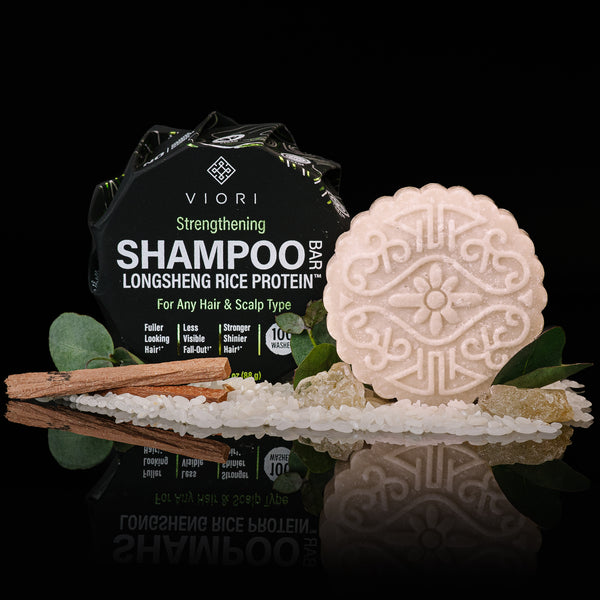
Viori's bars, for instance, are formulated to maintain a pH balance between 3.5-6.5-slightly acidic to neutral. This is actually ideal for cuticle sealing and color retention, though it makes initial pigment deposition more challenging from a formulation perspective. It's a mechanical-chemical synergy that liquid products simply can't replicate-the physical action works with the chemistry, not against it.
Mechanism #3: Plant-Based Darkening (The Natural Preservation Approach)
The third mechanism uses plant-derived compounds like black tea extract, coffee seed extract, black walnut hull, indigo, or fermented rice compounds.
This is where things get particularly fascinating from both a scientific and traditional knowledge perspective.
Fermented rice water contains inositol and develops phenolic compounds during fermentation. While inositol itself is colorless and primarily benefits hair strength and growth, the fermentation process creates melanin-like compounds and other darkening polyphenols.
The legendary Red Yao women-whose Longsheng rice water traditions inspire Viori's formulations-maintain deep black hair well into their eighties. While genetics and diet certainly play roles, the consistent use of fermented rice water likely contributes through several mechanisms:
- Supporting eumelanin pathways: Some fermented grain compounds may support the biochemical pathways that produce natural dark pigment (eumelanin) in the hair follicle itself
- Cuticle coating with darkening polyphenols: Fermented compounds can form a translucent dark coating on the hair shaft
- Oxidative protection: Preventing the oxidative degradation that causes melanin breakdown-the process that makes hair look faded or lighter over time
The critical distinction: This isn't "coloring" in the traditional sense. It's more accurately described as pigment preservation and enhancement.
A natural hair darkening bar using fermented rice wouldn't turn blonde hair black. But it could help someone with naturally dark hair maintain depth and prevent the lightening that occurs from sun exposure, heat styling, and oxidative stress. It's supporting what's already there rather than depositing artificial pigment-a subtle but important difference.
The Engineering Puzzle: Making Contradictory Goals Work Together
The Surfactant Dilemma
Cleansing agents (surfactants) like Sodium Cocoyl Isethionate-the gentle, coconut-derived cleanser used in quality bars-are designed to strip and remove substances from hair. That's literally their entire job.
But darkening products need to deposit substances onto hair.
See the problem?
Formulators must walk an incredibly fine line. They need to:
- Use enough surfactant to actually clean hair effectively
- Use gentle enough surfactants that they don't immediately strip away the darkening compounds
- Time the release so cleansing happens first, pigment deposition second
- Ensure the pigments bind strongly enough to survive the rinsing process
It's like asking someone to simultaneously push and pull a door. The formulation chemistry has to carefully sequence these competing actions.
The Conditioner Conundrum
Most effective darkening bars incorporate conditioning agents (like Behentrimonium Methosulfate, the sulfate-free conditioner derived from rapeseed that Viori uses) to smooth the cuticle and help pigments adhere.
But here's the paradox I've observed over years of working with formulations: cationic (positively charged) conditioners are attracted to the anionic (negatively charged) hair surface, which helps them stick. Many pigment molecules are also designed to be cationic for the exact same reason.
This means the conditioning agents and the darkening agents are competing for the same binding sites on your hair.
Sophisticated formulations solve this through sequenced releases-surfactants first to clean and slightly open the cuticle, pigments second to deposit, and conditioners last to seal everything in. In a solid bar, this sequencing is controlled through:
- Layering ingredients during the manufacturing process
- Using different binder systems that dissolve at different rates
- Adjusting particle sizes so different compounds release at different speeds
It's formulation choreography at its finest.
Application Technique: The Variable Nobody Discusses
Here's something almost never mentioned in product marketing, but absolutely critical: how you use a darkening bar dramatically affects the results in ways that don't apply to regular shampoo bars.
Direct Application vs. Lather Method
Direct application (rubbing the bar directly on hair):
- Creates higher pigment concentration at contact points
- Provides mechanical cuticle disruption that enhances deposition
- Risks uneven darkening if not done systematically
- Can create buildup in certain areas
Lather method (working up foam in hands first):
- Provides more even distribution
- Gentler on the hair cuticle
- Results in lighter, more gradual darkening
- Requires multiple applications for visible results
For color-treated hair specifically, the lather method is crucial. The friction from direct bar application can strip semi-permanent or demi-permanent color by physically disrupting the cuticle scales where color molecules lodge. I've seen clients inadvertently strip their expensive salon color this way, and it's a costly mistake.
Water Temperature Matters More Than You'd Think
Warm to hot water (what most people naturally use):
- Opens the cuticle more, allowing better pigment penetration
- Also causes faster pigment release from the bar
- Can lead to over-deposition if the bar is used too long
- Results in darker but potentially less even effects
Cool to cold water:
- Keeps the cuticle more closed, slowing deposition
- Creates more gradual, buildable darkness
- Extends the working time before pigments lock in
- Produces more natural-looking results but requires patience
When I'm working with clients who want subtle, natural-looking enhancement rather than dramatic change, I always recommend the cool water approach.
WHAT CUSTOMERS ARE SAYING
Real reviews for Hidden Waterfall Barra de Champú
The Timing Window
With liquid darkening shampoos, you can leave the product on for precise times. With bars, timing involves multiple phases:
- Wetting phase (30-60 seconds): Bar activates, initial surfactant release
- Working phase (1-2 minutes): Building lather, distributing product, pigment release begins
- Contact phase (2-5 minutes): Allowing pigments to deposit while conditioning agents coat
- Rinsing phase (1-2 minutes): Removing excess while leaving bound pigments
Professional insight: Most people under-time phases 3 and 4. They don't leave the product on long enough for proper pigment binding, then they rinse too quickly, washing away loosely deposited pigments. The result? Minimal darkening and frustration with a product that actually works-when used correctly.
The Buildup Factor: Why Results Compound Over Time
Unlike traditional shampoos where each use is essentially independent, darkening bars work on a cumulative deposition model. Understanding this completely changes your expectations.
The First-Use Phenomenon
First application with a darkening bar rarely produces dramatic results. Here's why:
- Virgin hair cuticle density: Undamaged hair has tightly packed cuticle scales with few "gaps" for pigments to lodge into
- Incomplete binding site saturation: There are many more potential pigment binding sites than can be filled in one use
- Competitive displacement: The cleansing process removes some loosely bound pigments even as others deposit
People often get discouraged after one use. Please don't. This is simply how the chemistry works.
The Progressive Darkening Curve
Applications 2-10 show accelerating results because:
- Previous pigment deposits create a "foundation" that new pigments can bind to
- Slight cuticle disruption from previous applications creates more receptive deposition sites
- Layering of pigments creates optical depth (similar to how multiple coats of wood stain darken more effectively than one coat)
Applications 10-30 typically show the most dramatic visible changes, as compounding effects really take hold.
Applications 30+ often plateau-the hair reaches its maximum pigment loading capacity for that specific formulation and hair type.
The Reversal Reality
Here's what companies often don't emphasize, but I believe you deserve to know: darkening from bars is semi-permanent at best.
Stop using the product, and over 4-8 weeks, the darkness will gradually fade as:
- Mechanical abrasion from brushing removes outer pigment layers
- Shampooing with regular products slowly strips deposited color
- UV exposure breaks down pigment molecules
- Natural hair growth brings out virgin, undarkened hair
I actually see this as a positive feature, not a drawback. It means mistakes aren't permanent, and you can adjust your darkness level by varying application frequency. You're in control.
The Hair Type Matrix: Why Your Results Will Differ
Porosity: The Single Most Determining Factor
Low porosity hair (cuticle scales lay flat and tight):
- Resists darkening initially
- Takes longer to show results (15-20 applications vs. 5-10)
- Once saturated, holds color significantly longer
- May show uneven results if application isn't methodical
- Benefits most from warm water and longer contact time
High porosity hair (cuticle scales lifted, damaged, or porous):
- Accepts darkening rapidly-sometimes surprisingly fast


