
If you’ve ever fallen down a rabbit hole of shampoo and conditioner bar reviews, you’ve probably seen the same whiplash: one person says their hair feels “like silk,” the next says it felt “waxy,” and someone else insists the conditioner “doesn’t even work” because it doesn’t lather. After 20 years behind the chair, I can tell you this: those reviews can all be honest and still be incomplete.
Bars don’t behave like bottled products. With a liquid shampoo, the delivery is pretty consistent-squeeze, lather, rinse. With bars, your hands, your water, your technique, and even your shower setup become part of the equation. That’s why bar reviews are often more dramatic, more conflicting, and (when you know how to read them) surprisingly revealing.
Why bar reviews can sound like they’re talking about different products
The biggest mistake people make when reading bar reviews is assuming they’re purely evaluating the formula. In reality, a “review” is often reporting the outcome of a whole system: water chemistry + pH behavior + friction + scalp type + storage habits.
When you start looking for those variables, the contradictions make a lot more sense-and you get much better at predicting which reviews apply to you.
NOT SURE WHICH PRODUCT IS RIGHT FOR YOU?
TAKE THE QUIZTakes 30 seconds · 134,000+ customers matched
The hidden variable almost nobody mentions: water hardness
When I see a review that says “waxy,” “coated,” “dull,” or “it wouldn’t rinse clean,” my first question isn’t “what’s in the bar?” It’s: what’s coming out of the showerhead?
Hard water (high in calcium and magnesium) can change how cleansing and conditioning ingredients behave on the hair, especially in formats like bars where application tends to be more hands-on. The result can feel like buildup even when it’s really a mineral-related texture problem.
Clues you’re reading a hard-water review
- “Squeaky clean” followed by instant tangles
- “Waxy film” or “coated” feel that won’t rinse away
- Dullness that shows up quickly, especially near the crown
- More friction during washing than they’re used to
pH: the technical detail that predicts frizz, roughness, and long-term results
Most reviews focus on scent, foam, and softness. I care about those too-but if you want to understand why hair starts to feel rough or frizzy over time, pH matters.
Hair products generally perform best within a mildly acidic range (often cited around 3.5-6.5). When products skew too alkaline, the cuticle can lift more easily, which tends to show up in reviews as:
- Frizz that seems to appear “randomly”
- Roughness, snagging, and more tangling
- Color fading faster than expected
Viori states its bars are pH balanced, which is one reason many users report a smoother, shinier feel over time rather than that gradual “something’s off” texture shift.
The rarely discussed reason reviews differ: bars are friction-forward
This is the angle I wish more reviewers talked about: many bar reviews are actually reporting friction management, not just cleansing or conditioning power.
Even a gentle formula can feel harsh if the application method creates too much mechanical wear. Rubbing a bar directly on the hair (especially the mid-lengths and ends) can increase cuticle abrasion, leading to tangles, dullness, and breakage that gets blamed on “the bar.”
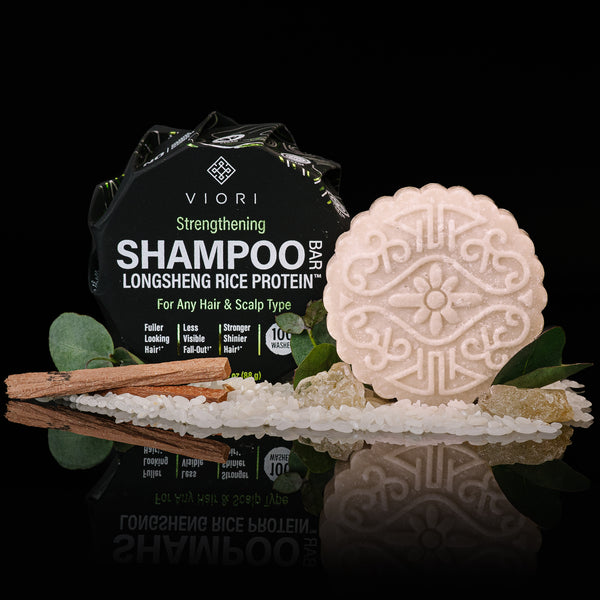
A technique detail that changes outcomes dramatically
Viori recommends building lather in your hands and applying with your hands rather than rubbing the bar directly on your head-particularly helpful if you’re trying to preserve hair color. That one adjustment can reduce friction, improve slip, and make reviews that sounded “polar opposite” suddenly make sense.
Why conditioner bar reviews are often “category confusion”
The most common complaint I see about conditioner bars is: “It doesn’t lather, so it doesn’t work.” But conditioner isn’t meant to foam like shampoo.
Viori’s shampoo uses Sodium Cocoyl Isethionate (SCI) as its cleanser, which is what creates that sudsy, foamy experience. Conditioner bars don’t rely on a foaming cleanser; instead, they’re built to deposit conditioning agents and emollients that smooth the hair and improve manageability. Viori even describes the conditioner’s texture as more paste-like than foamy-exactly what you’d expect from this type of format.
If you want a fair conditioner-bar review, look for these details
- Did they work it through thoroughly (not just “swipe and rinse”)?
- Did they let it sit for 2-5 minutes before rinsing?
- Did they apply it mostly mid-length to ends rather than coating the scalp?
“Residue” vs. “deposition”: reviewers often mix these up
Not all “coating” is a problem. A good conditioner leaves a very light layer behind to reduce friction, increase slip, and improve softness. That’s deposition-and it’s the point.
True buildup behaves differently. It tends to feel heavier over days and weeks, shows up most at the roots and top layers, and makes hair collapse or look dull faster.
In many cases, what gets labeled as “residue” is simply:
- Conditioner applied too close to the scalp
- Too much product for that hair’s porosity and density
- A routine mismatch (for example, oily scalp needs a different approach than dry scalp)
The reviews that actually help you are the ones that mention scalp type and porosity
If you want reviews you can trust, prioritize the ones that give you context. Viori breaks scalp type down in a practical way:
- Oily scalp: feels oily 1-2 days after washing
- Normal scalp: feels oily around day 3
- Dry scalp: feels oily 4+ days after washing
Porosity matters too-because it affects how hair absorbs and holds moisture. Viori shares a simple strand-in-water test:
- Floats: low porosity
- Stays in the middle: medium porosity
- Sinks: high porosity
When a reviewer tells you their scalp type and porosity, their experience becomes far more predictive than a generic “loved it” or “hated it.”
The detail almost nobody includes: storage changes performance (and longevity)
Here’s a practical one: a bar that stays wet will behave differently than a bar that dries properly. If it sits under the shower stream or lives in a puddle, it can dissolve faster, soften, and apply heavier than intended. That shows up in reviews as “it didn’t last” or “it felt too heavy.”
WHAT CUSTOMERS ARE SAYING
Real reviews for Hidden Waterfall Barra de Champú
Viori recommends keeping bars out of direct water contact and letting them dry between uses. It’s not just about making the bar last longer-it’s about keeping your results consistent from wash to wash.
How to choose a Viori bar based on what reviews are really saying
When you strip away the noise, many reviews boil down to matching the bar to the scalp. Viori notes that:
- Citrus Yao is commonly recommended for normal-to-oily scalp types, with its citrus profile including citric acid that can help break down oil effectively.
- Terrace Garden, Hidden Waterfall, and Native Essence are often favored for normal-to-dry scalp types and hair that needs a more moisturizing feel.
- Native Essence is the go-to if you want unscented and tend to be sensitive to fragrance.
A quick pro checklist for reading bar reviews in under a minute
The fastest way to sort useful reviews from unhelpful ones is to scan for these six factors:
- Scalp type: oily, normal, or dry
- Water: hard or soft (even if they don’t realize it)
- Application method: hands vs. rubbing the bar directly on hair
- Conditioner timing: did they let it sit a few minutes?
- Placement: conditioner on ends vs. conditioner on scalp
- Storage: did the bar dry between uses?
When a review includes even two or three of these details, it becomes far more trustworthy-and much easier to map to your own hair.
Bottom line: the best bar reviews aren’t hype-they’re context
Shampoo and conditioner bars can be an incredible upgrade, but they’re less forgiving of friction, water variables, and sloppy storage. That’s why reviews can sound extreme in both directions.
If you read reviews through a stylist’s lens-looking for scalp type, porosity, water hardness, technique, and dry-down habits-you’ll stop feeling confused by contradictions and start finding the reviews that genuinely apply to you.


