
“Jojoba shampoo” sounds straightforward-until you notice how wildly different people’s experiences can be. One person swears it’s the secret to softer hair and a calmer scalp. Another tries it and wonders why their roots look flat by lunchtime. The difference usually isn’t the jojoba itself-it’s the chemistry of the cleanser around it, how the formula is built to deposit (or not deposit) conditioning ingredients, and even how you apply the product.
After 20 years in professional hair, I’ve learned that ingredients don’t perform in isolation. They perform in systems. And jojoba is a perfect example: it’s one of the most misunderstood “oils” in haircare, mostly because it doesn’t behave like a typical oil at all.
Jojoba isn’t a typical oil (and that’s the point)
Here’s the detail most articles skip: jojoba is made primarily of wax esters, not the triglyceride oils found in many plant oils. That matters because wax esters are more similar to components in human sebum (your scalp’s natural oil). It’s a big reason jojoba can feel lightweight, silky, and “natural” on hair-when it’s used the right way.
NOT SURE WHICH PRODUCT IS RIGHT FOR YOU?
TAKE THE QUIZTakes 30 seconds · 134,000+ customers matched
In a shampoo format, that wax-ester structure also makes jojoba extremely sensitive to the formula design. Depending on how the cleanser is built, jojoba will typically do one of three things:
- Rinse away (minimal benefit, even if it’s on the ingredient list)
- Deposit selectively where hair is more damaged (the “best case” feel-soft but not greasy)
- Over-deposit (hair feels coated, limp, or heavy-especially at the roots)
That middle outcome-selective, controlled deposition-is the sweet spot, and it’s where most “jojoba shampoo” discussions fall short. They talk about jojoba, but not the mechanics that decide whether it actually behaves.
What jojoba really does during shampooing: friction control
Hair doesn’t “hydrate” like skin. When people say jojoba “moisturizes,” what they usually mean is that it improves how the hair behaves-especially during wash day, which is surprisingly hard on the hair fiber.
Shampooing is a high-friction event: water swells the strand, surfactants loosen oil and debris, hands massage and scrub, and hair gets detangled while it’s at its most vulnerable. In that moment, jojoba’s biggest contribution is often lubrication and friction reduction. That can translate into:
- less tangling while you wash
- better wet slip and easier comb-through
- a smoother cuticle feel after rinsing
- less breakage over time for fragile or porous hair
This is why jojoba tends to be especially appreciated by people with curly, coily, high-porosity, gray/white, or chemically treated hair-hair types that can feel “grabby” or rough when the cuticle is easily disturbed.
The paradox: jojoba can help oily scalps, but not by “turning oil off”
You’ll often hear that jojoba “balances oil.” In real-world scalp behavior, it’s usually more accurate to say: a well-designed jojoba cleanser can feel less stripping, and that can help some scalps settle down over time.
When a cleanser is too harsh or too alkaline, the scalp can feel tight or irritated. Many people respond by washing more often, scrubbing harder, or dealing with faster oil return. That’s one reason pH balance matters. For hair and scalp comfort, products generally perform best in a mildly acidic to near-neutral range (commonly referenced as roughly 3.5-6.5). When pH is out of range, the cuticle can stay more raised, and hair can feel rougher and duller long-term.
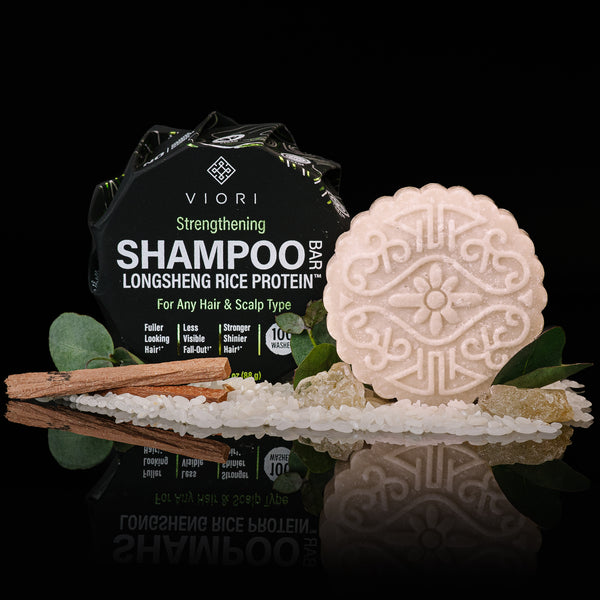
Viori bars are designed to be pH balanced, which is foundational for cuticle behavior, shine, and overall comfort-especially if you’re trying to cleanse without the “squeaky” feeling that often backfires on oily scalps.
The under-discussed secret: in shampoo, jojoba is only as good as the deposition system
This is the part that rarely gets explained clearly online: the real win isn’t simply adding jojoba. The win is controlling how conditioning ingredients attach to the hair-so you get softness without buildup.
Viori uses behentrimonium methosulfate (BTMS) as part of its conditioning backbone. Despite the name, BTMS isn’t a harsh sulfate cleanser. It’s a widely used conditioning ingredient because it is cationic (positively charged), which helps it bind to the hair-particularly where the hair is more negatively charged due to damage or wear.
In practical terms, BTMS can act like an “anchor” that helps hair feel smoother and improves slip. Then ingredients like jojoba can behave more like a controlled topcoat rather than a random layer that either vanishes or overcoats.
Why jojoba pairs so well with fermented rice-based actives
Some people worry about “protein overload,” and that’s a fair concern when protein is used too heavily or the hair doesn’t need it. The nuance is concentration and formulation. Viori uses Longsheng Rice Water™ and a low concentration of hydrolyzed rice protein, designed to be gentle enough for regular use.
Fermented rice water is associated with components like inositol (Vitamin B8) and panthenol (Vitamin B5), which are often used in haircare for manageability, feel, and overall strength support. Where jojoba fits in is simple: if you’re reinforcing the hair’s feel and resilience, you also want to reduce friction so hair doesn’t feel rough in the process.
Bar shampoo results often come down to technique (yes, really)
If you’ve ever felt like a bar shampoo “worked for everyone but you,” technique may be the missing piece. Rubbing a bar directly on the hair can increase friction, especially on porous or color-treated hair where the cuticle is already more sensitive.
Viori recommends building lather in your hands and applying with your palms instead of rubbing the bar directly on your head. If you want the short version of a pro-friendly method, try this:
- Wet hair thoroughly (more than you think you need).
- Rub the shampoo bar between your palms to build a creamy lather.
- Apply the lather to the scalp and massage with fingertips.
- Let the suds rinse through the lengths (don’t aggressively scrub the ends).
- Follow with conditioner, focusing mid-length to ends.
That one adjustment-less friction at application-can noticeably improve softness and reduce the “rough after rinse” feeling some people mistakenly blame on the ingredients.
WHAT CUSTOMERS ARE SAYING
Real reviews for Hidden Waterfall Barra de Champú
Choosing the right Viori bar for the jojoba benefits (without the heaviness)
Because Viori bars contain jojoba oil across the line, your choice is less about “which one has jojoba” and more about what your scalp needs most: stronger cleansing, balanced care, or extra comfort.
- Citrus Yao: often preferred for normal-to-oily scalps, with oil-control support (Viori notes the citrus profile includes citric acid, which helps break down oil).
- Hidden Waterfall: a balanced option many people enjoy for normal hair/scalp routines.
- Terrace Garden: commonly chosen when hair or scalp leans dry and you want a more moisturizing feel.
- Native Essence (unscented): ideal if you’re fragrance-sensitive or your scalp is easily reactive.
Troubleshooting: when jojoba shampoo doesn’t feel right
If hair feels coated or limp
This is most common with fine hair or low-porosity hair. Use less product, keep shampoo focused on the scalp, and rinse longer. If you’re choosing within Viori, leaning toward Citrus Yao can help if you’re prone to oiliness or buildup.
If hair feels clean but still frizzy
That’s often a cuticle management issue. Condition thoroughly mid-length to ends, let it sit a few minutes before rinsing, and consider finishing with cooler water to help the cuticle lie flatter.
If your scalp is flaky
Flakes can come from oiliness or dryness, and they don’t respond to the same routine. Viori guidance commonly points to Citrus Yao for oily scalp dandruff patterns, and Terrace Garden, Hidden Waterfall, or Native Essence when flakes are tied to dryness or sensitivity.
The takeaway: jojoba isn’t the hero ingredient-smart formulation is
Jojoba is a beautifully functional ingredient, but it’s not magic on its own. What determines whether it feels lightweight and silky-or heavy and off-is the full system: pH balance, the cleanser base, the conditioning “anchor,” and your wash-day technique.
Viori’s bars are built around that systems-thinking: pH-balanced design, a gentle cleansing approach, and conditioning architecture that helps hair feel smooth without relying on harsh stripping. If you’ve been curious about jojoba shampoo, this is the lens that makes the results finally make sense.


